14 / 249
Angola
A culture shaped by endurance, rhythm and renewal
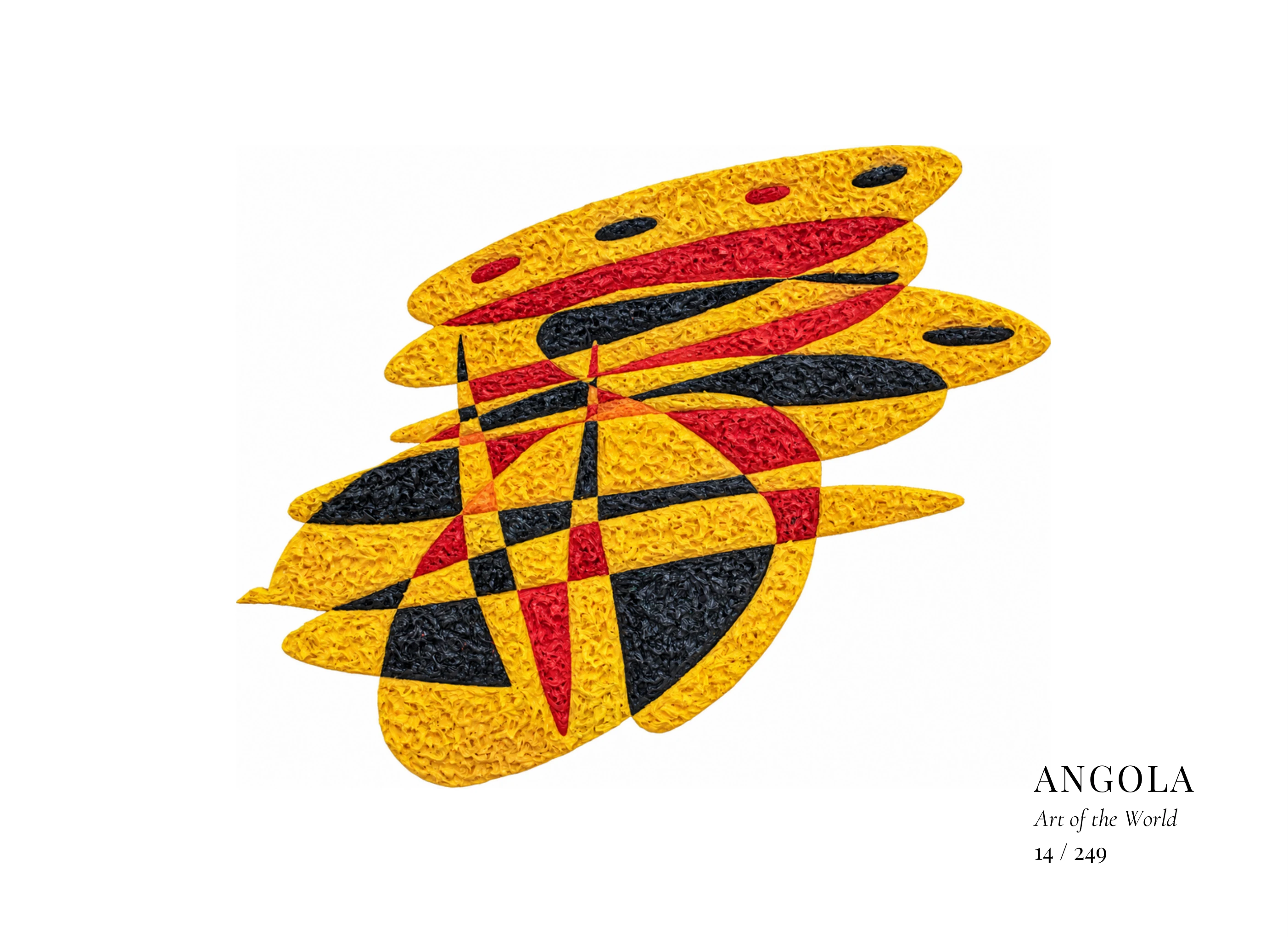
Description
The visual field is organised around a circular structure crossed by strong horizontal and vertical movements. Yellow provides luminosity, while black introduces depth and red creates concentrated energy. Dense impasto strengthens the interlocking geometry as elongated forms project beyond the centre without losing connection to it. Although the palette recalls Angola’s national colours, it remains abstract rather than emblematic. The composition suggests endurance transformed into movement, evoking a culture grounded in memory yet continually open to renewal.
Cultural Context
Angola lies on the Atlantic coast at the meeting point of Central and Southern Africa. Its historical formation includes powerful kingdoms such as Kongo and Ndongo, alongside extensive regional networks of exchange. Portuguese colonial rule ended with independence in 1975, followed by a long civil war. Contemporary Angola carries these histories within a continuing process of reconstruction and renewal.
Angola’s cultural identity encompasses Ovimbundu, Ambundu, Bakongo, Chokwe and many other communities and languages. Oral traditions, sculpture, textiles, literature, music and dance sustain diverse forms of cultural memory. Semba and kizomba have achieved international recognition, extending Angola’s rhythmic creativity far beyond its borders while remaining connected to a rich musical inheritance.
Exhibition Context
Yellow forms are laid out almost like a moving vessel, with dark bands and red diagonals crossing their length. The eye travels sideways along the painting rather than settling on a face. Angola's kingdoms, Portuguese colonial period and independence struggle give these interrupted passages a possible historical weight. Yet the crossing marks are not dated wounds; they make movement itself difficult and resilient. A country formed along both inland routes and an Atlantic coast appears here as a body that keeps going through successive cuts.