
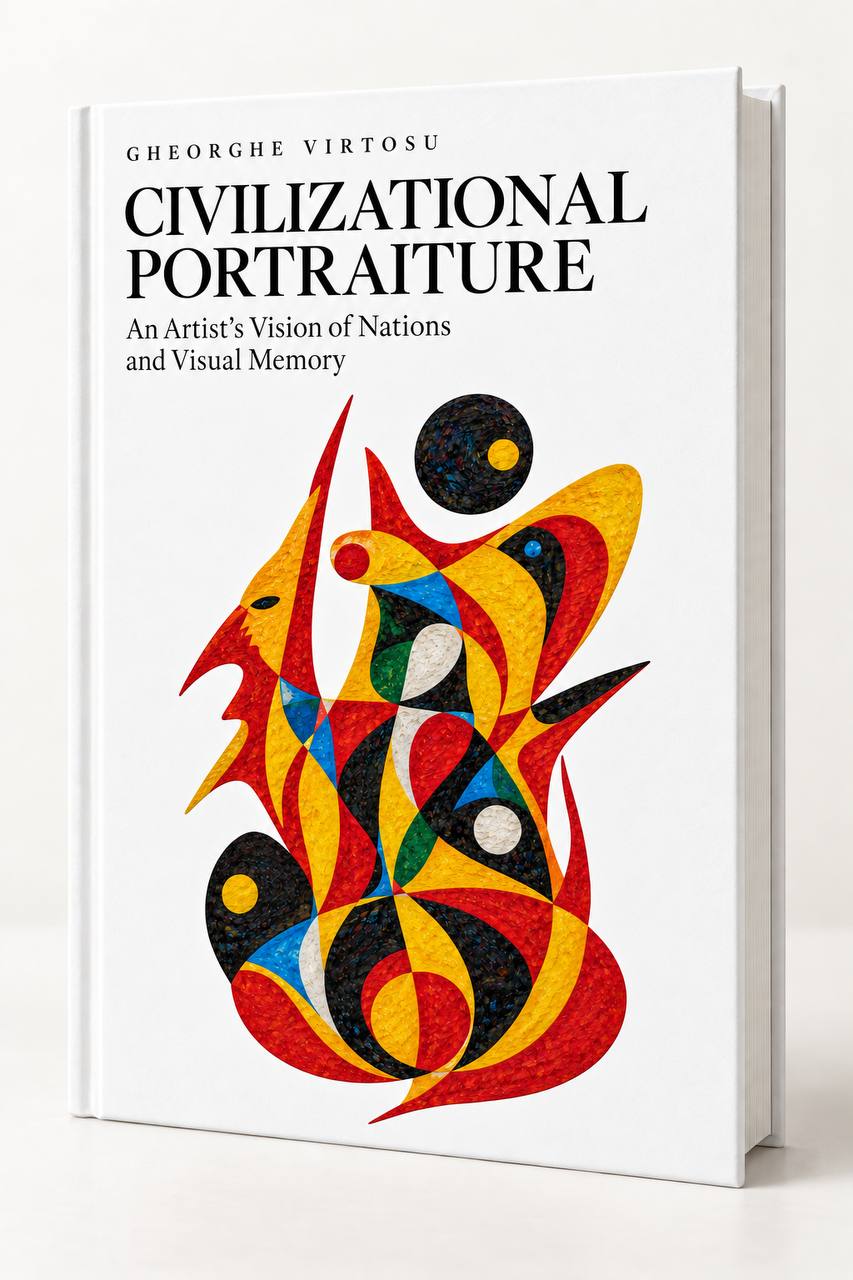
New Book Gheorghe Virtosu: An Artist’s Vision of Nations and Visual Memory — Civilizational Portraiture Examines the Artist’s Vision of Nations, Identity and Cultural Memory
06 Sep 2026 | Press ReleasesA new publication explores Gheorghe Virtosu’s distinctive approach to representing nations not through conventional symbols or political geography, but as complex cultural identities shaped by history, memory and collective experience.
5 September 2026 — Gheorghe Virtosu: An Artist’s Vision of Nations and Visual Memory — Civilizational Portraiture, a new book dedicated to the artist’s interpretation of nations and civilizations, has been released.
The publication examines a central dimension of Virtosu’s artistic practice: the possibility of portraying a country in much the same way that an artist might portray an individual—not by reproducing its physical appearance, but by attempting to reveal its character, contradictions, memories and historical consciousness.
The book introduces the concept of Civilizational Portraiture as a framework for understanding this approach.
Rather than treating nations as geographical territories or reducing them to flags, monuments and familiar national imagery, Virtosu’s paintings approach them as accumulated cultural structures. History, mythology, conflict, religion, political transformation, collective aspiration and inherited memory become elements of a larger visual identity.
In this sense, the works are not intended as illustrations of countries. They are portraits of civilizations.
Nations as Subjects
Portraiture has traditionally been concerned with the individual. Virtosu expands that principle toward a considerably larger subject: the nation itself.
What does a civilization remember?
Which historical experiences continue to shape its identity?
How can centuries of cultural development be compressed into a single visual field?
And what happens when the subject of a portrait is not one person, but millions of people connected through history, language, territory and inherited memory?
These questions form the intellectual foundation of An Artist’s Vision of Nations and Visual Memory.
The book examines how Virtosu constructs visual identities through abstraction, symbolic association, chromatic structure and layered composition. Individual works become encounters between contemporary painting and the much longer historical narratives through which civilizations understand themselves.
The Formation of Visual Memory
At the centre of the publication is the idea of visual memory: the images, symbols, forms and cultural associations through which societies preserve and reconstruct their understanding of the past.
Visual memory is never entirely stable. Civilizations continually reinterpret their histories. Certain events become monuments; others disappear from public consciousness. Symbols acquire new meanings, while political and cultural transformations alter the way earlier generations are understood.
Virtosu’s work operates within this unstable territory.
His paintings do not attempt to provide definitive historical accounts. Instead, they investigate how cultural identity survives through fragments—through remembered forms, inherited symbols, historical tensions and visual associations that continue to influence the present.
The resulting compositions occupy a space between portrait, historical reflection and abstraction.
Civilizational Portraiture
The publication develops Civilizational Portraiture as a way of describing an artistic practice concerned with the psychological and historical character of societies.
A conventional portrait asks who a person is.
Civilizational portraiture asks a more difficult question:
Who is a civilization?
The answer cannot be contained in a single emblem or historical event. A nation may simultaneously carry memories of achievement and catastrophe, continuity and rupture, faith and political transformation.
Virtosu approaches these contradictions as essential components of cultural identity rather than problems to be resolved.
The paintings therefore resist simplified national narratives. Their subjects emerge instead through accumulation: layers of historical experience compressed into contemporary visual structures.
Art, Identity and Historical Consciousness
Gheorghe Virtosu: An Artist’s Vision of Nations and Visual Memory — Civilizational Portraiture positions these works within a broader discussion about the relationship between contemporary art and historical consciousness.
At a moment when questions of national identity, cultural inheritance and collective memory remain central to public life, the publication considers what painting can contribute to this conversation.
Its proposition is that art can operate differently from historical writing, political discourse or documentary evidence.
A painting does not need to explain an entire civilization.
It can instead create a visual encounter with its complexity.
Through this approach, Virtosu’s national works become less about representing territory than about investigating the forces that allow cultures to recognize themselves across generations.
About Gheorghe Virtosu
Gheorghe Virtosu is a contemporary artist whose practice explores identity, history, power, conflict and the structures through which individuals and societies understand themselves.
His work combines abstraction with symbolic and historical references, creating compositions in which colour, form and visual tension operate as carriers of psychological and cultural meaning.
Across his wider practice, Virtosu has examined political figures, historical personalities, social systems and collective identities. His works concerned with nations extend this investigation from the individual human subject toward the larger historical identities created by civilizations.
About the Publication
Title: Gheorghe Virtosu
Subtitle: An Artist’s Vision of Nations and Visual Memory
Series / Concept: Civilizational Portraiture
Subject: Contemporary Art · Cultural Identity · Nations · Visual Memory · Civilizational Portraiture
Publication: 2026
The book is intended for readers interested in contemporary art, cultural history, national identity, visual culture, collecting and the relationship between artistic representation and collective memory.
Media and Institutional Enquiries
Review copies, publication information, images and additional materials are available for members of the press, cultural institutions, researchers and art professionals upon request.
Read the Digital Edition
Gheorghe Virtosu: An Artist’s Vision of Nations and Visual Memory — Civilizational Portraiture is available to read online as an interactive digital edition.