58 / 249
Burkina Faso
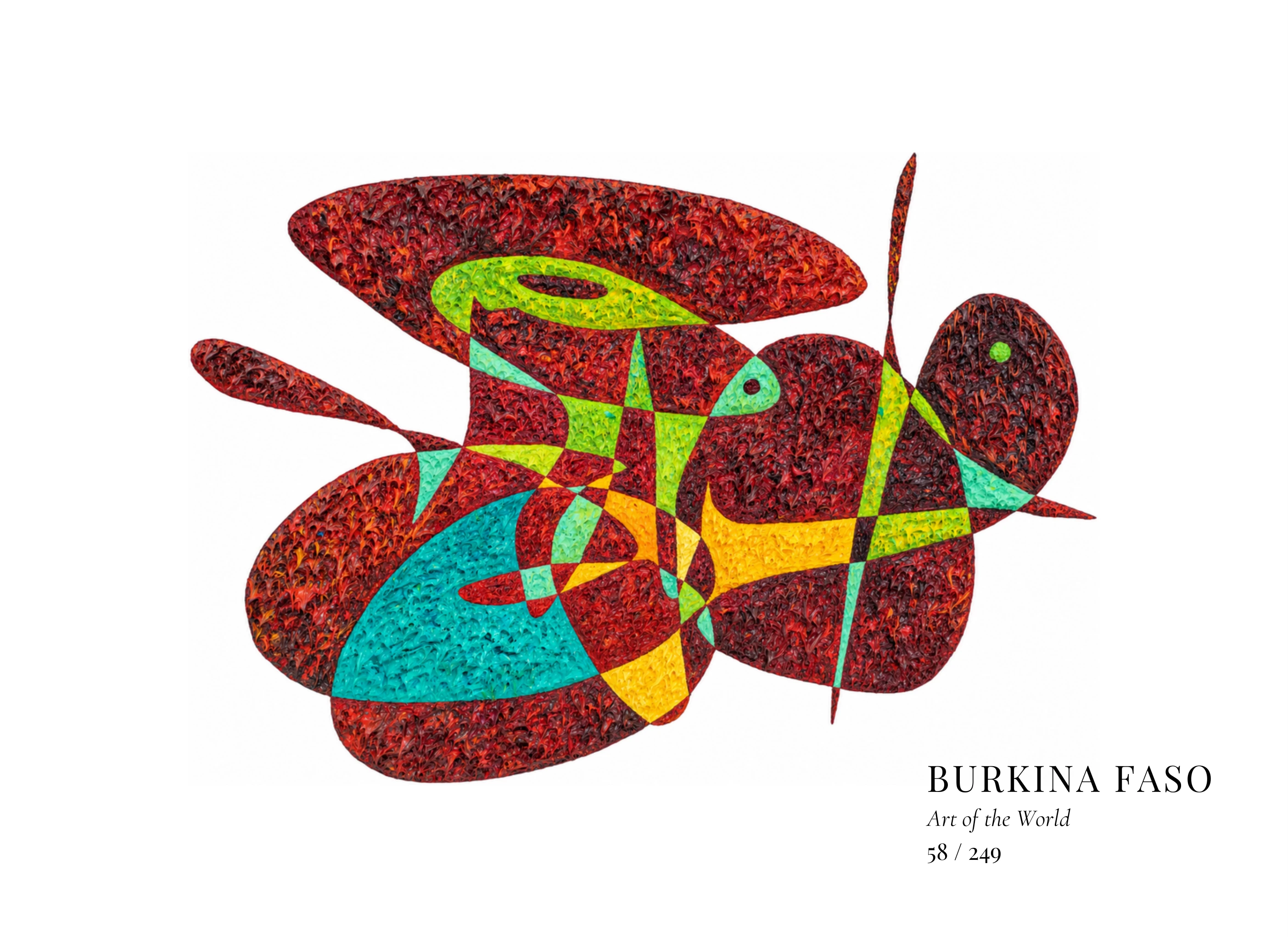
Inheritance in Motion
Description
The visual field is driven by deep crimson and dark maroon, illuminated by turquoise, green and intense yellow. Broad rounded masses surround a tightly interwoven centre of triangles, curves and intersecting bands. Dense impasto gives every colour physical weight, while long pointed extensions create directional energy beyond the central body. The composition suggests inheritance as something active rather than fixed: separate forms meet, divide and reconnect, evoking cultural plurality held together through continuing exchange and renewal.
Cultural Context
Burkina Faso lies in the heart of West Africa, across the transition between the Sahel and the savannah. Its history encompasses powerful societies including the Mossi kingdoms, whose political traditions endured for centuries, alongside many communities connected through regional trade and migration. Formerly Upper Volta under French colonial rule, the country became independent in 1960 and adopted the name Burkina Faso in 1984.
Its cultural life reflects remarkable plurality, including Mossi, Fulani, Bobo, Lobi, Gurunsi and many other peoples. Mooré, Dyula, Fulfulde and numerous Indigenous languages coexist within a rich tradition of oral history, music and performance. Mask traditions, carved sculpture, architecture, textiles and metalwork remain internationally admired, while Ouagadougou has become especially influential through African cinema and the FESPACO film festival.