22 / 249
Cabo Verde
The Culture of Departure and Return
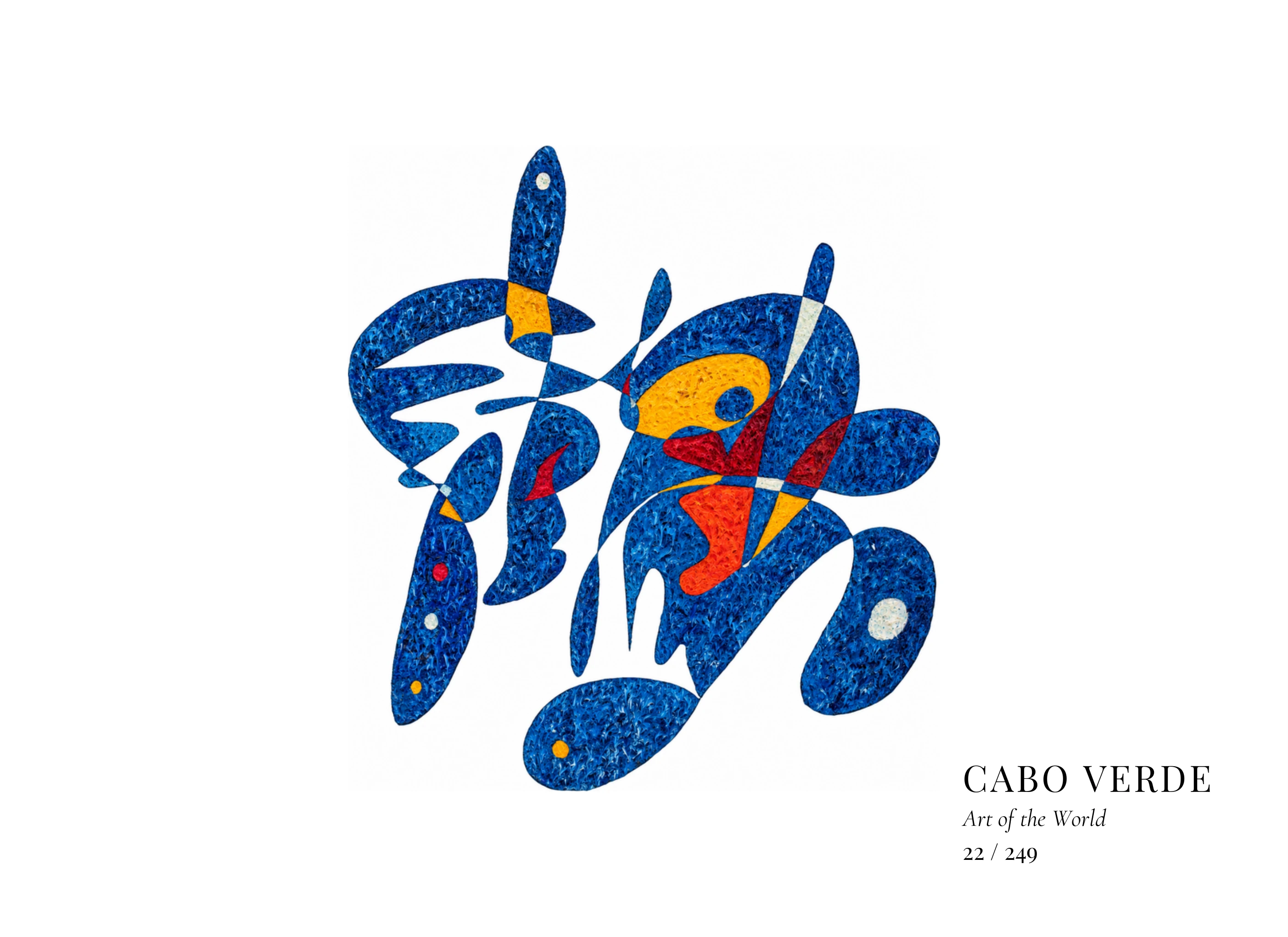
Description
The visual field is dominated by densely worked blue, punctuated by yellow, crimson, orange and small areas of white. Its silhouette disperses into elongated forms, detached ovals and narrow extensions, creating movement around a concentrated central structure. Curves repeatedly separate and return, while white negative spaces keep the composition open and mobile. The work can be read as an evocative rhythm of departure and return: individual forms travel outward yet remain visually connected to a shared centre.
Cultural Context
Cabo Verde is an Atlantic archipelago west of Senegal, formed from volcanic islands rising from the ocean. Uninhabited before Portuguese settlement in the fifteenth century, the islands developed at the intersection of African and European histories and Atlantic navigation. Independence in 1975 established a nation whose historical experience has been profoundly shaped by mobility, resilience and connections with a worldwide diaspora.
Cape Verdean Creole varieties, alongside Portuguese, express a culture distinguished by storytelling, poetry and music. Morna, coladeira and funaná have carried the islands’ emotional vocabulary internationally, while literature has explored insularity, migration, memory and belonging. Craft traditions, dance and contemporary visual culture further reflect the archipelago’s distinctive Atlantic identity.