87 / 249
Cameroon
Many Landscapes, One Living Rhythm
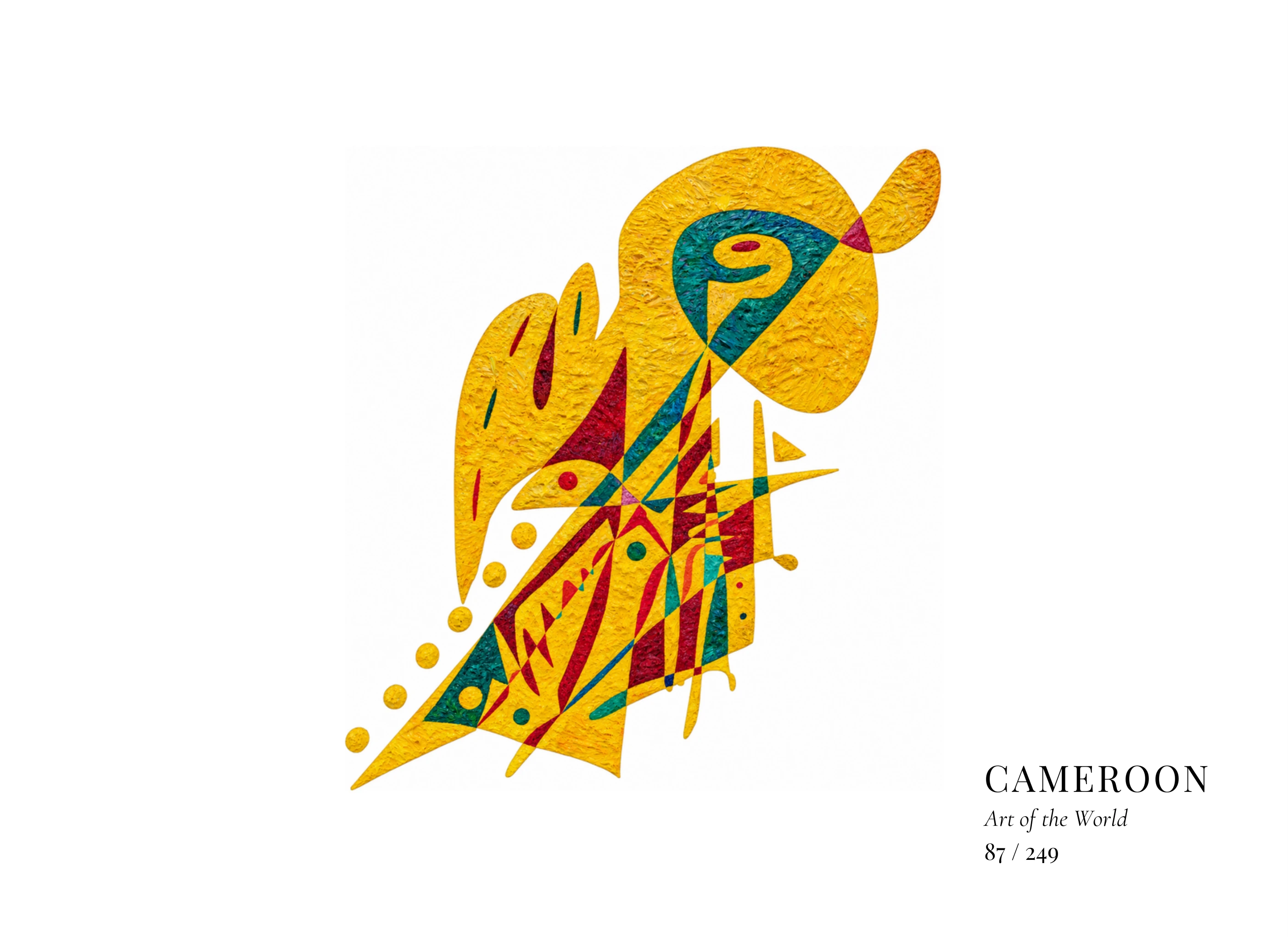
Artist: Gheorghe Virtosu
Catalogue: Art of the World
Catalogue Nr: 087/249
Source of Print: Excerpt from Divine DNA, 2016 (oil on canvas)
Medium: Limited Edition Print
Edition: 1/1
Authentication: Approved and signed by the artist on the reverse.
Artwork Classification: Civilisational Portraiture
Part of Art of the World, an El Arte Monumental project exploring contemporary art, cultural identity and visual memory.
Description
The composition’s radiant yellow field is animated by crimson and turquoise forms, dense impasto and sharp geometric intersections. Sweeping curves contrast with narrow lines, pointed extensions and detached circles, creating an energetic visual rhythm. Its many interconnected sections suggest Cameroon’s cultural plurality, while the surrounding white space gives the composition openness and clarity.
Cultural Context
Cameroon occupies a remarkable meeting ground between West and Central Africa, extending from the Gulf of Guinea through forests, highlands and savannah to the Lake Chad basin. Historic kingdoms, trading societies and migrations shaped its diverse regions. German colonial rule was followed by French and British administration, before independence and reunification established modern Cameroon.
The country’s cultural richness embraces numerous peoples and languages, including Bamileke, Bamum, Fulani, Beti and many others. French and English are official languages. Sculpture, beadwork, textiles, architecture, oral traditions, dance and music reveal a deep creative inheritance, while contemporary literature, cinema and popular music carry Cameroonian culture internationally.
Exhibition Context
A yellow-green upper head and sharp lower forms balance around a red centre, making an animal presence that could turn in several directions. Cameroon was divided between French and British administrations after German rule, while its local histories were older than either division. The painting's split orientations invite a reading of a country shaped by more than one institutional language. The shared centre holds the parts together without making their visible differences disappear.