98 / 249
Democratic Republic of the Congo
A Continent Within a Country
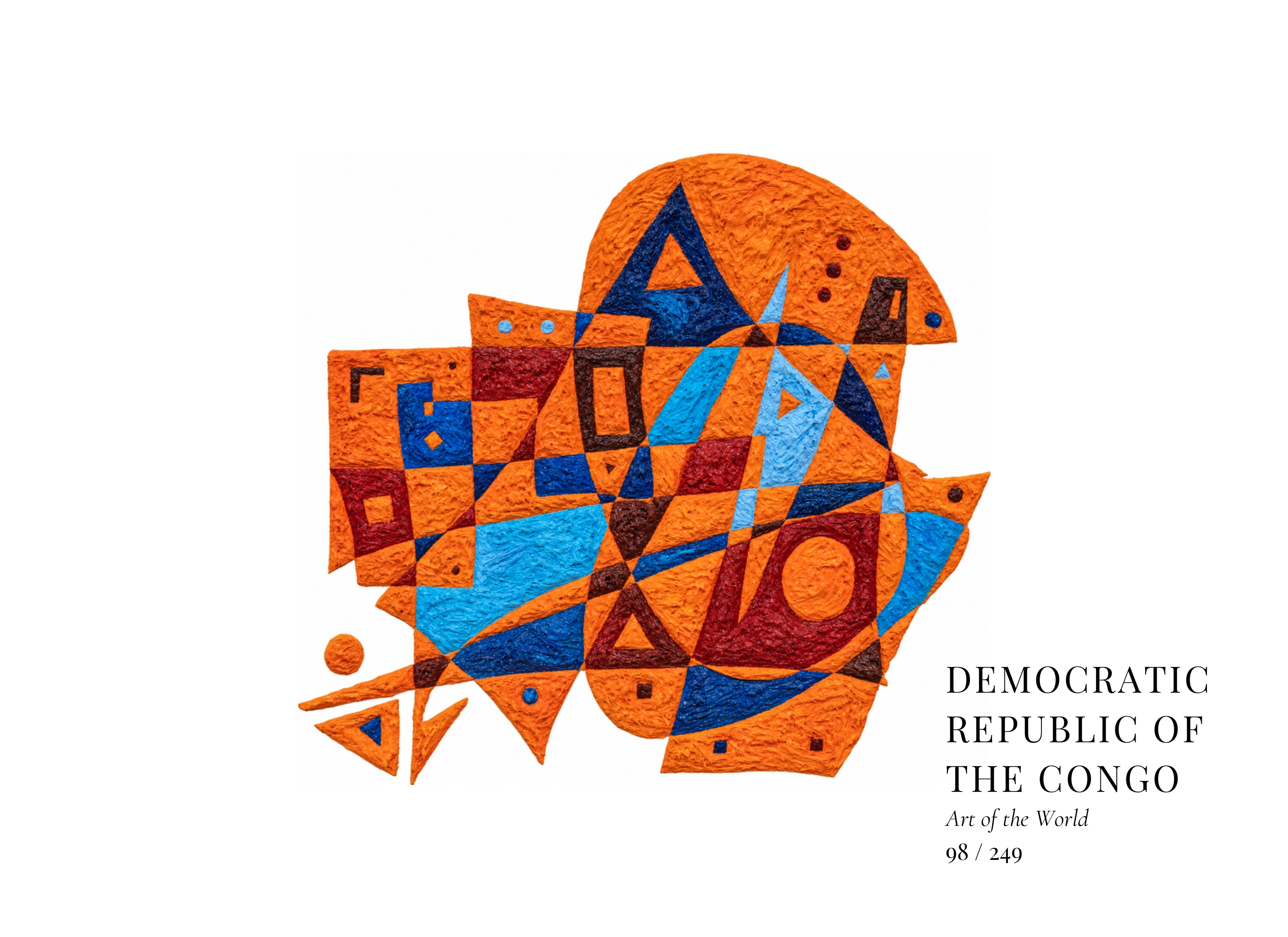
Description
The composition's luminous orange field is structured by intersecting triangles, rectangles, circles and directional forms. Deep blue and burgundy provide concentrated contrasts, while dense impasto gives the composition physical intensity. Its distributed geometry suggests immense cultural plurality: distinct elements retaining their individuality while participating in a larger interconnected rhythm.
Cultural Context
The Democratic Republic of the Congo occupies an immense territory in Central Africa, shaped by the Congo River, equatorial forests, highlands and mineral-rich landscapes. Historic kingdoms including Kongo, Luba and Lunda contributed to a complex civilisational inheritance. Independence from Belgian colonial rule came in 1960.
Congolese culture encompasses hundreds of communities and languages. Kongo, Luba, Kuba, Lunda, Mangbetu and many other traditions have produced remarkable sculpture, textiles and ceremonial arts. Literature, painting, fashion and dance remain vibrant, while Congolese music has profoundly influenced popular culture across Africa and beyond.
Exhibition Context
Orange blocks, dark windowlike voids and bright blue diagonal paths build a form beneath a broad half-dome. The Democratic Republic of the Congo's Kongo, Luba and Lunda histories preceded Belgian colonial exploitation and the making of a vast modern state. Here the body looks constructed, broken and remade, rather than like a ready-made national animal. The analogy does not assign a province or historical crime to any square; its force lies in how the pieces refuse an easy, stable fit.