66 / 249
Djibouti
Where Continents Meet
Description
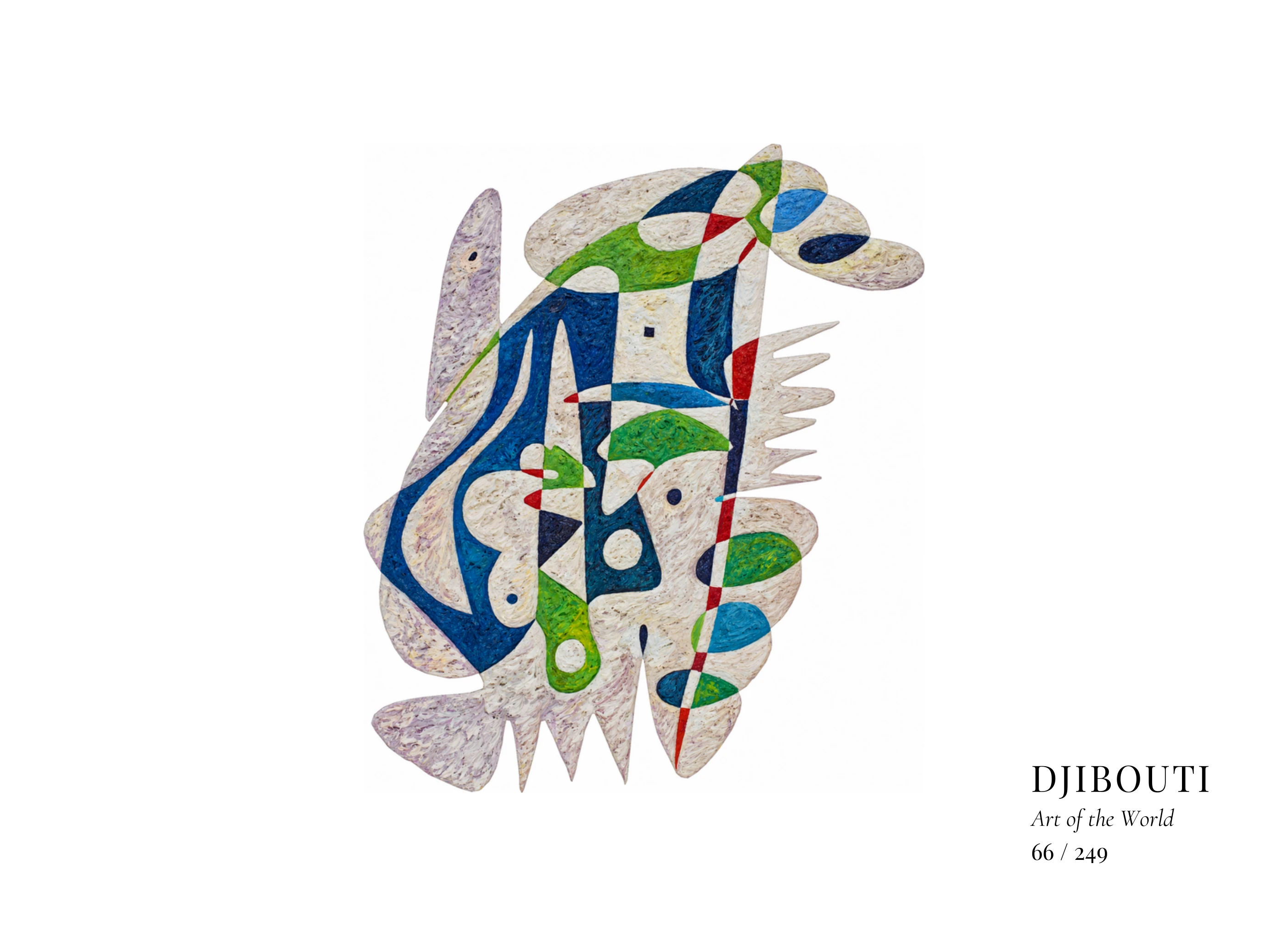
The composition's vertical structure combines white, blue, green and red within a network of curves and geometric divisions. Deep blue gives visual weight, while green and red establish movement and contrast. Serrated edges, narrow extensions and shifting internal planes suggest both anchorage and passage. The composition can be read as evoking Djibouti itself: compact yet expansive in its connections, a meeting place shaped by movement and exchange.
Cultural Context
Djibouti occupies a strategic meeting point between the Horn of Africa, the Red Sea and routes towards the Arabian Peninsula. Volcanic landscapes, salt lakes, desert plains and coastline define its dramatic geography. Centuries of regional exchange shaped its society before French colonial rule; Djibouti achieved independence in 1977.
Somali and Afar traditions are central to the country’s cultural identity, enriched by longstanding connections across Africa and Arabia. Somali, Afar, Arabic and French contribute to its multilingual life. Poetry, oral history, music and communal traditions carry memory across generations, while the country’s maritime position sustains an outward-looking character.
Exhibition Context
A long pale neck, angular blue centre and green fragments make a figure that seems to stretch between widely separated zones. Djibouti sits at the meeting of the Horn of Africa, Red Sea and routes toward Arabia. The painting's drawn-out anatomy can be viewed as a crossroads made bodily, with passage running through its centre. It does not depict a shipping lane or port. Its visual idea is contact: parts meet at angles and continue beyond them.