75 / 249
Gabon
The Intelligence of the Forest
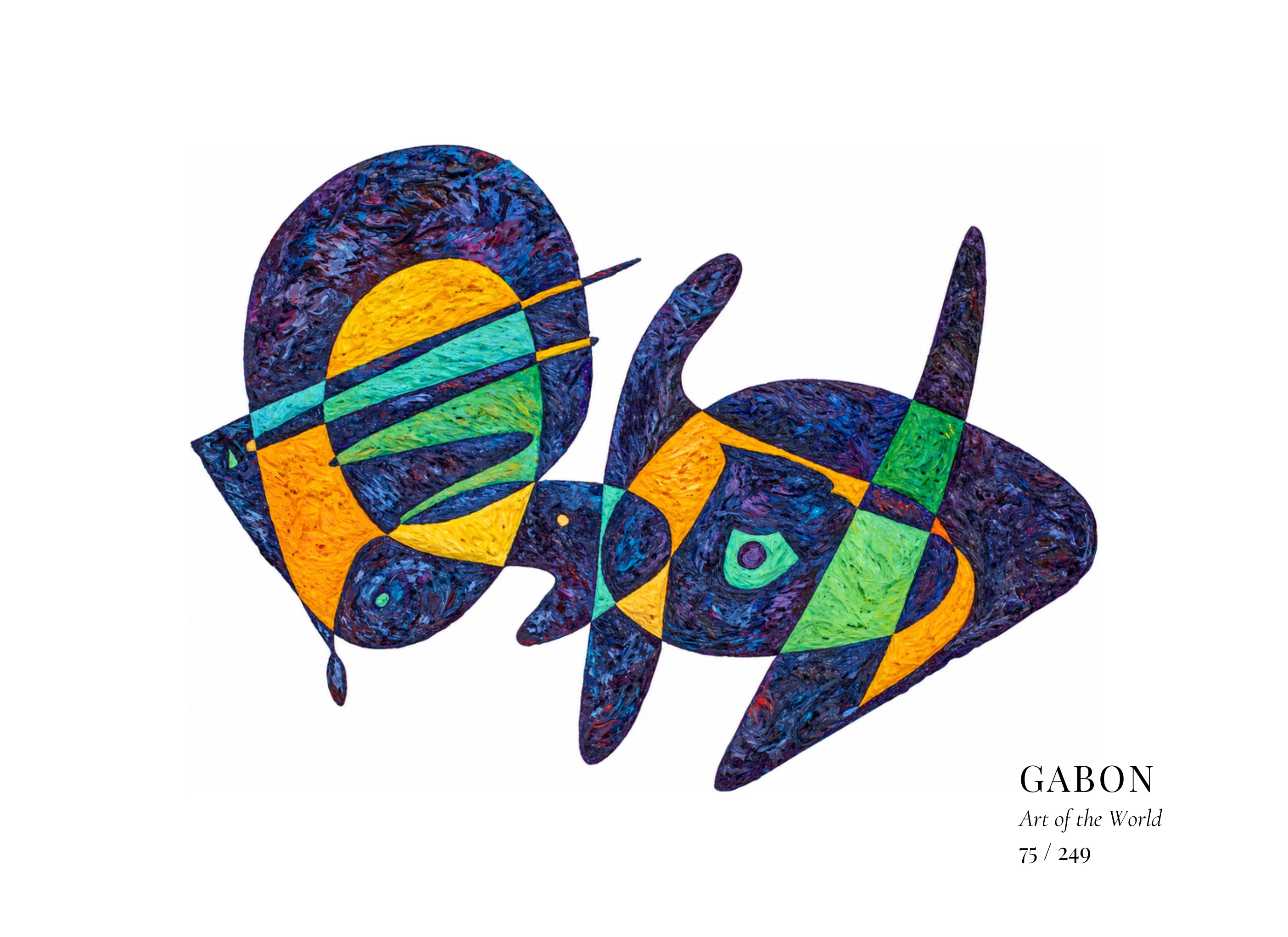
Artist: Gheorghe Virtosu
Catalogue: Art of the World
Catalogue Nr: 075/249
Source of Print: Excerpt from Divine DNA, 2016 (oil on canvas)
Medium: Limited Edition Print
Edition: 1/1
Authentication: Approved and signed by the artist on the reverse.
Artwork Classification: Civilisational Portraiture
Part of Art of the World, an El Arte Monumental project exploring contemporary art, cultural identity and visual memory.
Description
The composition's blue-violet field creates an atmosphere of depth, interrupted by luminous yellow and green. Rounded masses meet sharper projections, while bands, arcs and triangular forms connect separate visual areas. Dense impasto strengthens the composition’s physical presence. Its interconnected geometry suggests a living network, evoking Gabon’s environmental abundance and cultural depth while allowing each element to retain its distinctive visual energy.
Cultural Context
Gabon lies on Central Africa’s Atlantic coast, shaped by immense equatorial forests, river systems and coastal landscapes. Long- established communities and regional networks preceded French colonial rule, which ended with independence in 1960. Forest and ocean remain defining elements of the country’s geography and cultural imagination.
Fang, Myene, Punu, Nzebi and many other communities contribute distinct languages and artistic traditions. Sculpture, masks, reliquary figures, music and oral storytelling have preserved ancestry, knowledge and communal memory. Gabonese sculptural traditions also became highly influential in encounters between African art and European modernism, while contemporary creativity continues to reinterpret inherited forms.
Exhibition Context
Two blue-green oval shapes appear to swim or lean across a dark interior, each with an eye and a separate direction. Gabon's river and forest networks long connected communities before and after French rule. The painting's joined bodies make those routes feel animate, while the dark central area gives their crossings depth. It cannot be read as a forest map, but its emphasis on multiple watchful presences rather than one dominating figure suits a place shaped by many local connections.