55 / 249
Guinea
The Wellspring of West Africa
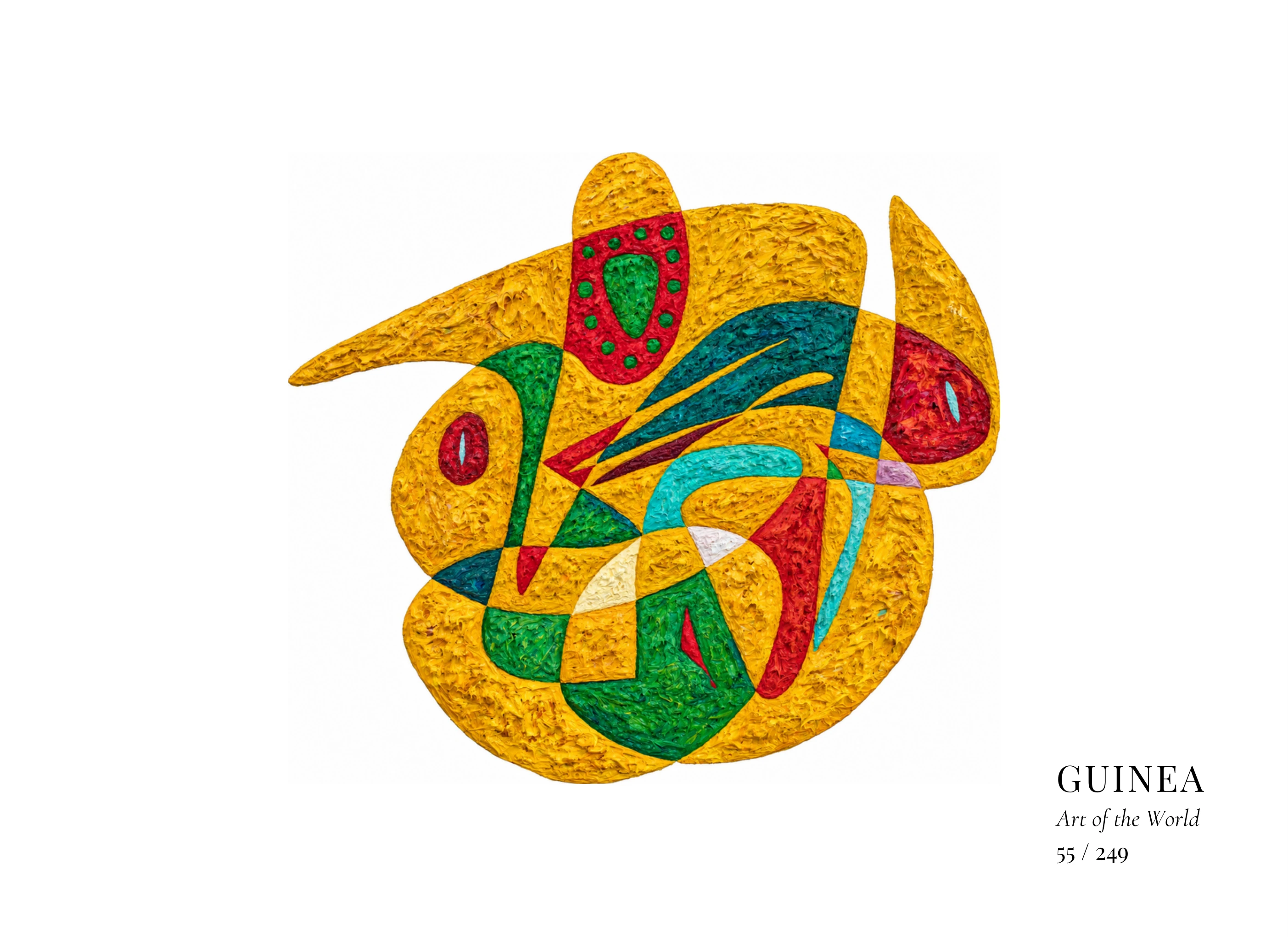
Description
The composition’s radiant yellow structure creates warmth and cohesion, crossed by green, red, turquoise and white. Dense impasto gives every colour physical weight, while curves, sharp intersections and enclosed forms distribute movement across the composition. Directional lines connect distinct areas without imposing a single centre. This balance of warm and cool passages suggests plurality held in dynamic relationship, evoking Guinea as a source of cultural vitality: grounded in memory, connected through movement and continually renewed.
Cultural Context
Guinea extends from the Atlantic coast through forested regions and savannah to the Fouta Djallon highlands, where several major West African rivers have their sources. Its history reflects Mandé states, Fulani political traditions, regional trade and later French colonial rule. Independence in 1958 established Guinea as a sovereign state with a distinctive place in modern West African history.
Mandinka, Fulani, Susu and the diverse communities of Forest Guinea contribute rich linguistic and cultural traditions. Oral history, poetry and music hold particular importance in transmitting ancestry and knowledge. Sculpture, textiles, dance and craftsmanship further express regional identities, while Guinea’s musical traditions have achieved influence well beyond its borders.