31 / 249
Guinea-Bissau
A Culture of Courage and Continuity
Description
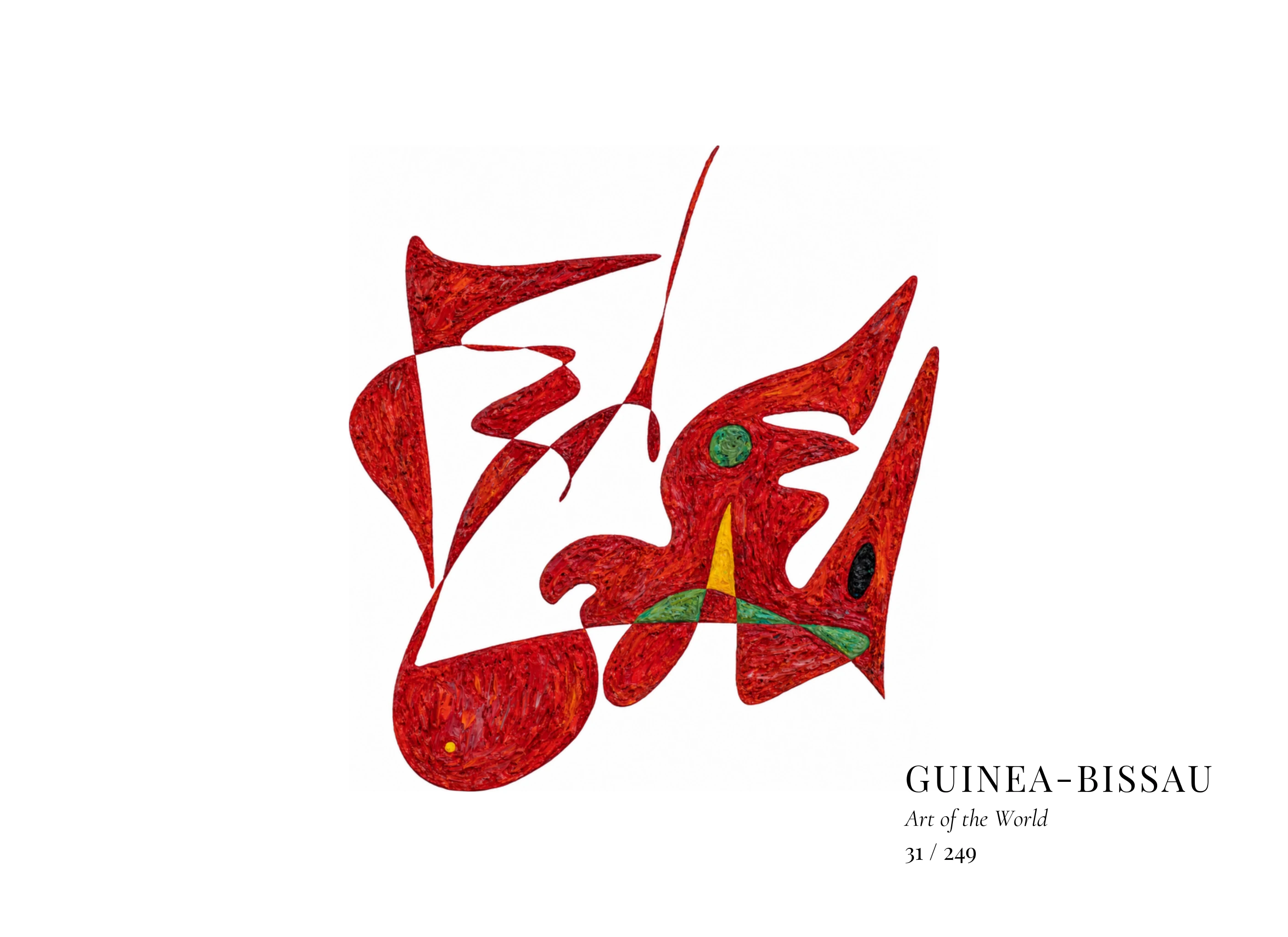
The work is commanded by a powerful red structure, enriched by green, yellow and black accents. Dense impasto gives the broad planes substantial weight, while curved contours and slender projections create outward movement. A strong central axis balances these extensions, and surrounding white space clarifies the irregular silhouette. The relationship between enduring masses and finer directional forms suggests continuity alongside renewal, evoking Guinea-Bissau as a culture strengthened by plurality, collective memory and shared purpose.
Cultural Context
Guinea-Bissau joins the West African mainland with the Bijagós Archipelago, a landscape shaped by rivers, mangroves, forests and the Atlantic. Regional societies developed through agriculture, coastal exchange and inland networks before Portuguese colonial rule. Independence, declared in 1973 and recognised in 1974, became an important chapter in the history of African self-determination.
Balanta, Fula, Mandinga, Manjaco, Papel and Bijagó communities contribute to the country’s remarkable cultural plurality. Oral history, music, dance and communal ceremonies sustain knowledge across generations, while weaving, carving and other crafts reflect distinctive regional traditions. Amílcar Cabral’s intellectual legacy further connected cultural dignity, education and national independence.