37 / 249
Morocco
The Crossroads of Red Earth
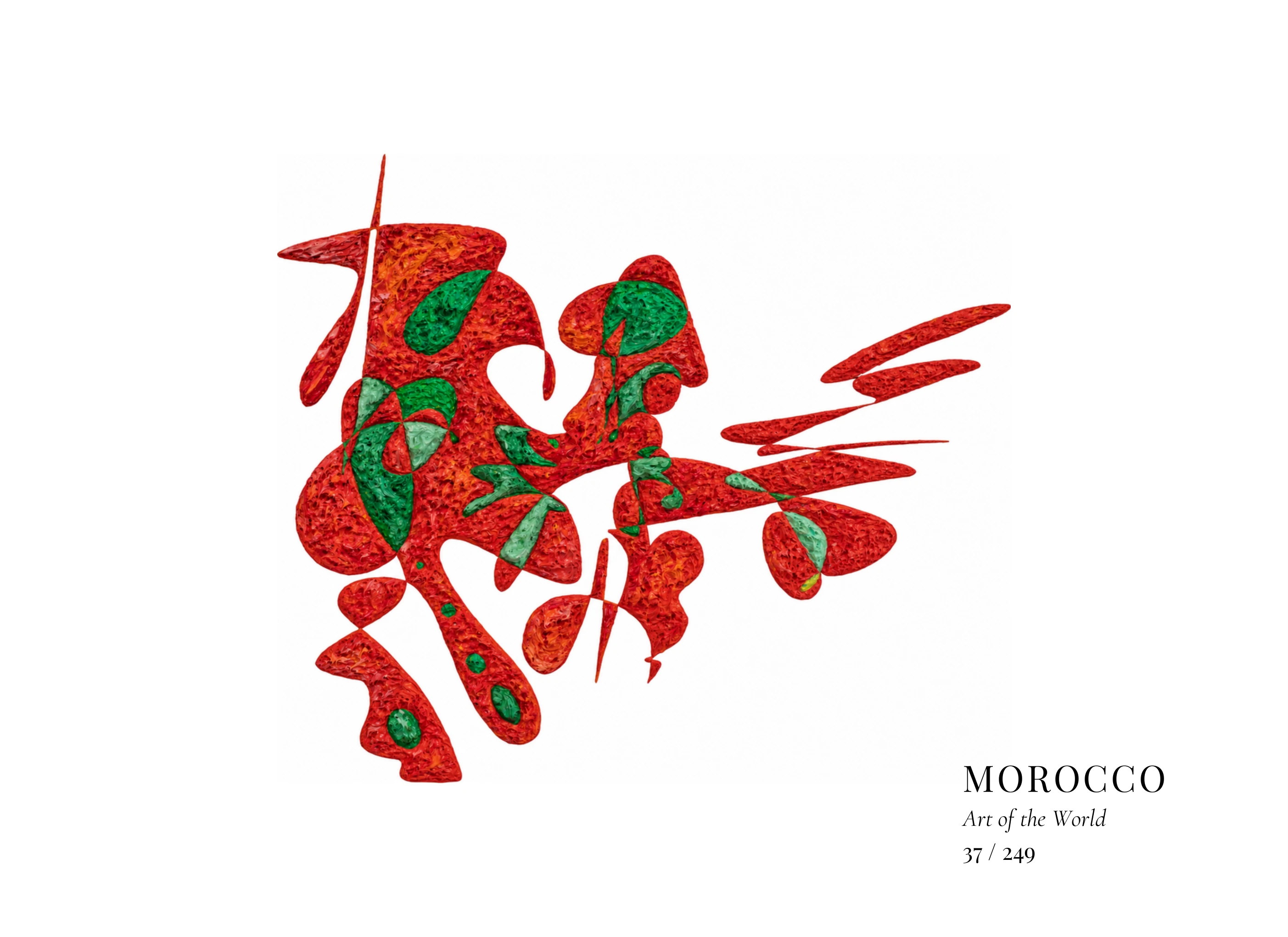
Description
The work is dominated by a forceful field of red, recalling earth, heat, architecture and ceremonial colour. Green forms move through the surface like leaves, eyes, tiles or fragments of an inherited script. On the right, long horizontal projections create speed and outward movement; on the left, denser overlapping shapes suggest the compressed pathways of an ancient medina. The work holds structure and improvisation together, presenting Morocco as a culture continually renewed through the interaction of many histories.
Cultural Context
Morocco stands between the Atlantic Ocean, the Mediterranean and the Sahara, shaped by movement across all three. Its identity brings together Amazigh foundations, Arab and Islamic traditions, sub-Saharan African connections, Andalusian refinement and a historic Jewish presence. Ancient medinas, mountain communities, desert settlements and imperial cities reveal a civilization formed through encounter rather than isolation.
This inheritance lives through architecture, music, craft and daily ritual. Geometric zellige, carved plaster, woven carpets, metalwork, calligraphy and richly patterned textiles transform practical objects into carriers of memory. Gnawa music preserves deep African connections, while Amazigh symbols, oral traditions and regional languages express identities rooted in land, ancestry and community.
Exhibition Context
Red forms rise and branch like a gathering of figures, with green nodes interrupting their shared body. Morocco's Amazigh, Arab-Islamic, Andalusian, Saharan and Atlantic inheritances provide a strong setting for that branching arrangement. The parts remain connected without looking identical, and the white gaps let separate profiles emerge. The work can suggest the making of a culture through encounter; it does not allocate one branch to a named community or turn complex histories into a single symbol.