97 / 249
Mozambique
The Architecture of Coastal Memory
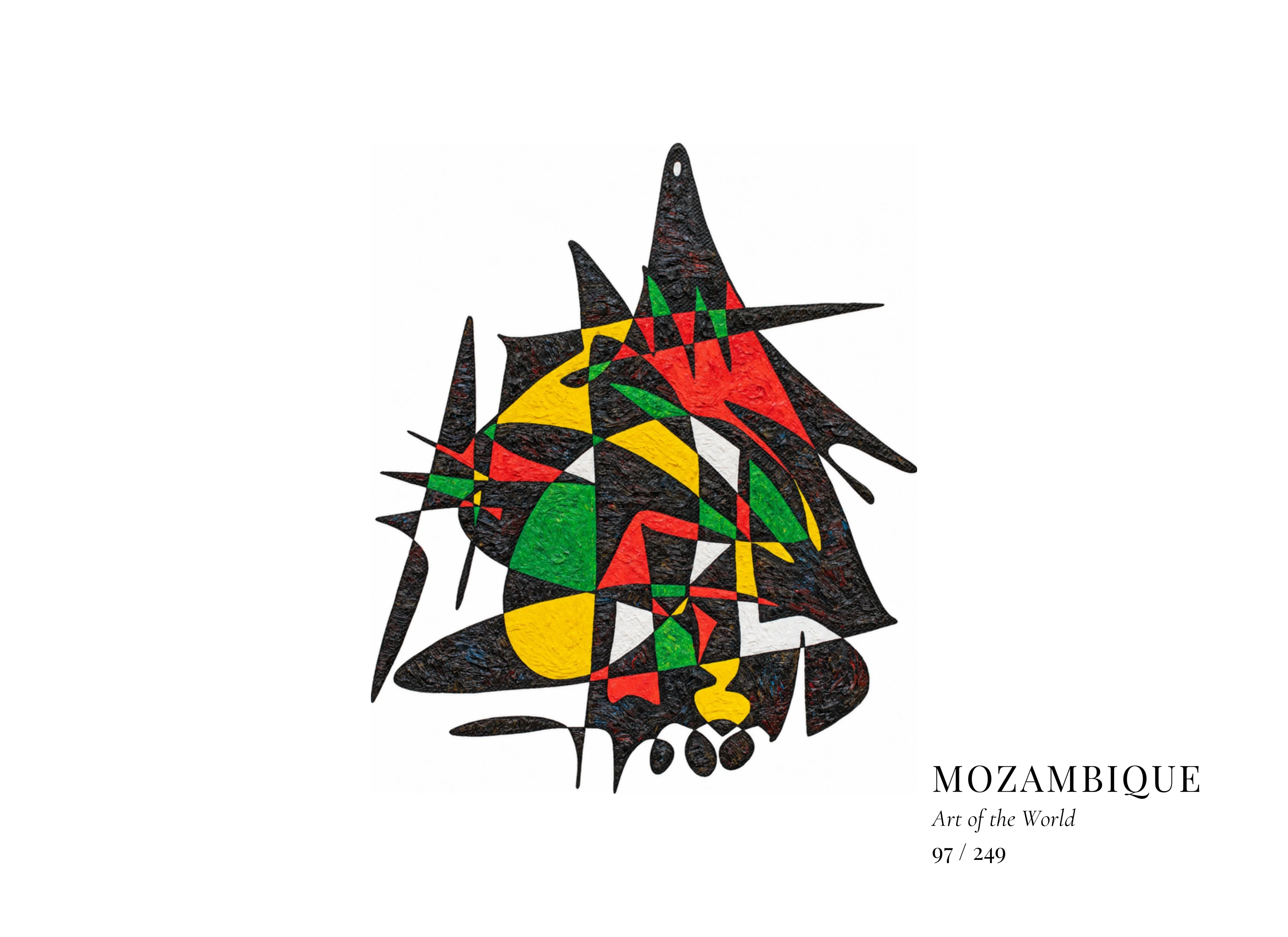
Description
The composition is built around a dense black framework crossed by red, yellow, green and white forms. The dark structure carries weight and tension, while sharp points and projecting lines produce a feeling of movement in several directions at once. Bright geometric passages resemble sails, signals, masks or fragments of architecture. The work presents Mozambique as a civilization of intersecting forces—coastal and inland, ancestral and modern, wounded by history yet continually reconstructing itself.
Cultural Context
Mozambique stretches along the Indian Ocean, where African societies have engaged with maritime worlds for centuries. Coastal ports connected the region with Swahili, Arab, Persian and Indian trading networks long before Portuguese rule. Inland kingdoms and communities developed their own political, spiritual and artistic traditions, creating a country shaped by both the ocean and the vast landscapes beyond it.
Its cultural life reflects the traditions of Makua, Tsonga, Sena, Shona, Yao, Makonde and many other communities. Makonde sculpture, capulana textiles, dance, oral storytelling and musical forms such as marrabenta reveal a powerful capacity to transform historical experience into shared expression. The Island of Mozambique remains a visible record of the encounters, migrations and conflicts that shaped the nation.