94 / 249
Namibia
The Memory of the Living Desert
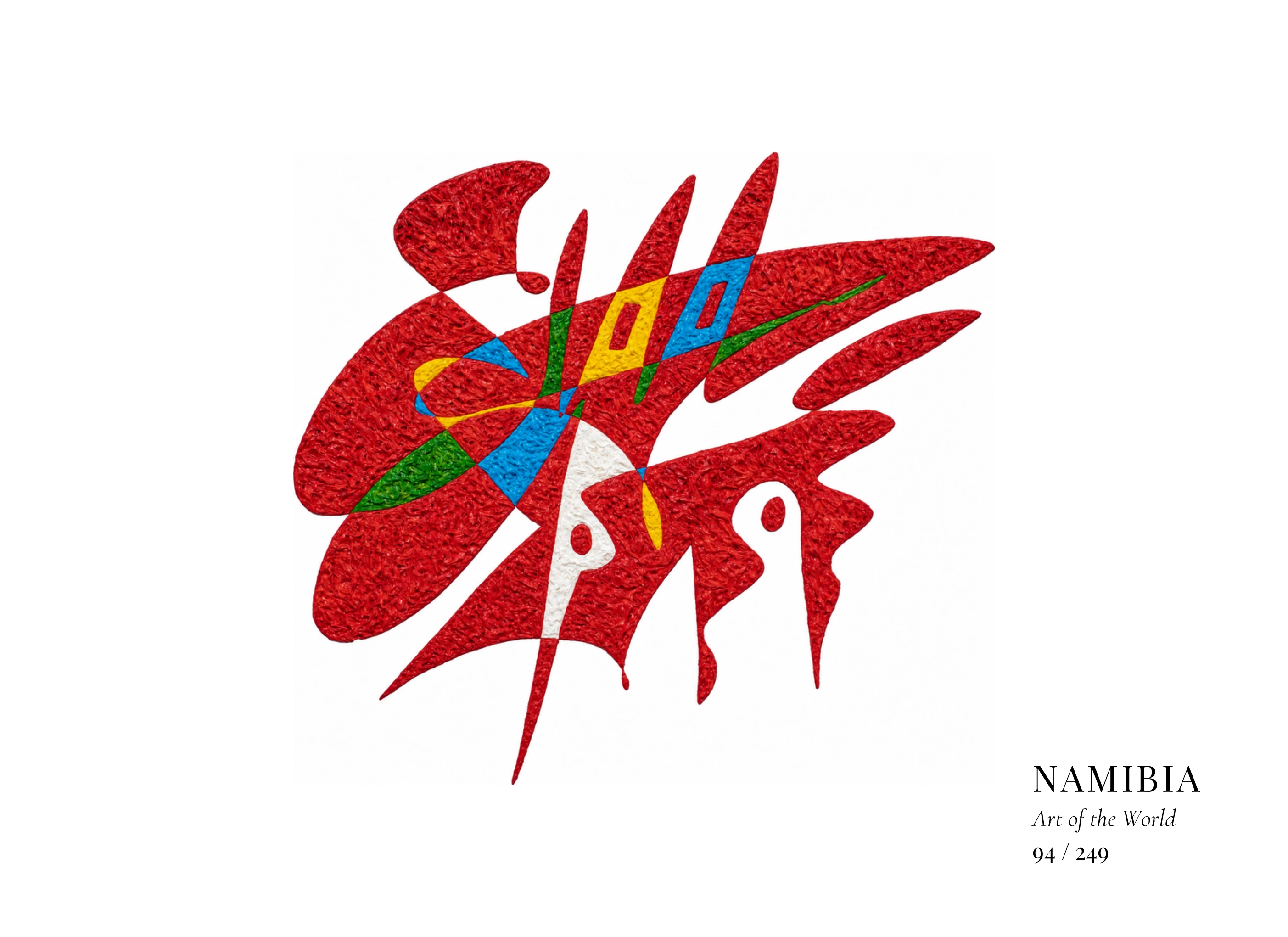
Description
The composition expands through a commanding red field, its sweeping forms suggesting dunes, wind, flame and animal movement. Blue, green, yellow and white elements intersect near the centre like pathways or signals crossing a vast terrain. Long projections extend toward the right, while pointed forms descend beneath the body of the work, creating tension between flight and rootedness. The image presents Namibia as a living landscape—severe, luminous and marked by histories that remain present within its modern identity.
Cultural Context
Namibia is shaped by immense horizons: the ancient Namib Desert, the Atlantic coast, the Kalahari and the broad northern plains. Human presence reaches deep into this landscape. The rock engravings of Twyfelfontein preserve one of Africa’s most important records of early spiritual and environmental knowledge, revealing how communities understood animals, movement and survival across an arid world.
The country’s identity is carried by San, Nama, Damara, Ovambo, Kavango, Herero, Himba and many other communities. Oral traditions, beadwork, leatherwork, textiles, music and distinctive forms of dress preserve relationships between ancestry and place. Namibia’s modern history also bears the trauma of German colonial rule and the genocide of the Ovaherero and Nama peoples. Independence in 1990 opened a new national chapter founded upon remembrance, endurance and self-determination.