96 / 249
Republic of the Congo
Currents Through the Equatorial Green
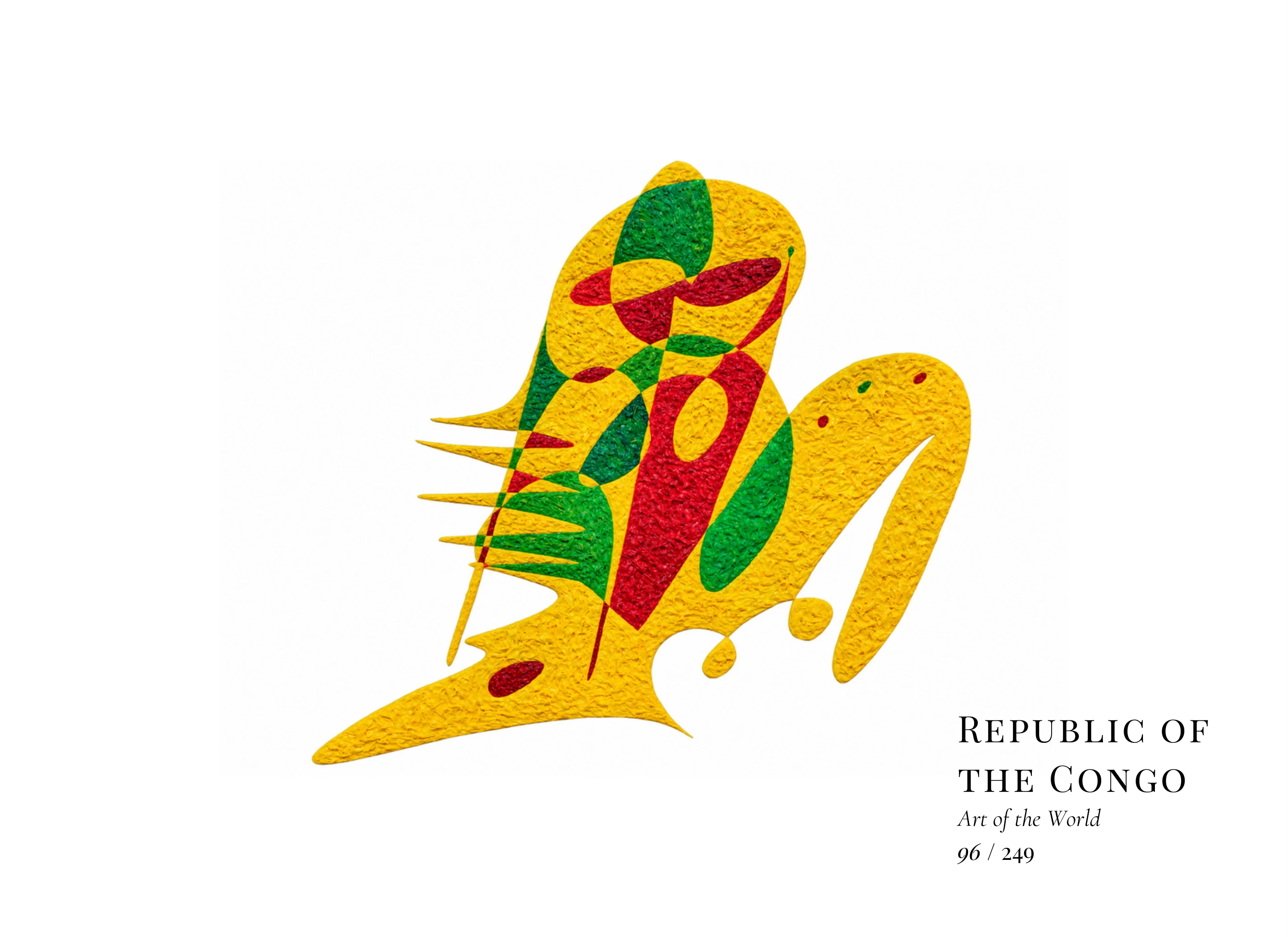
Description
The composition is dominated by brilliant yellow, punctuated by dense green and crimson forms. Curved compartments meet sharp intersections, pointed extensions and small detached elements, creating a rhythm of expansion and interruption. Thick impasto intensifies the colours, while surrounding white space emphasises the irregular silhouette. The image suggests plurality held within a restless structure, with distinct forms remaining visible while contributing to a larger interconnected whole.
Cultural Context
The Republic of the Congo stretches from the Atlantic coast into the forests and savannas of Central Africa. Kongo and Teke societies established important political and trading networks before French colonial rule incorporated the territory into French Equatorial Africa. Independence came in 1960, followed by political upheaval, socialist government and periods of conflict. Brazzaville and the Congo River remain central to the country’s historical and geographical identity.
Congolese culture reflects considerable linguistic and artistic diversity. French is the official language, while Lingala and Kituba are widely used alongside numerous Indigenous languages. Sculpture, masks, textiles, oral traditions and ceremonial arts form important parts of its cultural inheritance. Brazzaville has also become an influential centre of Central African literature and music, particularly Congolese rumba.