67 / 249
São Tomé and Príncipe
Islands at the Atlantic Crossroads
Description
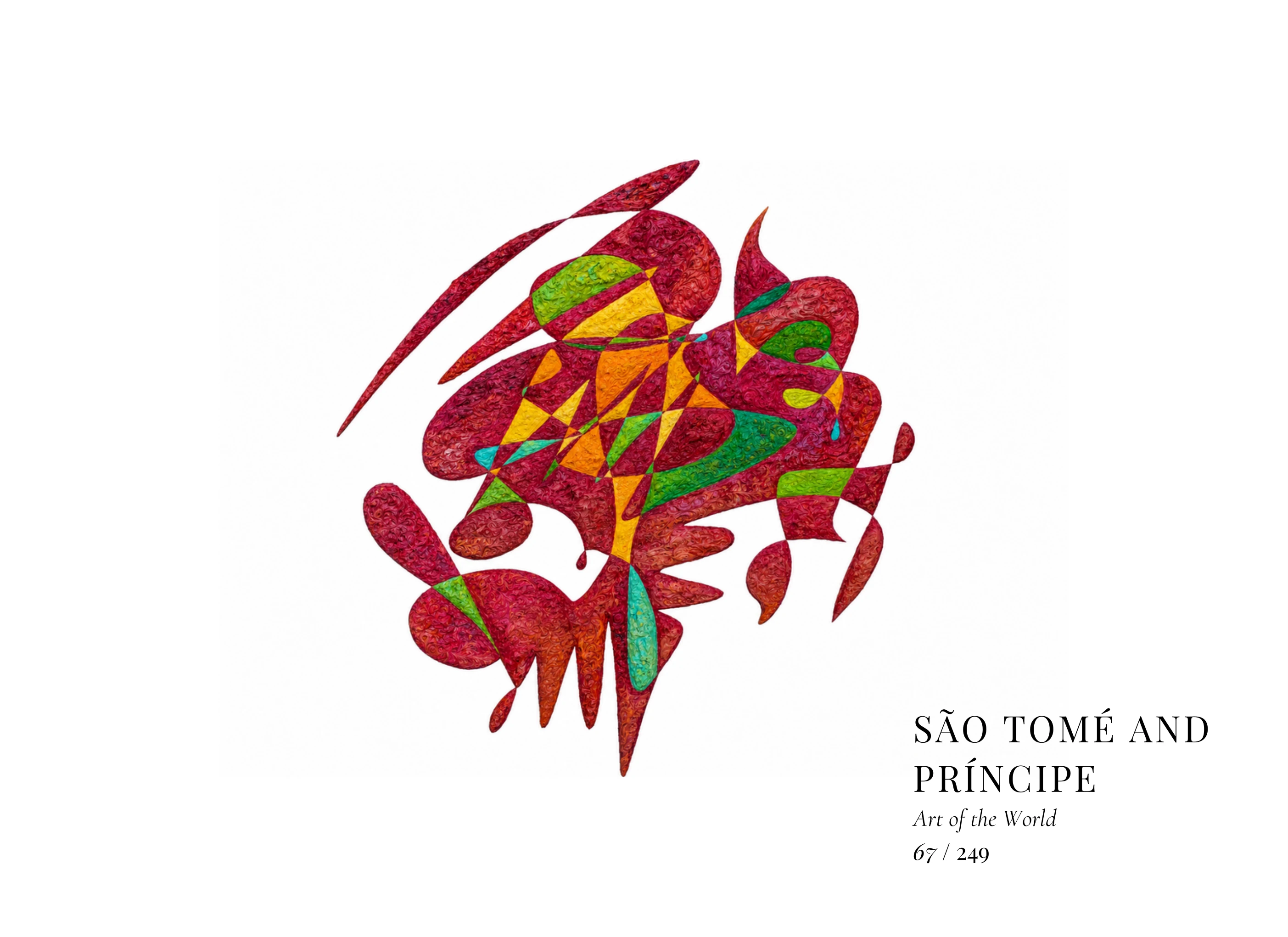
The composition gathers burgundy, crimson and earthy reds around passages of green, turquoise, yellow and orange. Dense impasto gives the surface an almost organic intensity. Angular internal divisions collide with rounded forms, elongated arcs and numerous detached fragments, while expansive white spaces keep the structure visually open. The image evokes an archipelagic rhythm: concentrated masses separated by intervals yet connected through colour, movement and recurring forms.
Cultural Context
São Tomé and Príncipe is an equatorial island nation in the Gulf of Guinea, formed by volcanic landscapes, dense forests and steep mountains. Uninhabited before Portuguese settlement in the late fifteenth century, the islands became plantation colonies producing sugar and later cocoa and coffee through systems of enslaved and coerced labour. Independence from Portugal was achieved in 1975, establishing one of Africa’s smallest sovereign states.
Its culture developed through encounters between African peoples and Portuguese colonial society. Portuguese is the official language, alongside several Portuguese-based creoles. Oral traditions, music and dance remain central to cultural life, while forms such as tchiloli combine theatre, music and historical storytelling. The islands’ architecture, cuisine and festivals similarly reveal centuries of cultural exchange and adaptation.