36 / 249
Senegal
Between Sahel and Atlantic
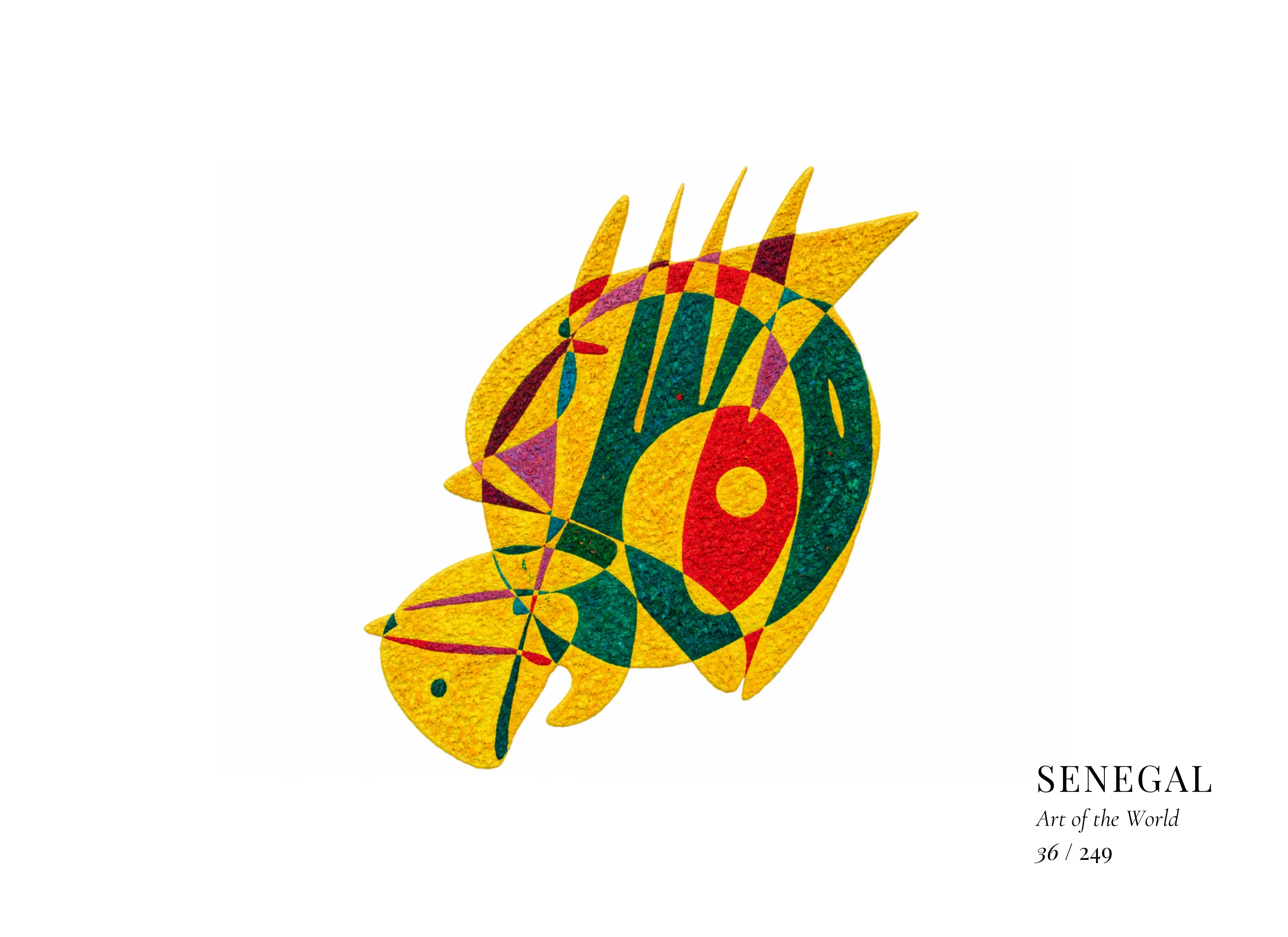
Description
The composition is dominated by luminous yellow and deep green, animated by red, violet and turquoise accents. A rounded central mass is crossed by elongated bands, sharp vertical projections and tightly interlocking geometric divisions. Thick impasto gives the colours physical intensity, while pointed extensions push forcefully into the surrounding white space. The image suggests movement between concentration and openness, its layered rhythms evoking a country shaped by intersecting histories, communities and Atlantic connections.
Cultural Context
Senegal occupies Africa’s westernmost Atlantic reaches, where the Sahel meets a long coastline shaped by the Senegal and Casamance river systems. Historical kingdoms including Jolof and Waalo participated in regional trade and political networks before French colonial expansion. Dakar became a major centre of French West Africa, and Senegal achieved independence in 1960, developing a strong tradition of civilian political institutions.
Senegalese culture reflects Wolof, Pulaar, Serer, Jola, Mandinka and other communities. French is the official language, while Wolof is widely spoken. Islamic traditions, particularly Sufi brotherhoods, have profoundly influenced social life. Oral poetry, griot traditions, sabar drumming, mbalax music, textiles, glass painting, literature and cinema contribute to a remarkably influential modern cultural landscape.