10 / 249
South Africa
Many Histories, One Ground
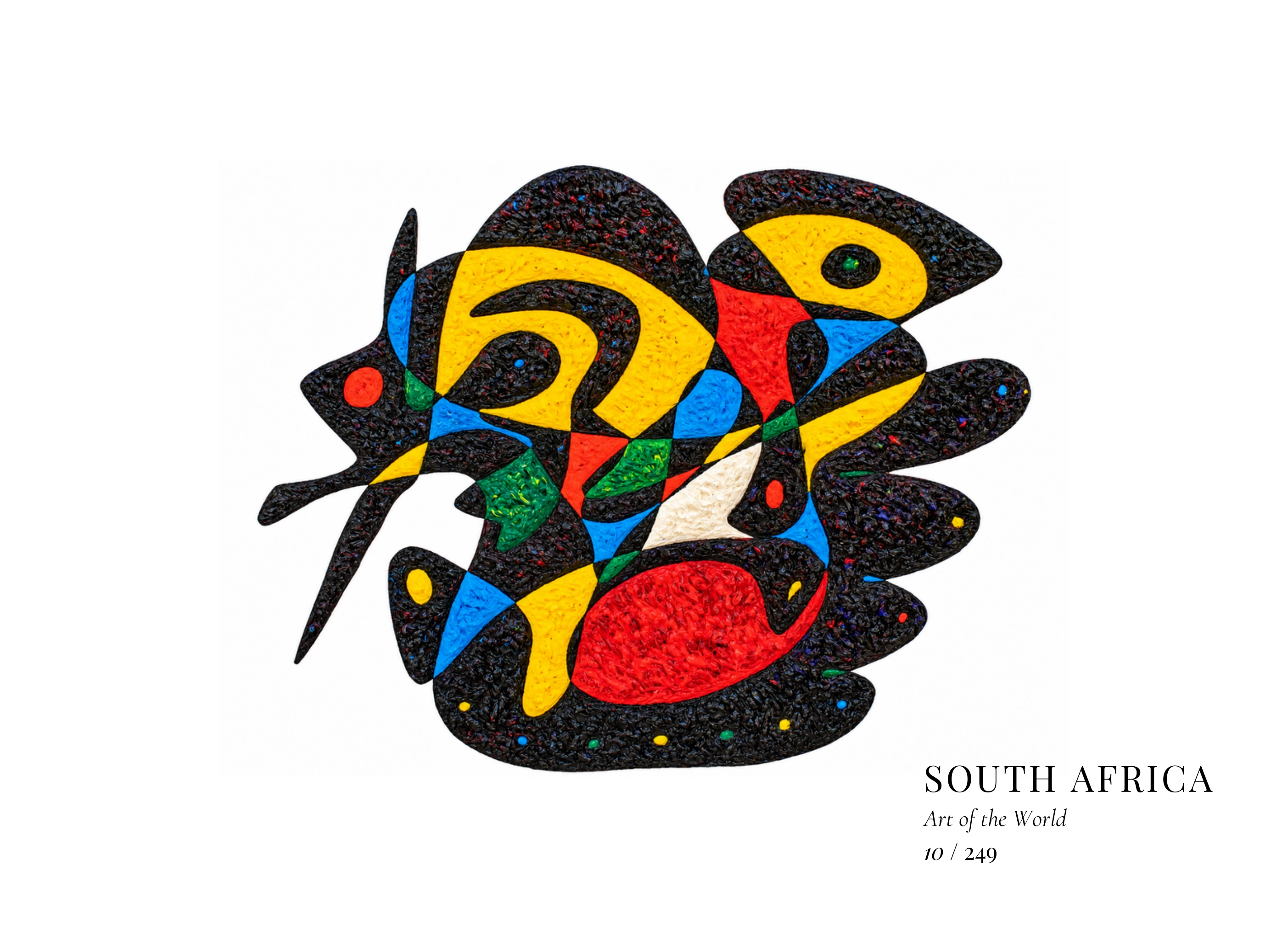
Artist: Gheorghe Virtosu
Catalogue: Art of the World
Catalogue Nr: 010/249
Source of Print: Excerpt from Divine DNA, 2016 (oil on canvas)
Medium: Limited Edition Print
Edition: 1/1
Authentication: Approved and signed by the artist on the reverse.
Artwork Classification: Civilisational Portraiture
Part of Art of the World, an El Arte Monumental project exploring contemporary art, cultural identity and visual memory.
Description
Dense black impasto forms the composition’s visual ground, illuminated by brilliant yellow, red, blue and green. Curving bands, sharp intersections, circular details and irregular compartments create an intense internal rhythm, while small coloured marks animate the outer edges. The contrast between dark mass and saturated colour suggests histories existing simultaneously rather than resolving into uniformity. Its interlocking geometry evokes plurality, tension and connection within a single energetic structure.
Cultural Context
South Africa occupies the continent’s southern tip, between the Atlantic and Indian oceans. Its history encompasses ancient San and Khoekhoe communities, powerful African societies including the Zulu and Xhosa, Dutch and British colonisation, mineral-driven industrialisation and the institutionalised racial segregation of apartheid. Democratic rule began in 1994, marking a profound political transformation whose social and economic legacies remain complex.
The country’s cultural identity is exceptionally plural, reflected in its twelve official languages and many communities. Oral traditions, beadwork, mural painting, textiles, sculpture and architecture coexist with influential traditions in literature, jazz, popular music, theatre, photography, cinema and contemporary art. Cultural expression has repeatedly served as a means of preserving memory and confronting historical division.
Exhibition Context
Many eyes, mouths and coloured segments contend inside a broad black silhouette. No single face can claim the whole painting, even though its overlapping parts form one body. South Africa's many Indigenous, colonial and migrant histories make that visual plurality consequential, and the hard divisions recall a society long separated by apartheid. The work can be read toward democratic coexistence without pretending that its differently coloured parts illustrate specific communities or that their joining resolves the historical divisions.