72 / 249
Sudan
Nile, Desert and Deep Memory
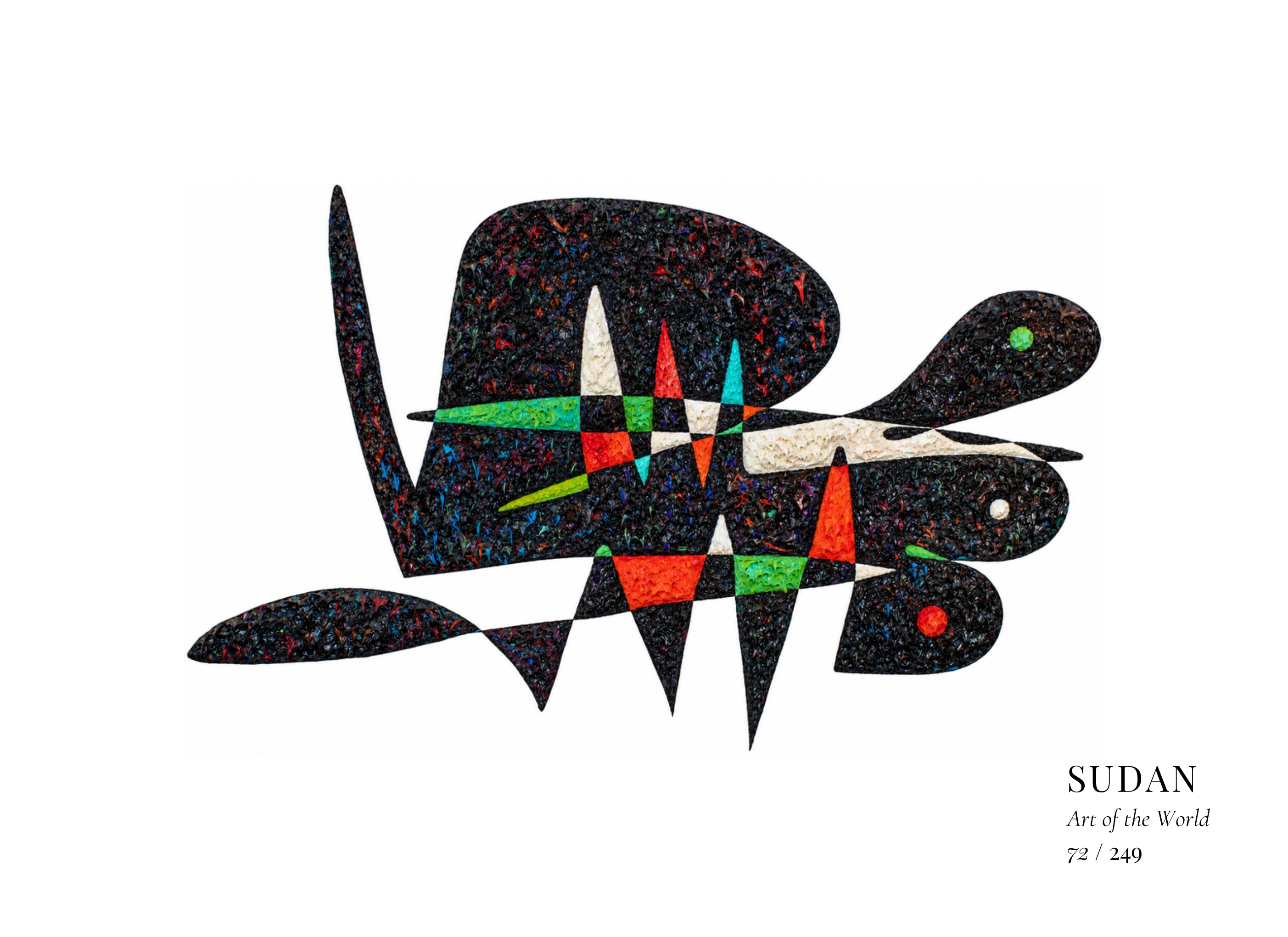
Description
Dark impasto dominates the composition, carrying subtle traces of red, blue and green beneath its surface. Against this density, white, turquoise, green and fiery orange forms create sharp points, horizontal bands and geometric intersections. Long extensions pull the silhouette in opposing directions, while isolated circular details punctuate its outer forms. The image suggests histories layered across a difficult terrain: concentrated, intersecting and fragmented, yet connected by a persistent visual current.
Cultural Context
Sudan stretches from the Sahara through the Nile Valley towards the Sahel and Red Sea. Its history reaches through ancient Nubian and Kushite kingdoms, Christian medieval states and later Islamic sultanates. Ottoman-Egyptian and Anglo-Egyptian rule preceded independence in 1956. Subsequent political upheaval, conflict and the secession of South Sudan in 2011 have profoundly shaped the modern state.
Sudan’s cultural identity encompasses Arab, Nubian, Beja, Fur and many other communities. Arabic is dominant, alongside numerous Indigenous languages. Poetry, oral storytelling, music, architecture, weaving, pottery and decorative traditions reflect the country’s cultural depth, while the archaeological heritage of Nubia preserves one of Africa’s great ancient civilisations.