8 / 249
Swaziland
Tradition in Living Motion
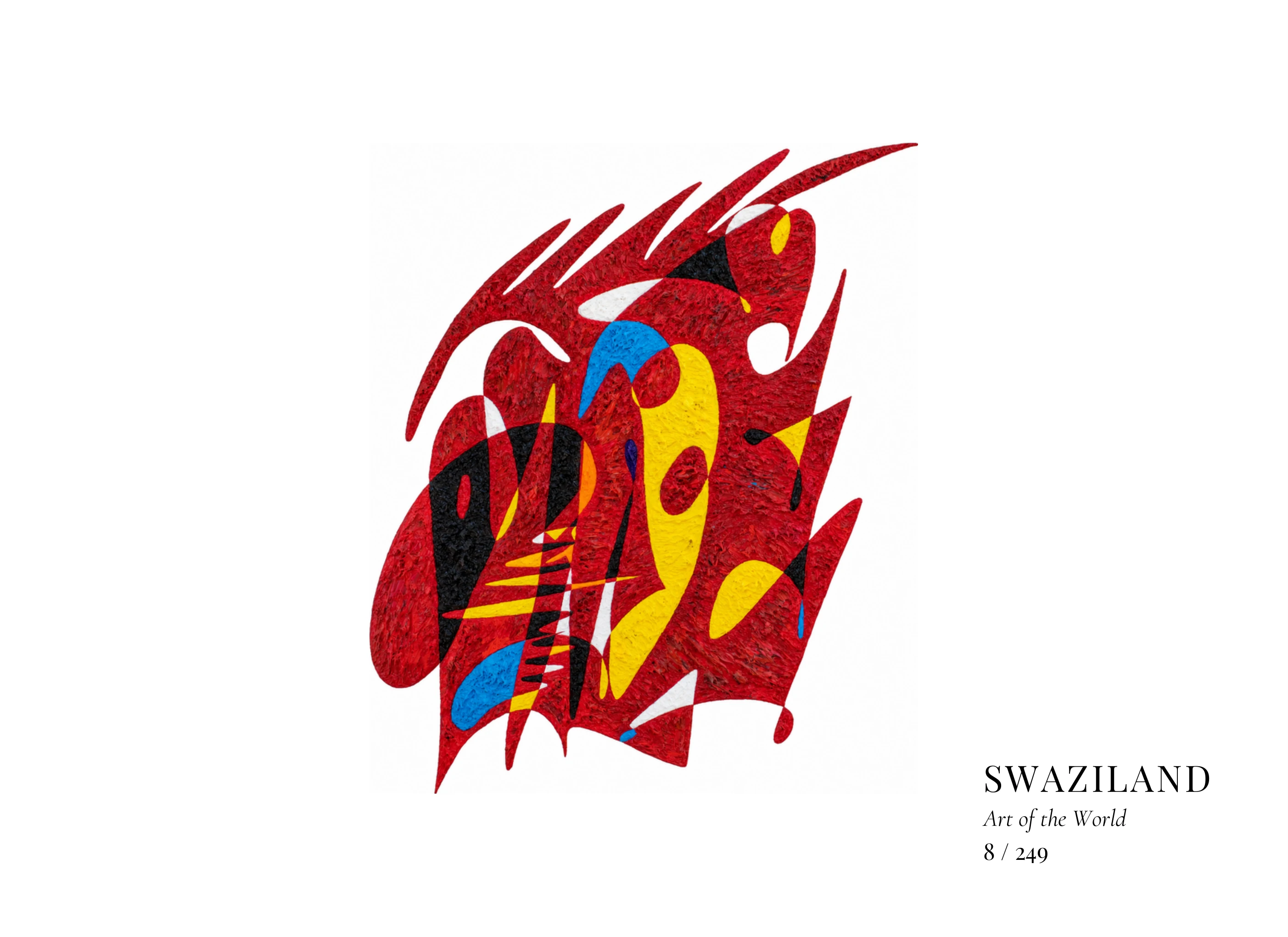
Description
The composition's powerful red structure is punctuated by yellow, blue, black and white, producing strong contrasts across its dense impasto surface. A central vertical movement provides stability while long projections extend outward with energy. Angular divisions meet curved passages, creating a rhythm that suggests continuity without stillness. The composition can be read as evoking Eswatini’s living cultural inheritance: firmly rooted, collectively sustained and continually renewed.
Cultural Context
Eswatini is a compact kingdom in Southern Africa, where mountains, fertile valleys, grasslands and lowveld create a varied landscape. Formerly known internationally as Swaziland, the country adopted the name Kingdom of Eswatini in 2018, affirming the name long used in siSwati.
The cultural traditions of the emaSwati remain highly visible in contemporary life. Ceremonies including Incwala and Umhlanga bring communities and generations together through song, movement and dress. Weaving, beadwork, carving, ceramics and textiles further express inherited knowledge through colour, pattern and skilled craftsmanship.
Exhibition Context
Spines rise from a red headlike form, and a bright yellow interior looks almost shielded by the jagged exterior. The result is less a named animal than a fiercely presented presence. Eswatini's monarchy and ceremonial traditions give the crest and guarded centre a possible heraldic resonance, while the red, blue and yellow accents keep the form unsettled. The historical association deepens the image, but the painting does not establish that any one spur depicts a crown, weapon or rite.