21 / 249
Togo
A Narrow Land of Many Crossroads
Description
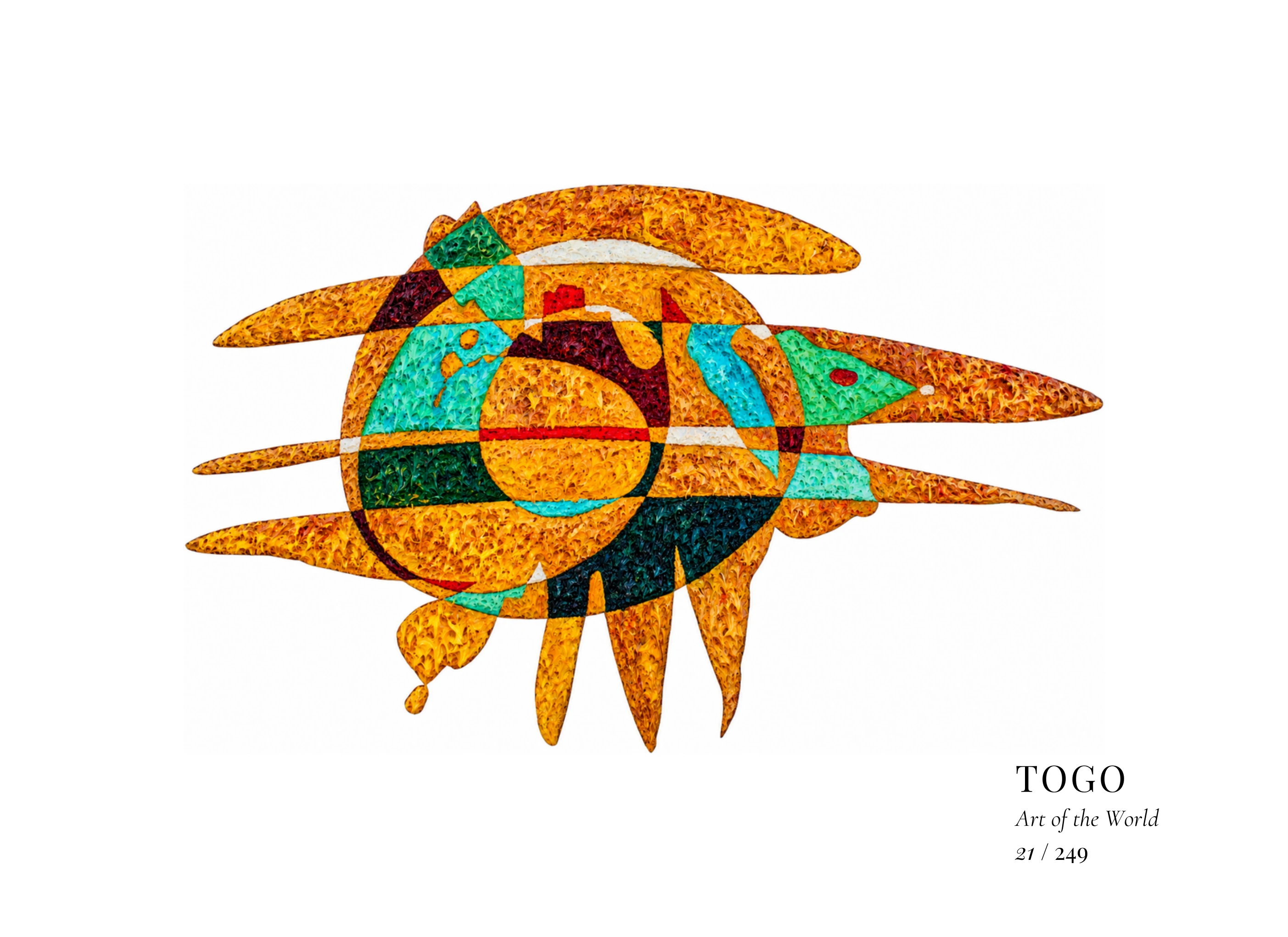
Warm ochre dominates the composition, crossed by turquoise, green, crimson, black and white. A dense central body expands into long pointed extensions, while curved bands and geometric compartments create a strong internal rhythm. Thick impasto gives the surface an earthy physicality, contrasting with the surrounding white space. The image suggests movement through intersecting territories, its elongated structure evoking connection, passage and cultural plurality.
Cultural Context
Togo stretches from the Gulf of Guinea northwards through coastal plains, central hills and savanna. Its territory has long connected inland West African societies with Atlantic trading networks. German colonial rule began in the nineteenth century, followed after the First World War by French administration. Togo became independent in 1960, entering a postcolonial history marked by political change and long periods of centralised rule.
The country includes Ewe, Kabiyè, Mina, Tem and many other communities. French is the official language, while numerous Indigenous languages remain central to everyday life. Oral traditions, music, dance, weaving, pottery, sculpture and ceremonial arts express this cultural plurality. Religious life encompasses Christianity, Islam and enduring Indigenous traditions, including Vodun practices.