35 / 249
Tunisia
Between Mediterranean and Desert
Description
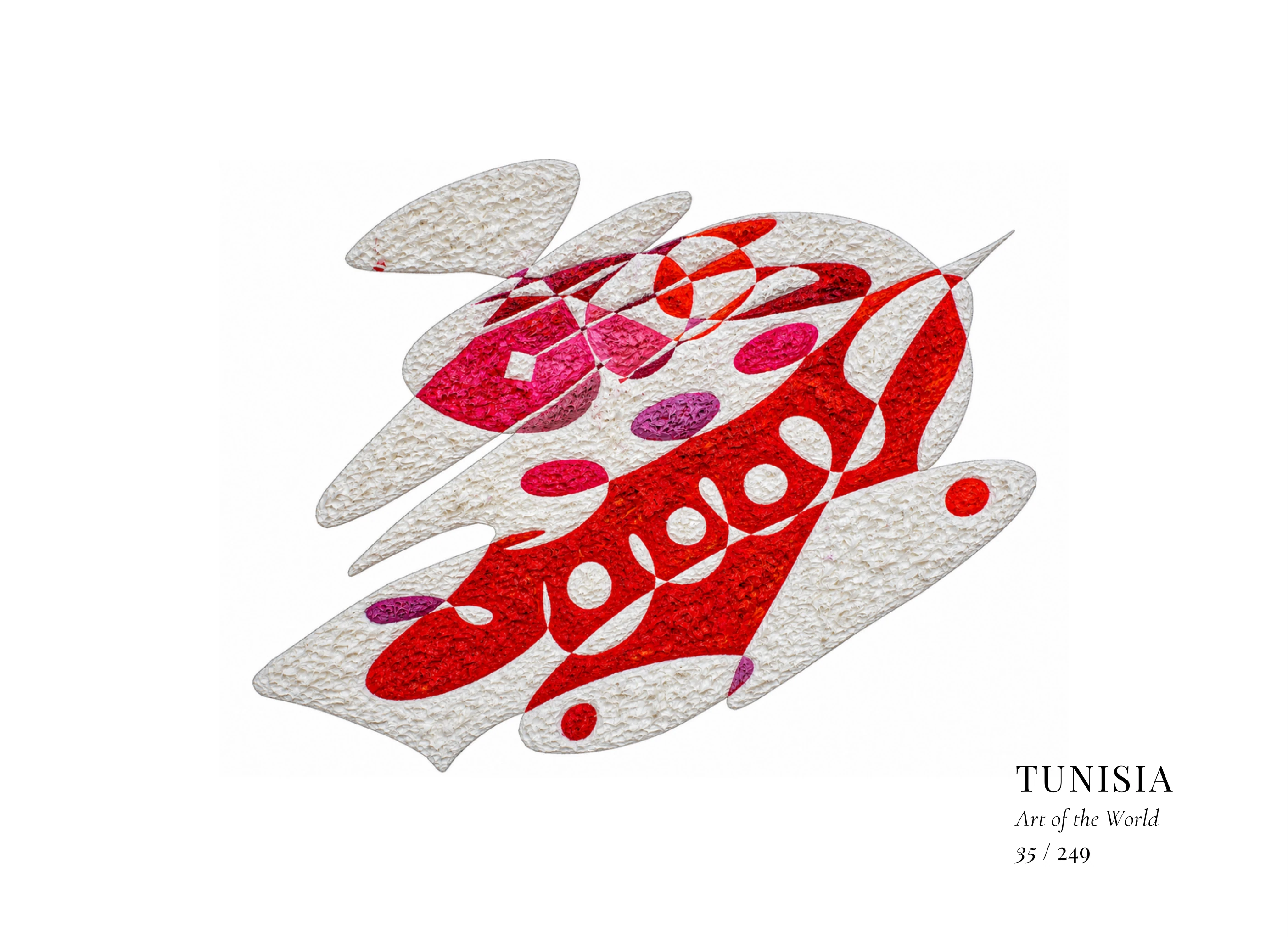
White dominates the composition, animated by intense crimson, scarlet, magenta and violet. A sweeping red structure crosses the centre, punctuated by circular openings and surrounded by elongated white forms, sharp extensions and floating ovals. Dense impasto gives both colour and white space a strongly tactile presence. The image suggests layers of movement and exchange, with intersecting forms evoking a country shaped by successive Mediterranean and North African histories.
Cultural Context
Tunisia occupies North Africa’s Mediterranean coast, extending southwards towards the Sahara. Ancient Carthage made the region a major Mediterranean power before Roman, Byzantine, Arab-Islamic and Ottoman rule. A French protectorate was established in 1881, followed by independence in 1956. In 2011, Tunisia became the birthplace of the uprisings that transformed political life across much of the Arab world.
Tunisian culture reflects Amazigh, Arab, Mediterranean, African and Ottoman inheritances. Arabic is the official language, while French remains widely used. Architectural traditions, ceramics, weaving, metalwork and calligraphy coexist with strong literary, musical and cinematic cultures. The historic medinas of Tunis, Sousse and other cities preserve distinctive forms of urban craftsmanship and design.