175 / 249
Zanzibar
Islands of Monsoon Exchange
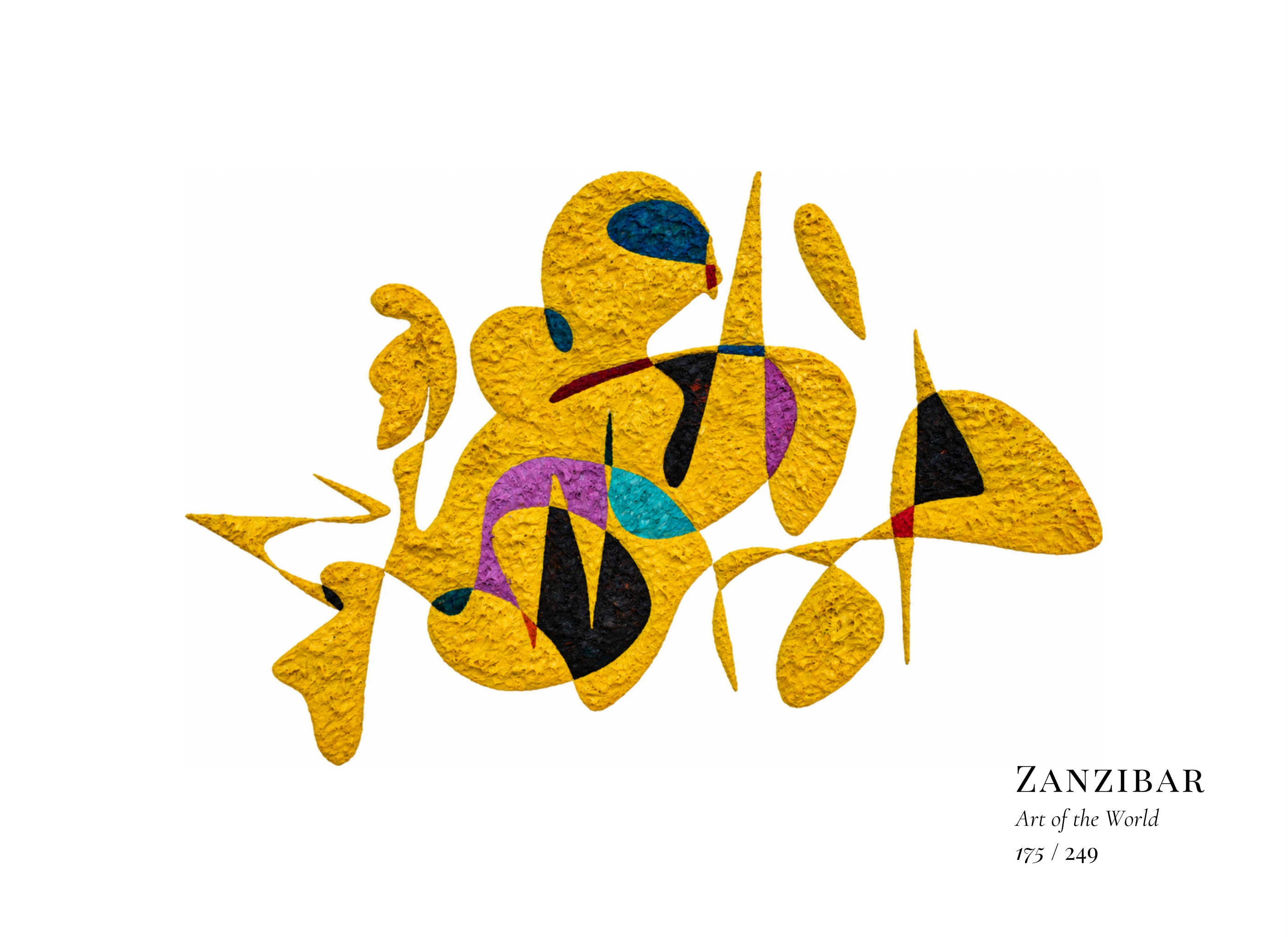
Description
Golden yellow dominates the composition, punctuated by black, turquoise, violet and crimson. Irregular masses are connected by extremely fine lines, pointed extensions and isolated floating forms. Dense impasto contrasts with fragile linear passages and broad white intervals. The image suggests an island world defined by both separation and connection, its dispersed elements evoking movement across maritime space.
Cultural Context
Zanzibar is a semi-autonomous archipelago within Tanzania, lying in the Indian Ocean off the East African coast. For centuries its islands occupied a strategic position in maritime networks linking the Swahili coast with Arabia, Persia and India. African settlement, Islamic culture, Omani rule and the colonial era all shaped Zanzibar before its 1964 revolution and subsequent union with Tanganyika.
Swahili language and culture are central to Zanzibar’s identity. Stone Town preserves a remarkable architectural inheritance of coral-stone houses, carved doors, mosques and mercantile buildings. Poetry, taarab music, weaving, woodcarving and maritime traditions reflect the archipelago’s long history of cultural exchange.
Exhibition Context
Several yellow small heads and beaklike shapes rise from a compact dark and pale body. Zanzibar's island culture emerged through Swahili, Arab, Persian and Indian Ocean connections. The repeated profiles give a persuasive sense of several histories speaking within one small place rather than one pure origin. Its central mass holds them together while the heads continue to face out toward exchange. No beak is a named trading partner, and that openness is the point.