93 / 249
Zimbabwe
Stone, Plateau and Enduring Memory
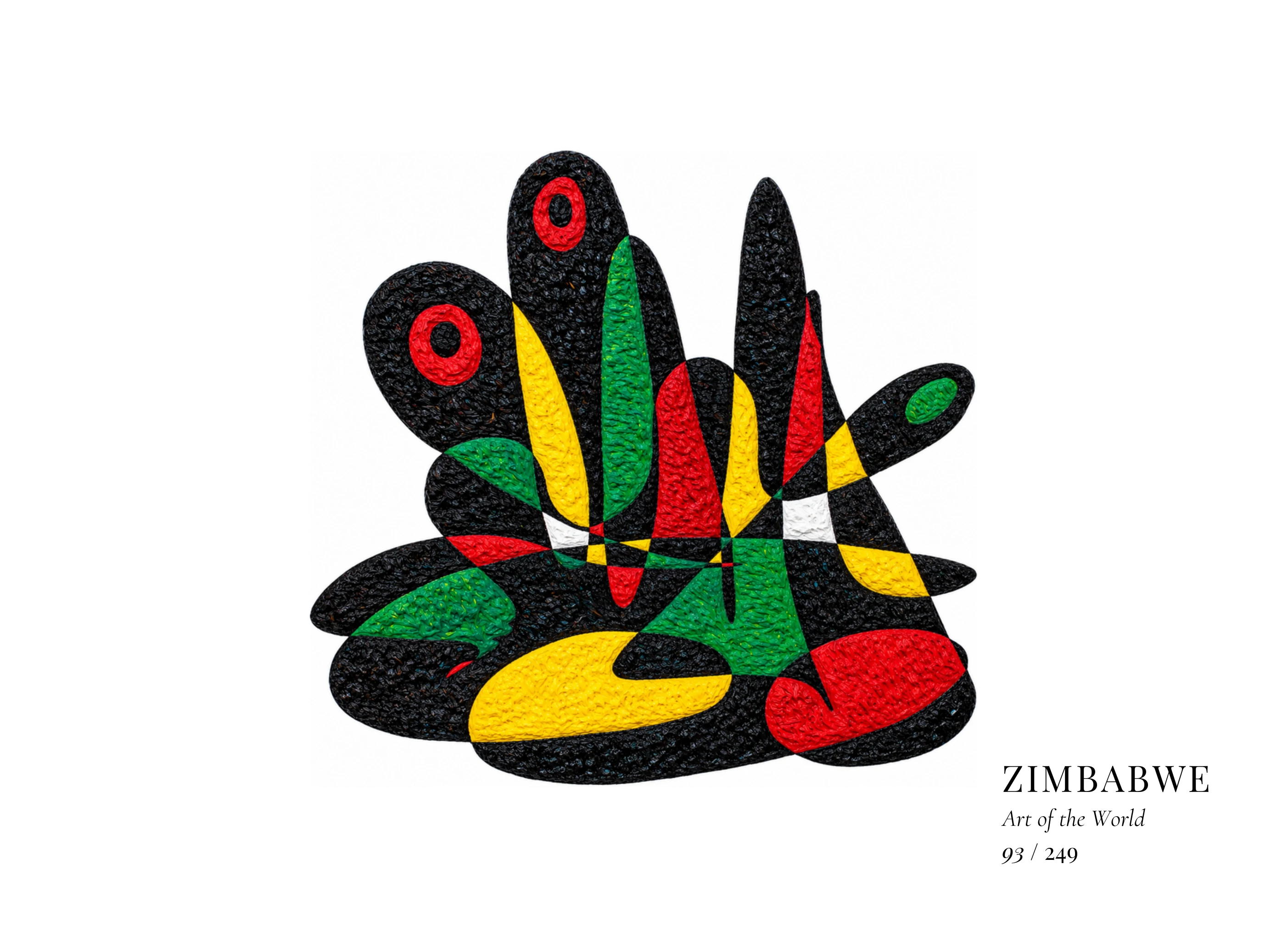
Description
Black impasto forms the composition’s dense foundation, crossed by vivid red, yellow, green and small areas of white. Tall pointed forms rise from a broad horizontal base, while circles, wedges and curved compartments create a concentrated internal rhythm. The strongly interlocked geometry suggests accumulation and continuity, while the contrast between dark mass and saturated colour evokes histories held together through transformation.
Cultural Context
Zimbabwe occupies a high plateau in southern Africa between the Zambezi and Limpopo river systems. Its history includes powerful Shona-speaking states and the monumental stone centre of Great Zimbabwe, followed by later regional kingdoms. British colonial occupation created Southern Rhodesia; after a prolonged liberation struggle, Zimbabwe achieved internationally recognised independence in 1980.
Shona and Ndebele traditions are prominent within a culturally diverse society. Oral history, music, dance, pottery, weaving and carving remain important, while mbira music has particular cultural significance. Zimbabwe is also internationally recognised for modern stone sculpture and a substantial literary tradition.
Exhibition Context
Black upright forms rise from a colourful base like heads on long necks, their circular eyes looking outward separately. Zimbabwe's Great Zimbabwe, later kingdoms, settler colonial history and independence cannot be contained in any one profile. The painting's many vertical presences give the country a layered, inhabited scale; none needs to stand for an era. Its heavy base and distinct eyes make history appear as a shared ground supporting more than one voice.