236 / 249
Afghanistan
Crossroads of Mountains and Empires
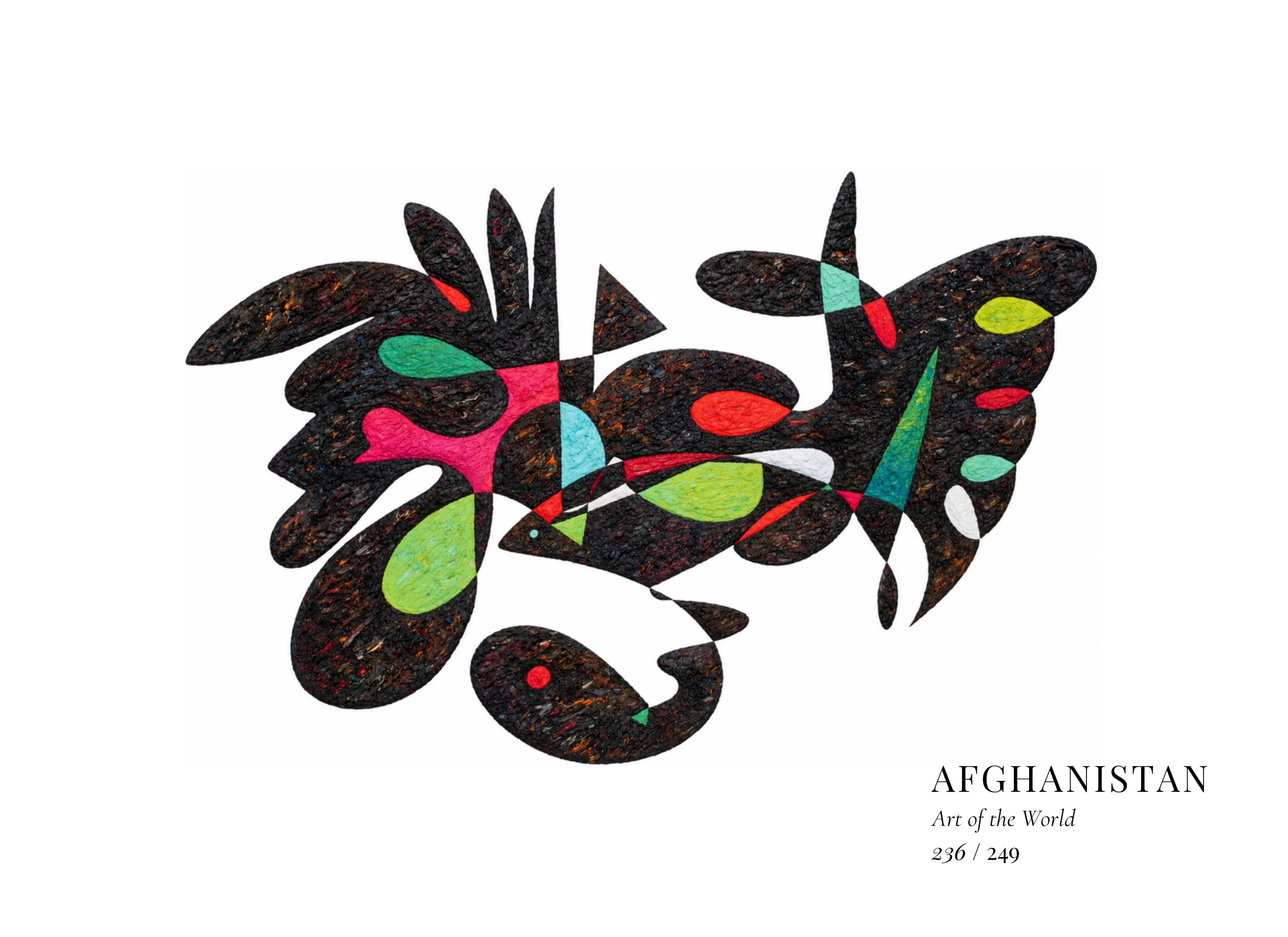
Description
Dark impasto creates a dense, fragmented silhouette animated by turquoise, green, pink, red and white. Curving masses meet sharp verticals and detached elements, while coloured ovals punctuate the composition. The tension between concentrated darkness and open white space suggests histories of movement, rupture and cultural continuity across a complex crossroads.
Cultural Context
Afghanistan lies between Central and South Asia, dominated by the Hindu Kush and historically connected to routes linking Iran, India and the Eurasian steppe. Ancient kingdoms, Buddhist and Islamic civilisations, Persianate culture and successive empires shaped the region. Modern Afghanistan emerged through eighteenth-century state formation, followed by struggles over sovereignty, foreign intervention and prolonged conflict.
Afghanistan’s cultural inheritance includes Pashtun, Tajik, Hazara, Uzbek and many other communities. Dari and Pashto are the principal official languages. Poetry, storytelling, calligraphy, carpet weaving, ceramics, metalwork, miniature painting and music preserve traditions formed through centuries of cultural exchange.