144 / 249
Armenia
Stone, Mountain and Continuity
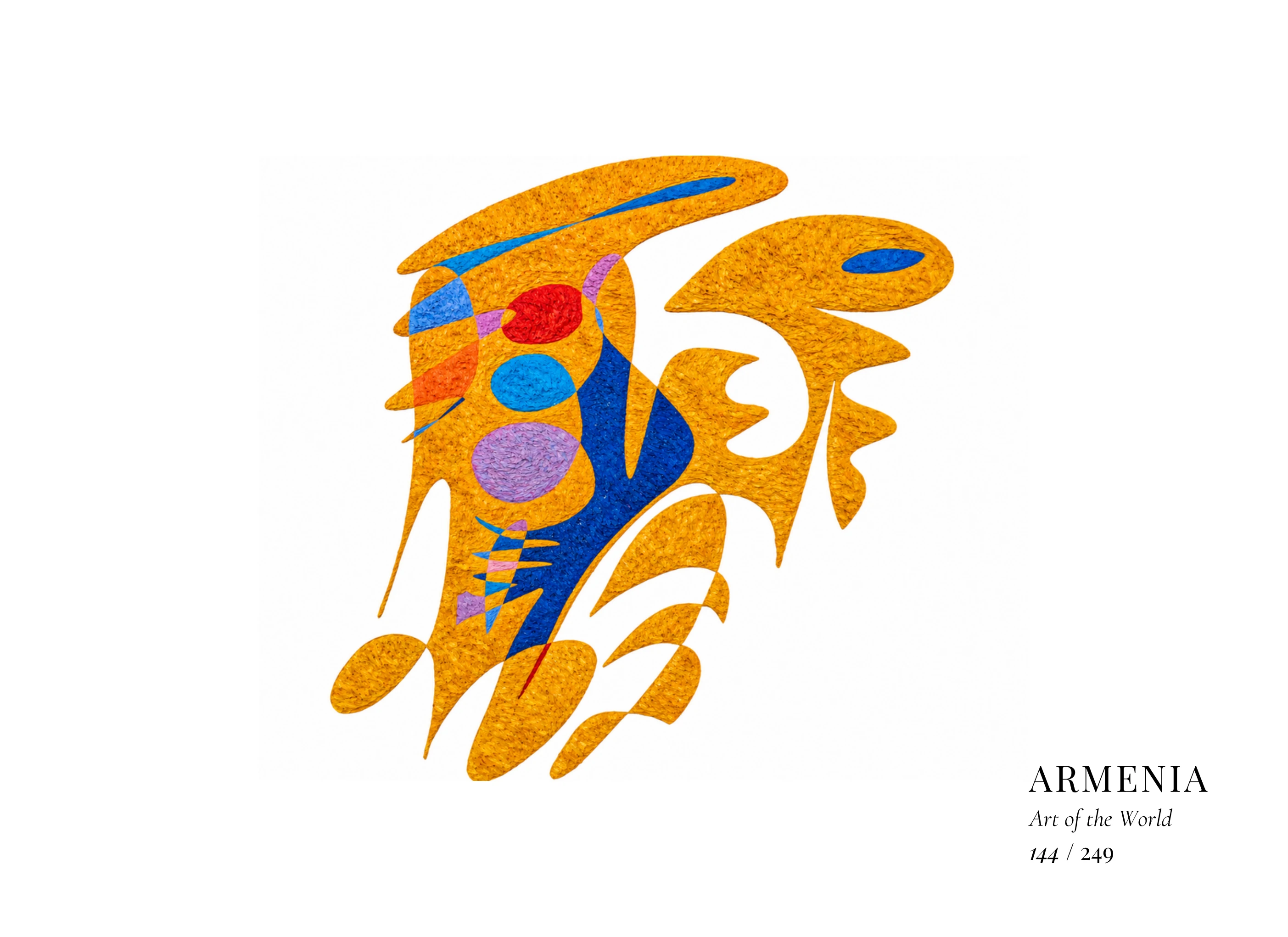
Description
Golden ochre envelops the composition, crossed by an intense cobalt-blue current and punctuated by red, violet and pale blue. Broad sweeping forms contrast with narrow points, openings and suspended extensions. Dense impasto gives the surface a geological weight, while the flowing internal divisions suggest continuity through transformation. The image evokes cultural memory held within a structure that is simultaneously monumental, open and in motion.
Cultural Context
Armenia occupies the mountainous South Caucasus, at a historic meeting point between Anatolia, Persia and the wider Caucasian world. Ancient kingdoms shaped its early history, and Armenia adopted Christianity in the early fourth century. Centuries under competing regional empires were followed by Russian and Soviet rule; the modern Republic of Armenia became independent in 1991.
Armenian identity is strongly connected to its distinctive language and alphabet, Christian heritage and global diaspora. Illuminated manuscripts, stone-carved khachkars, church architecture, carpet weaving, metalwork, music and literature form an exceptionally rich cultural inheritance maintained across centuries of displacement and political change.