142 / 249
Azerbaijan
Between Fire and the Caspian
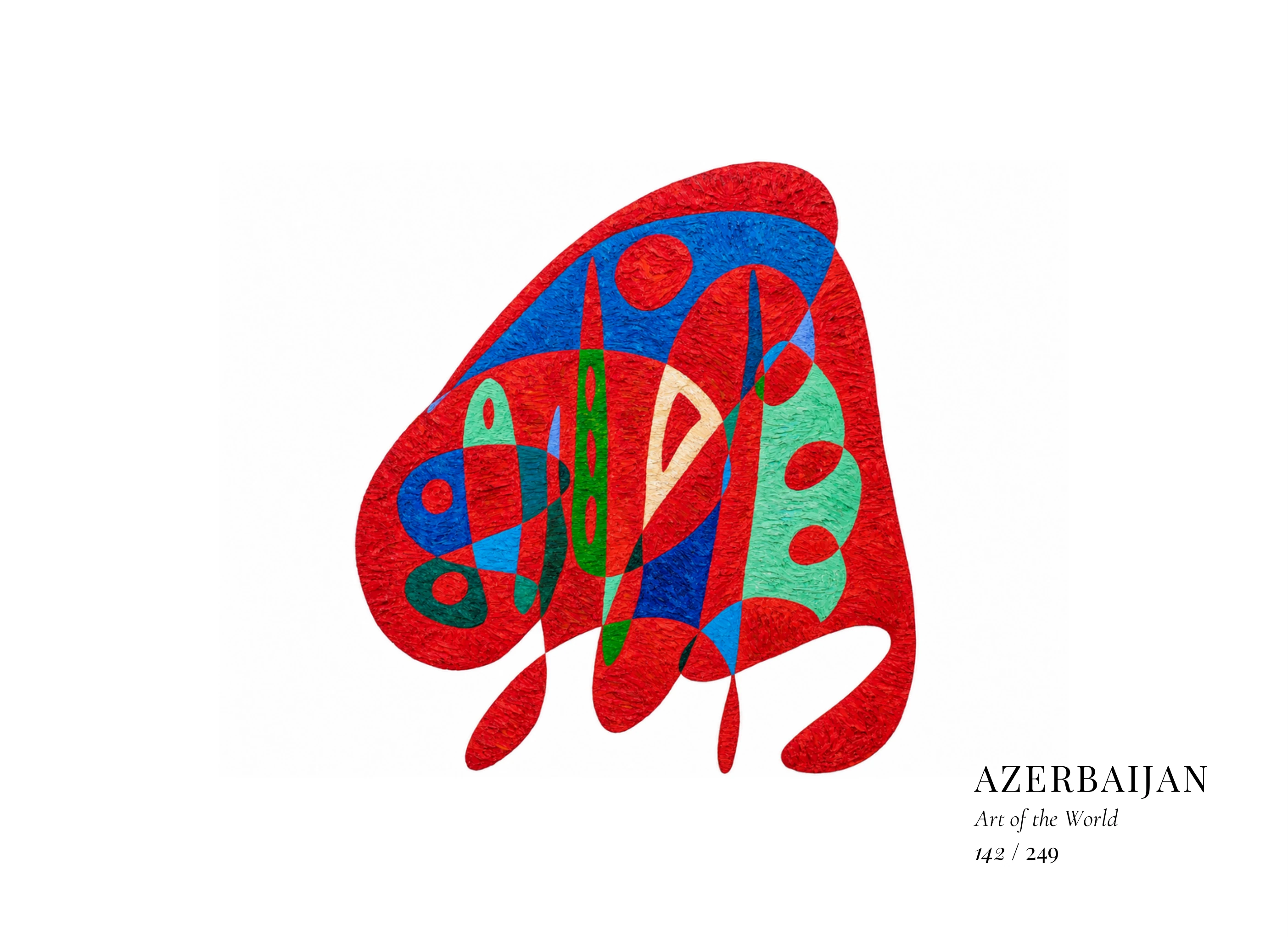
Artist: Gheorghe Virtosu
Catalogue: Art of the World
Catalogue Nr: 142/249
Source of Print: Excerpt from Divine DNA, 2016 (oil on canvas)
Medium: Limited Edition Print
Edition: 1/1
Authentication: Approved and signed by the artist on the reverse.
Artwork Classification: Civilisational Portraiture
Part of Art of the World, an El Arte Monumental project exploring contemporary art, cultural identity and visual memory.
Description
The visual field is dominated by intense red, crossed by blue, green, turquoise and pale forms. Tall pointed elements interrupt rounded masses, while circles, narrow divisions and open white spaces create a shifting internal rhythm. Its dense impasto gives the colour physical presence. The composition can be read as evoking a country formed through layers of encounter, movement and continuity.
Cultural Context
Azerbaijan lies between the Caucasus Mountains and the Caspian Sea, at a historic meeting point of Europe and Asia. Persian, Turkic, Islamic and Russian influences have shaped its development, while trade routes connected the region to wider networks of exchange. The modern republic emerged from the Soviet Union as an independent state in 1991.
Azerbaijani culture combines Turkic language and traditions with Persian and Caucasian inheritances. Mugham music, poetry, carpet weaving, architecture and decorative arts occupy important places in its cultural memory. Baku, with its historic walled city and modern architecture, embodies the dialogue between inherited forms and contemporary life.
Exhibition Context
An arching red back contains blue-green eyes and several overlapping inner forms. Azerbaijan's Caspian location and histories of Persian, Turkic and Russian influence make the layered interior culturally suggestive. The enclosing body looks complete at first, then opens into other faces when the viewer follows its red edges. That unsettled effect suits a crossroads better than an emblem of one pure origin. No specific eye represents a language or period; the figure's plurality is its subject.