126 / 249
Bangladesh
River Country, Woven Memory
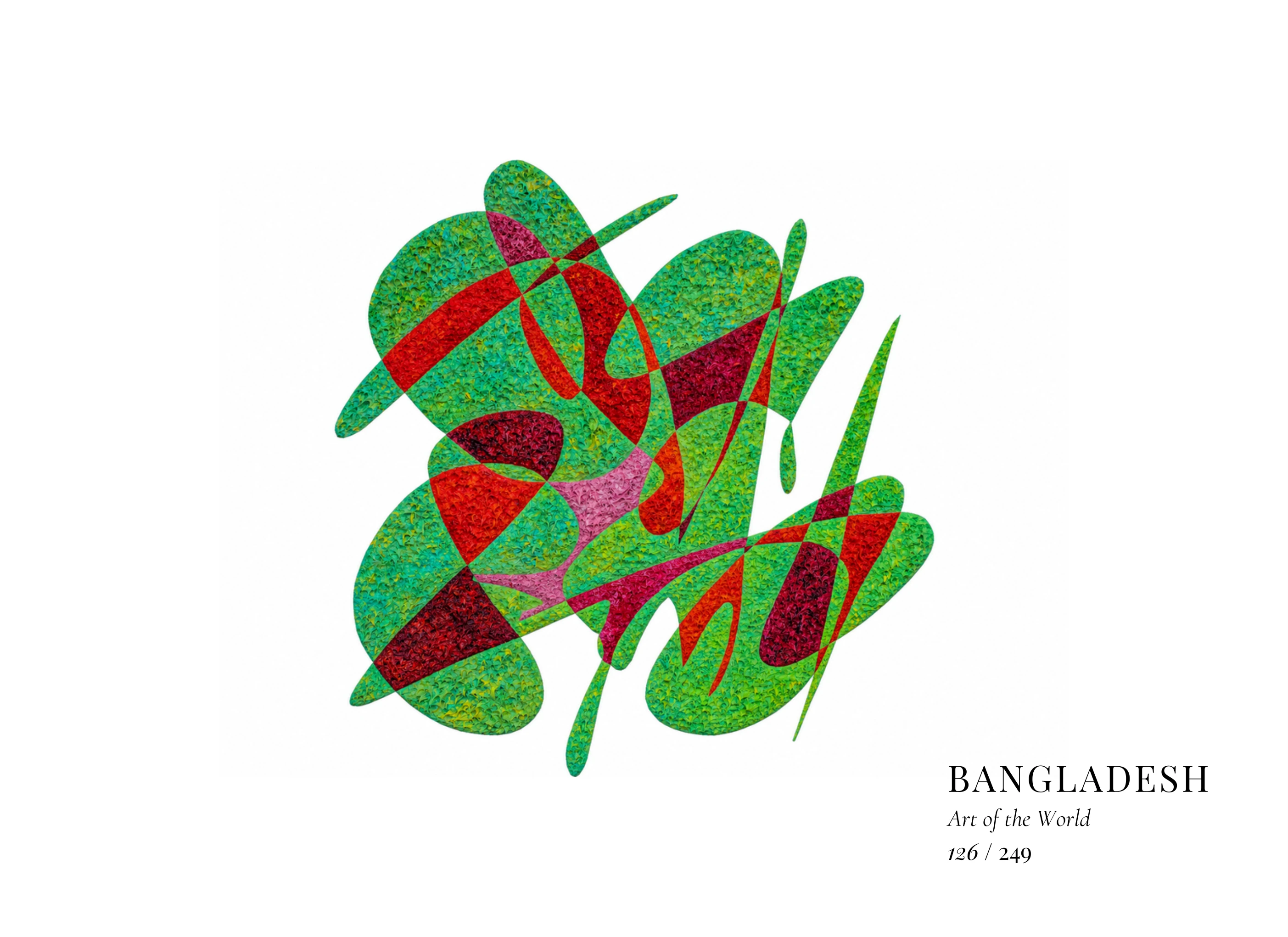
Description
The artwork suggests a landscape of convergence, movement and accumulated memory. Dense impasto gives its surface a tactile intensity, while overlapping colours, curved silhouettes and internal divisions create a shifting visual rhythm. Narrow extensions and areas of white space balance density with openness. The composition can be read as recalling the fluidity of a river-shaped country: interconnected yet continually changing, with distinct forms held within a larger, dynamic whole.
Cultural Context
Bangladesh lies within the immense Ganges–Brahmaputra–Meghna delta, a landscape formed by rivers, fertile floodplains and the Bay of Bengal. Part of the wider civilisation of Bengal, the region developed through Buddhist and Hindu kingdoms, Islamic sultanates, Mughal rule and British colonialism. Following partition in 1947, it became East Pakistan; political and linguistic struggles eventually led to the Liberation War and independence in 1971.
Bengali language and culture stand at the centre of national identity, alongside Indigenous and minority traditions. The Language Movement of 1952 holds particular historical importance. Poetry, Baul music, oral storytelling, jamdani weaving, nakshi kantha embroidery, terracotta architecture and contemporary visual culture reveal a society in which inherited craftsmanship and modern expression continually intersect.