2 / 249
Brunei
Between Rainforest and Sultanate
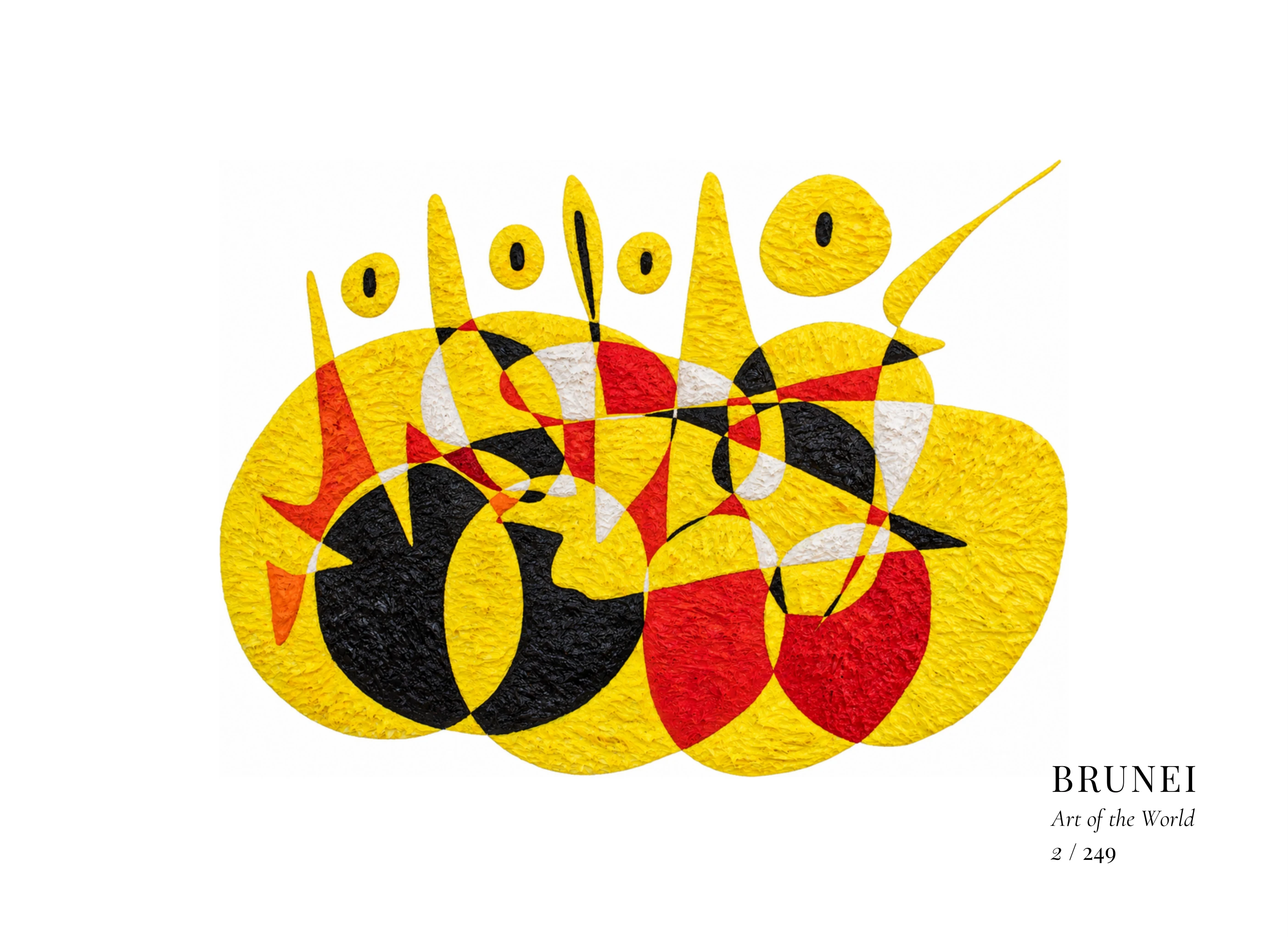
Description
The artwork suggests a compact structure held together by contrasting colours, layered surfaces and strongly defined internal divisions. Dense impasto gives the composition physical weight, while irregular contours and projecting forms introduce movement beyond its central mass. Darker passages anchor brighter areas, creating a rhythm between concentration and openness. The interplay of connected yet distinct forms can be read as evoking Brunei’s meeting of rainforest, river, maritime history and contemporary statehood.
Cultural Context
Brunei occupies a small territory on the northern coast of Borneo, facing the South China Sea and surrounded by the Malaysian state of Sarawak. Its history is closely connected to maritime Southeast Asia and the powerful Bruneian sultanate, which once exercised influence across parts of Borneo and neighbouring islands. A British protectorate from 1888, Brunei became fully independent in 1984. Petroleum and natural gas later transformed its economy while extensive tropical forests remained an important part of its landscape.
Malay culture and Islam are central to national identity, alongside Chinese communities and Indigenous peoples of Borneo. Malay is the official language, while English and several Indigenous languages are also spoken. Cultural traditions include weaving, silverwork, woodcarving, ceremonial arts and boatbuilding. Kampong Ayer, the historic settlement built over the Brunei River, reflects a long relationship between architecture, water and communal life.