171 / 249
Cambodia
Stone, Water and Enduring Memory
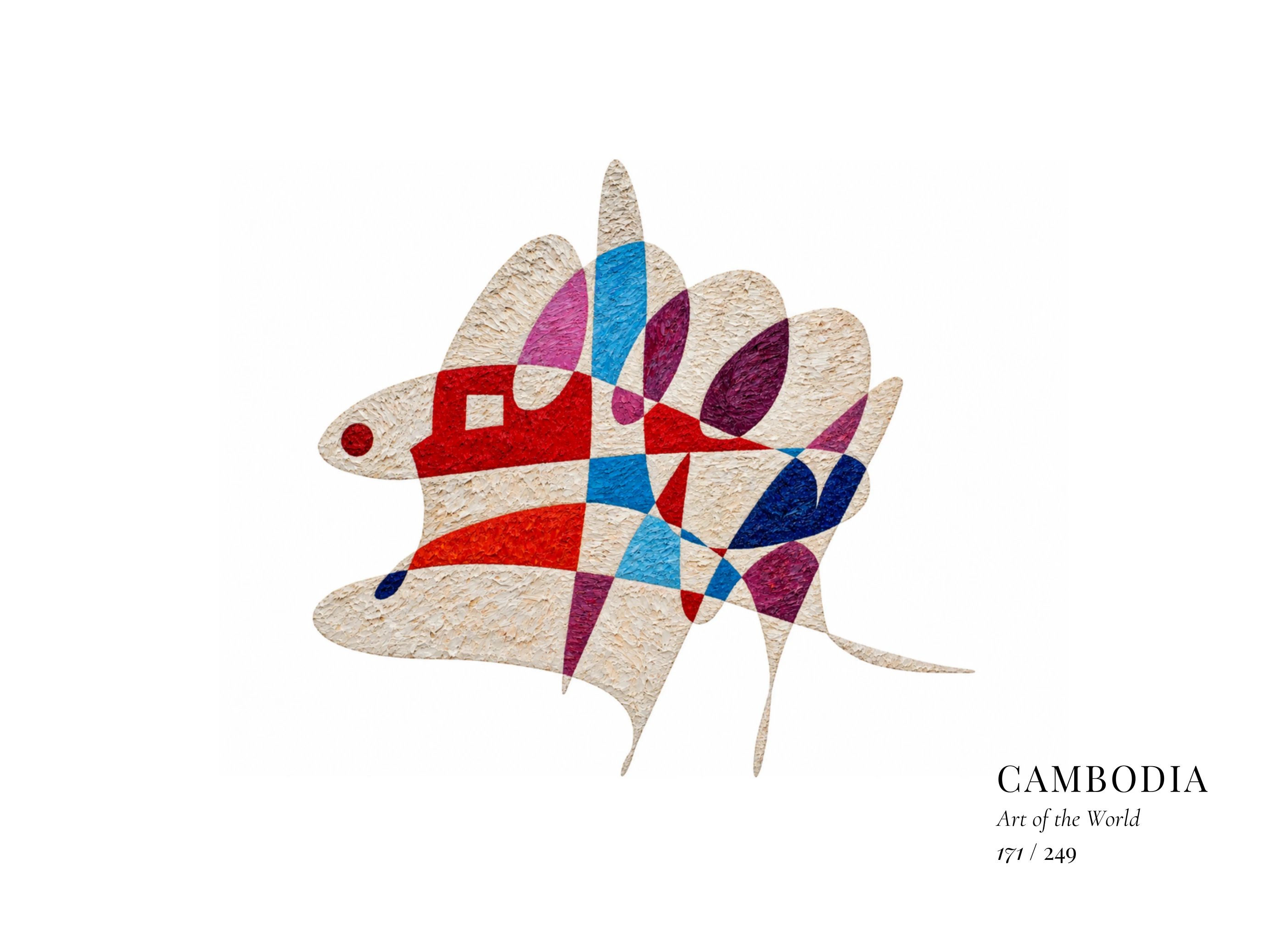
Description
The artwork presents a dense interplay of colour, texture and irregular geometry. Thick impasto gives its intersecting forms a sculptural presence, while contrasting passages create shifting areas of tension and balance. Curved contours meet sharper extensions, and white negative spaces interrupt the composition with moments of openness. Its layered structure suggests continuity shaped by rupture and renewal, evoking Cambodia’s complex historical memory without reducing that experience to literal imagery.
Cultural Context
Cambodia lies in mainland Southeast Asia, shaped by the Mekong River, the Tonlé Sap and fertile central plains. Its history is inseparable from the Khmer Empire, whose power reached its height between the ninth and fifteenth centuries and produced the monumental complex of Angkor. French colonial rule ended with independence in 1953. The violence of the Khmer Rouge period from 1975 to 1979 profoundly marked the country, followed by decades of reconstruction and renewal.
Khmer culture forms the heart of Cambodian identity, with Theravada Buddhism playing a major role in spiritual and communal life. The Khmer language, classical dance, shadow theatre, silk weaving, stone and wood carving, temple architecture and distinctive musical traditions preserve connections across generations. Angkorian art remains an extraordinary inheritance, while contemporary Cambodian artists continue to engage with memory, displacement and social transformation.