198 / 249
Georgia
Between Mountains and Crossroads
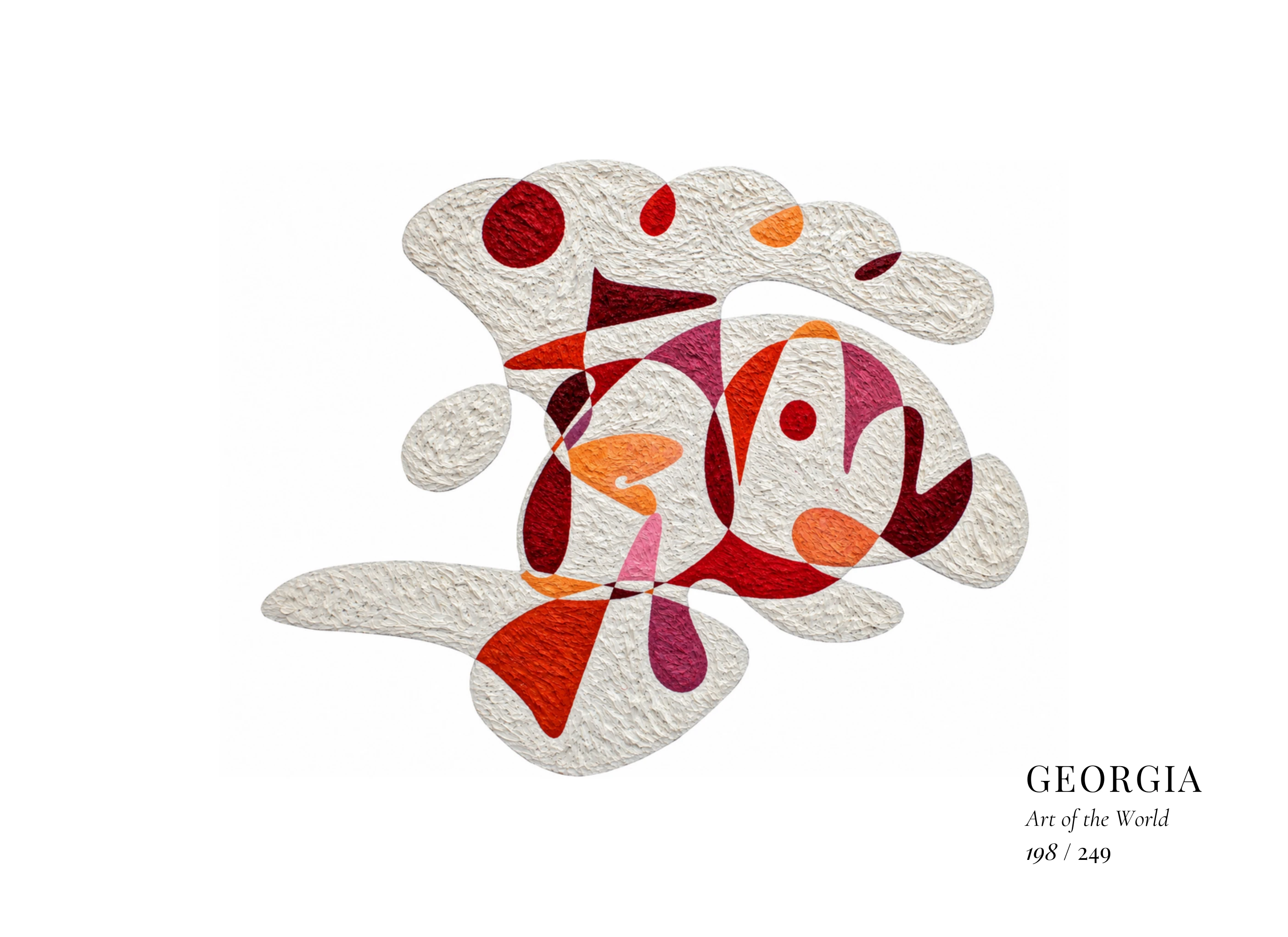
Description
The artwork builds its presence through a compact yet irregular silhouette, where strongly coloured sections meet across abrupt internal boundaries. Dense impasto makes the surface feel layered and substantial, while projecting forms and narrower extensions disturb any sense of static symmetry. Contrasting areas of colour create visual tension, and the surrounding white space sharpens the individuality of the overall shape. Its combination of concentration, fragmentation and outward movement suggests a country formed at geographical and cultural intersections, while the persistence of the connected structure evokes continuity across periods of profound historical change.
Cultural Context
Georgia lies in the South Caucasus, between the Greater Caucasus mountains and the Black Sea, at a historic meeting point of Europe and Asia. Ancient kingdoms such as Colchis and Iberia connected the region with wider Mediterranean and Near Eastern worlds. Christianity was adopted in the fourth century and became central to Georgian statehood and culture. After periods of medieval political strength, Persian, Ottoman and Russian influence, Georgia was incorporated into the Soviet Union and regained independence in 1991.
Georgian identity is distinguished by its unique language and alphabet, Orthodox Christian heritage and strong regional traditions. Medieval churches and monasteries, stone carving, fresco painting, metalwork and illuminated manuscripts form an important artistic inheritance. Polyphonic singing is particularly renowned, while poetry, dance, wine-making and the supra feast tradition reinforce the relationship between communal life, landscape and historical memory.