239 / 249
Iran
Geometry of an Ancient Continuum
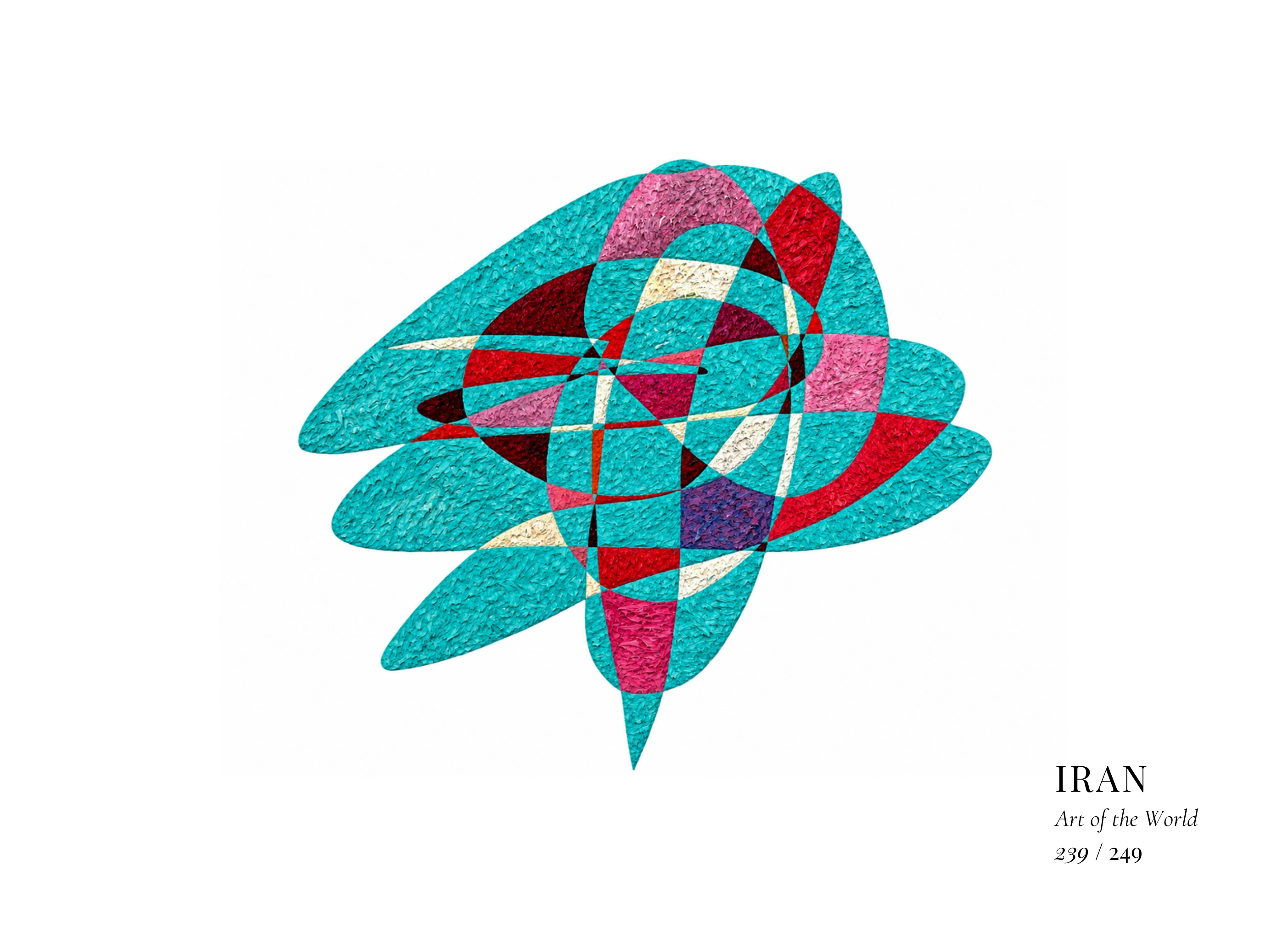
Description
The artwork is organised around an expansive turquoise field, densely worked in impasto and divided by overlapping arcs, bands and angular compartments. Crimson, burgundy, rose, violet and ivory punctuate the dominant blue-green surface, producing a complex internal rhythm. Curved forms repeatedly intersect with straight lines, while broad lateral extensions and a long descending point pull the silhouette beyond its concentrated centre. The geometry suggests continual layering rather than fixed symmetry: forms pass through, conceal and re-emerge from one another. This intricate visual structure can be read as evoking Iran’s long cultural continuum, in which successive histories remain distinct yet deeply interwoven.
Cultural Context
Iran occupies the Iranian plateau between Central Asia, the Caucasus, Mesopotamia and the Persian Gulf, with mountain ranges enclosing deserts and fertile valleys. Its history reaches from ancient Elam through the Achaemenid, Parthian and Sasanian empires to the Islamic period and successive Persian dynasties. The Safavid establishment of Twelver Shiʿism profoundly shaped the country, while the twentieth century brought rapid modernisation, political upheaval and the 1979 revolution.
Persian language and literature are central to Iranian cultural identity, alongside Azeri, Kurdish, Luri, Arabic, Balochi and other traditions. The poetry of Ferdowsi, Hafez, Saadi and Rumi forms part of an enduring literary inheritance. Persian gardens, architecture, calligraphy, miniature painting, ceramics, metalwork and carpet weaving reveal sophisticated traditions of geometry, colour and ornament, complemented by internationally influential modern literature and cinema.