237 / 249
Iraq
Between Rivers and Memory
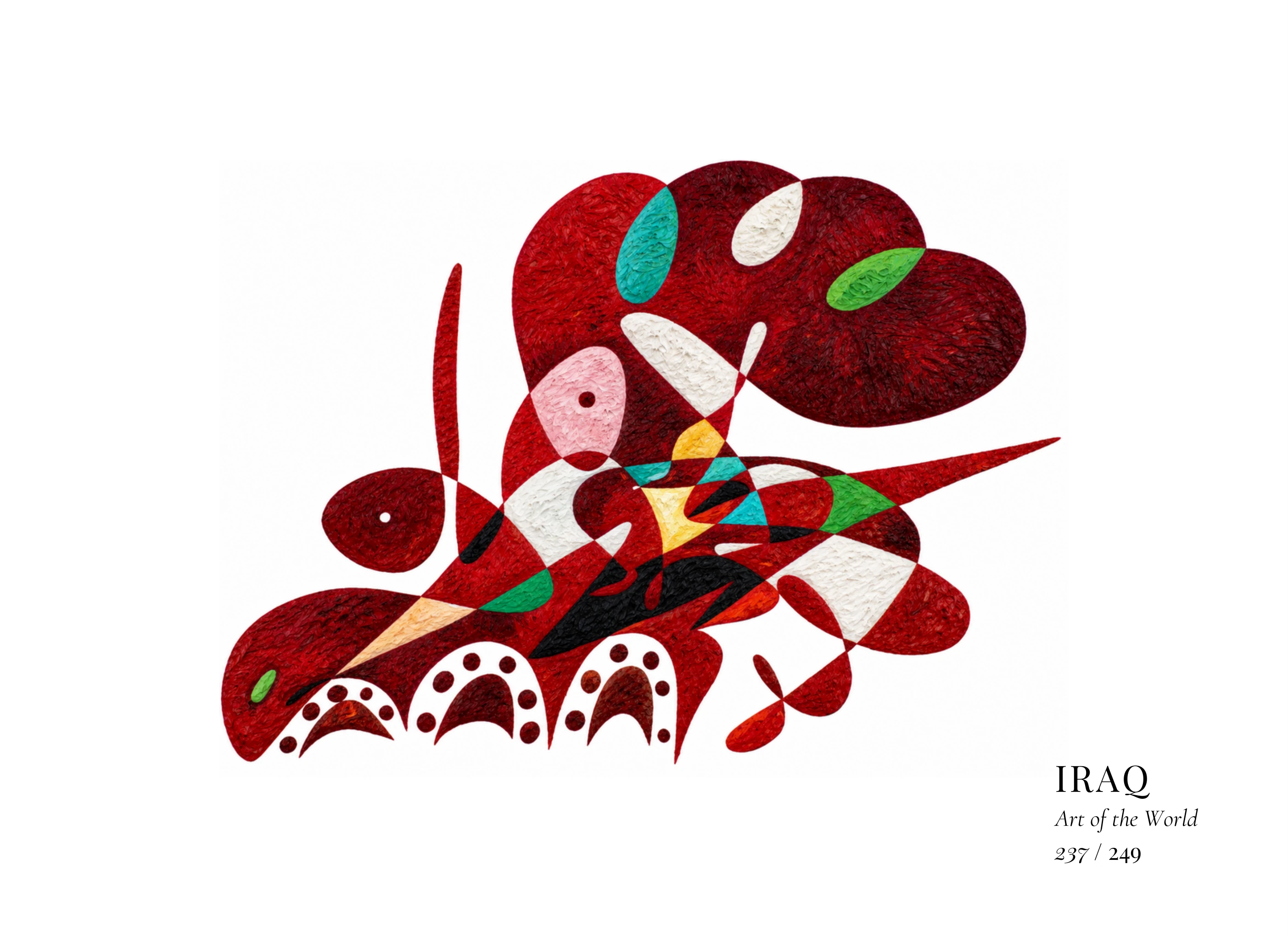
Description
The artwork is dominated by deep crimson and burgundy, its dense impasto creating a surface of unusual physical intensity. Large rounded masses gather above a more fragmented central structure, where white, black, green, turquoise and yellow intersect in compressed geometric passages. Long pointed extensions drive the composition horizontally and vertically, while smaller detached forms create pauses within the surrounding white space. Along the lower edge, repeated white arches punctuated by dark red circles establish a striking visual rhythm. The tension between monumental curves and fractured internal geometry suggests accumulated historical layers—continuity repeatedly interrupted, reorganised and carried forward.
Cultural Context
Iraq lies at the heart of Mesopotamia, shaped by the Tigris and Euphrates and extending from northern mountains to southern marshlands and desert. Here arose Sumerian, Akkadian, Babylonian and Assyrian civilisations, followed by Persian, Hellenistic and Islamic rule. Baghdad became a major intellectual centre under the Abbasid Caliphate. After Ottoman rule and the British mandate, Iraq became independent in 1932; its modern history has been marked by political upheaval, war and reconstruction.
Iraq’s culture encompasses Arab, Kurdish, Turkmen, Assyrian and other communities, with Arabic and Kurdish as official languages. Its inheritance includes ancient sculpture and architecture, Islamic calligraphy, manuscript illumination, poetry, music, weaving and metalwork. Baghdad, Mosul, Basra, Najaf and other centres have contributed distinct religious, literary and artistic traditions to a culturally plural society.