124 / 249
Israel
Layers of Land and Memory
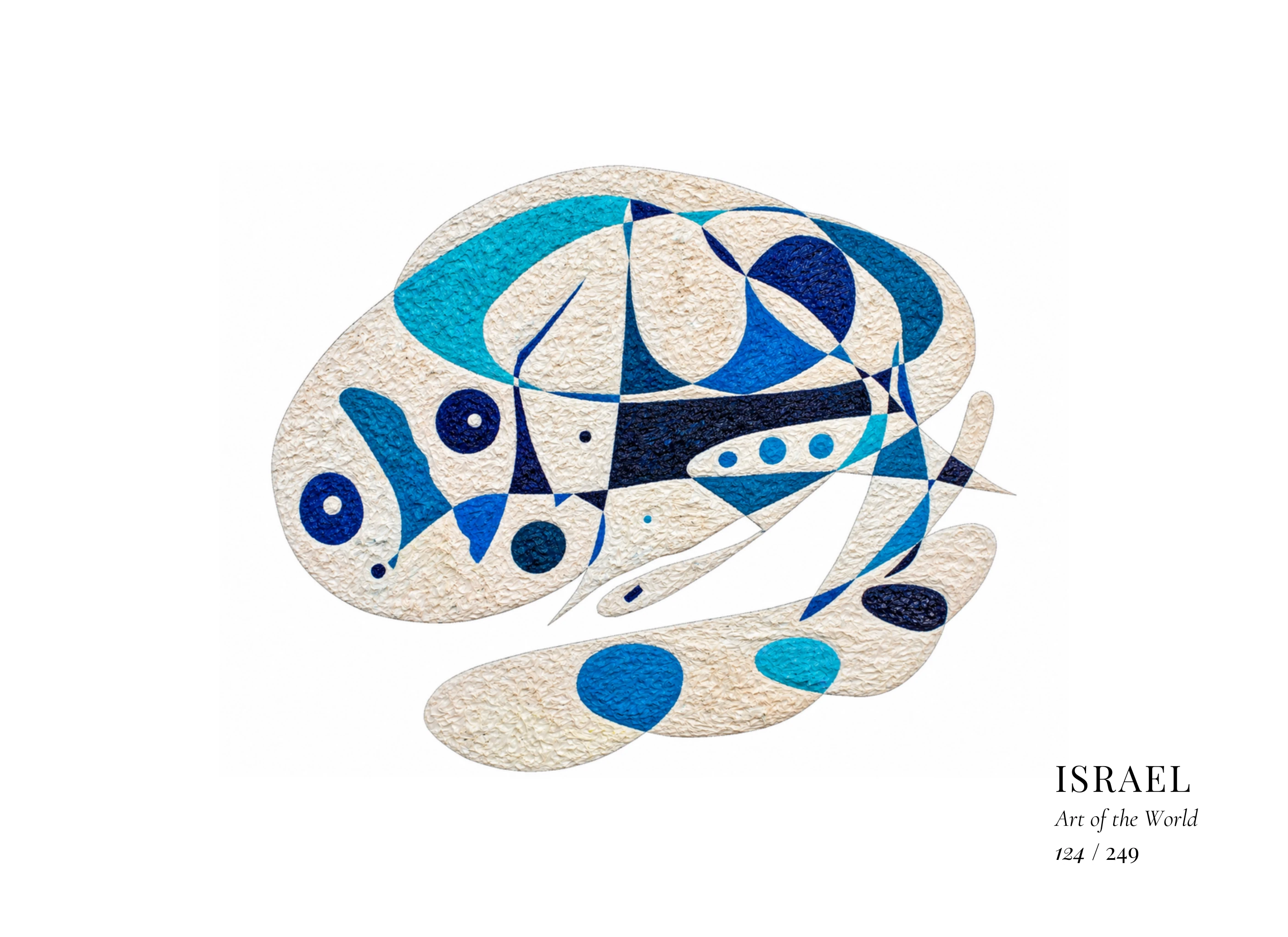
Description
The artwork is dominated by ivory-white impasto crossed by an intricate spectrum of blues, from turquoise to deep navy. Large rounded forms overlap with crescents, circles, pointed triangles and narrow linear extensions, producing a composition that feels simultaneously expansive and tightly interlocked. A dark horizontal band anchors the upper mass, while a separate elongated form below introduces a second visual register. Circular elements recur across both sections, creating rhythm amid the shifting geometry. The tension between enclosed shapes, crossings and open white intervals suggests a landscape of proximity and division, while the layered structure evokes histories and communities occupying the same complex field of memory.
Cultural Context
Israel lies on the eastern Mediterranean, between coastal plains, uplands, the Jordan Valley and the Negev desert. The land has been central to Jewish history and religion since antiquity and is also deeply significant to Christianity and Islam. After centuries under successive empires, including Ottoman rule and the British Mandate, the State of Israel was established in 1948. Its modern history has been shaped by Jewish immigration, state-building, war, contested borders and the continuing Israeli- Palestinian conflict.
Israeli culture has developed through the meeting of Jewish communities originating in Europe, the Middle East, North Africa and elsewhere, alongside Arab citizens and other communities. Hebrew was revived as a modern spoken language, while Arabic remains culturally important. Literature, music, architecture, design, dance, cinema and contemporary art reflect a society formed through migration, inherited traditions and intense encounters between different histories.