138 / 249
Japan
Rhythms of Continuity and Change
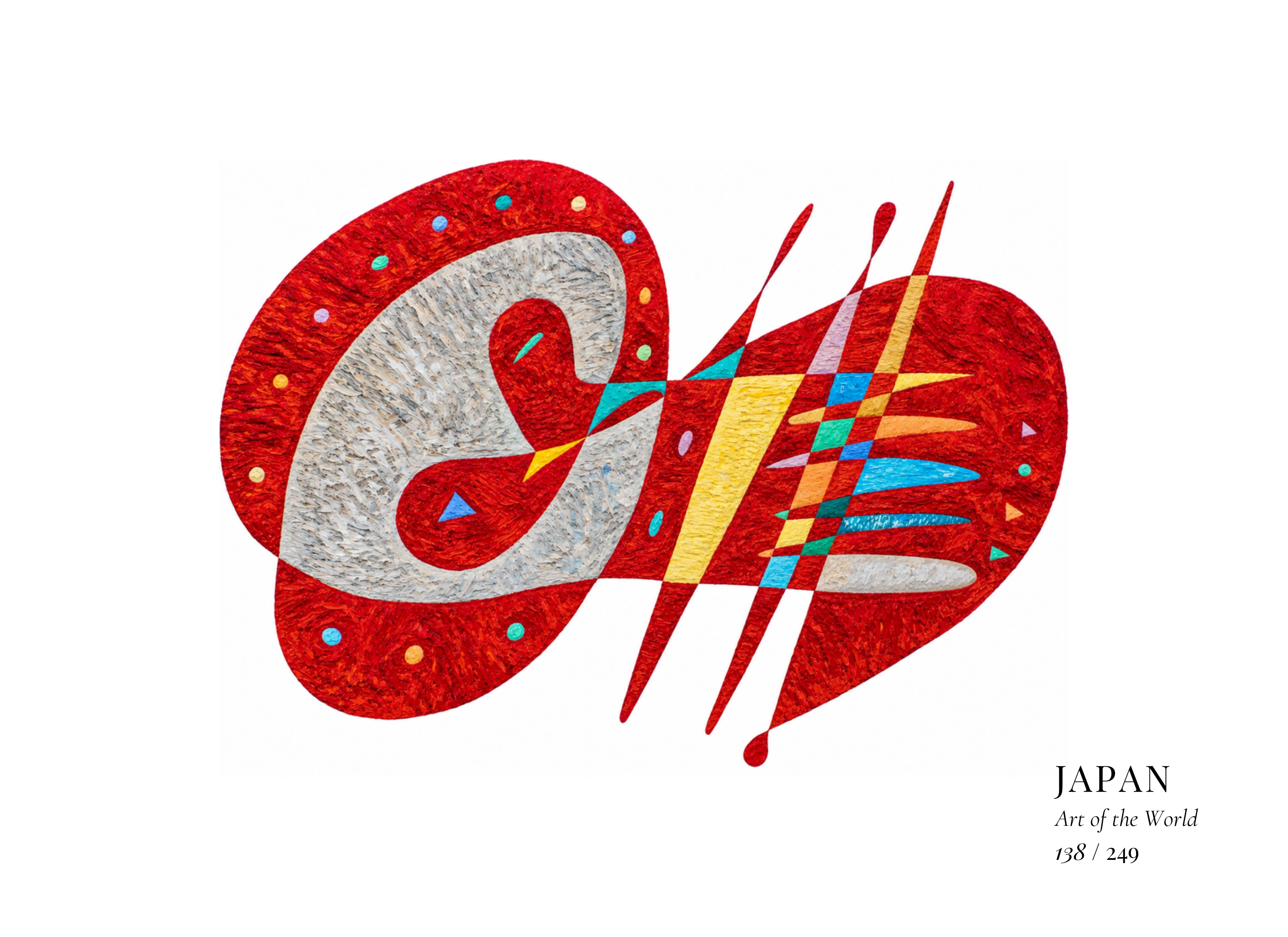
Description
The artwork is driven by a brilliant red field divided into two broad interconnected masses. On the left, a large grey-white enclosure surrounds curling red forms, creating a concentrated spiral movement punctuated by small coloured circles and triangles. The right becomes more linear: yellow, turquoise, blue, green and pale violet bands intersect with sharp horizontal projections and slender vertical extensions. Heavy impasto gives the entire structure tactile intensity, while the surrounding white space emphasises its sweeping silhouette. The contrast between the inward-turning left section and the directional geometry of the right suggests a visual dialogue between continuity and transformation, order and energetic change.
Cultural Context
Japan is an island country in East Asia, stretching across a mountainous volcanic archipelago in the Pacific. Its history developed through ancient court culture, Buddhist influence, warrior governments and long periods of regional rule before political consolidation under the Tokugawa shogunate. The Meiji Restoration of 1868 accelerated industrialisation and international engagement. Following the destruction of the Second World War, Japan rebuilt as a democratic state and became a major economic and cultural power.
Japanese culture combines enduring traditions with continual reinvention. Shinto and Buddhist practices coexist within a rich heritage of temple architecture, gardens, ceramics, lacquerware, calligraphy, woodblock printing and textile arts. Poetry, theatre, tea culture and craftsmanship remain influential, while architecture, cinema, photography, manga, animation, fashion and design have given modern Japan an exceptional international cultural presence.