174 / 249
Jordan
Desert Crossroads, Enduring Paths
Description
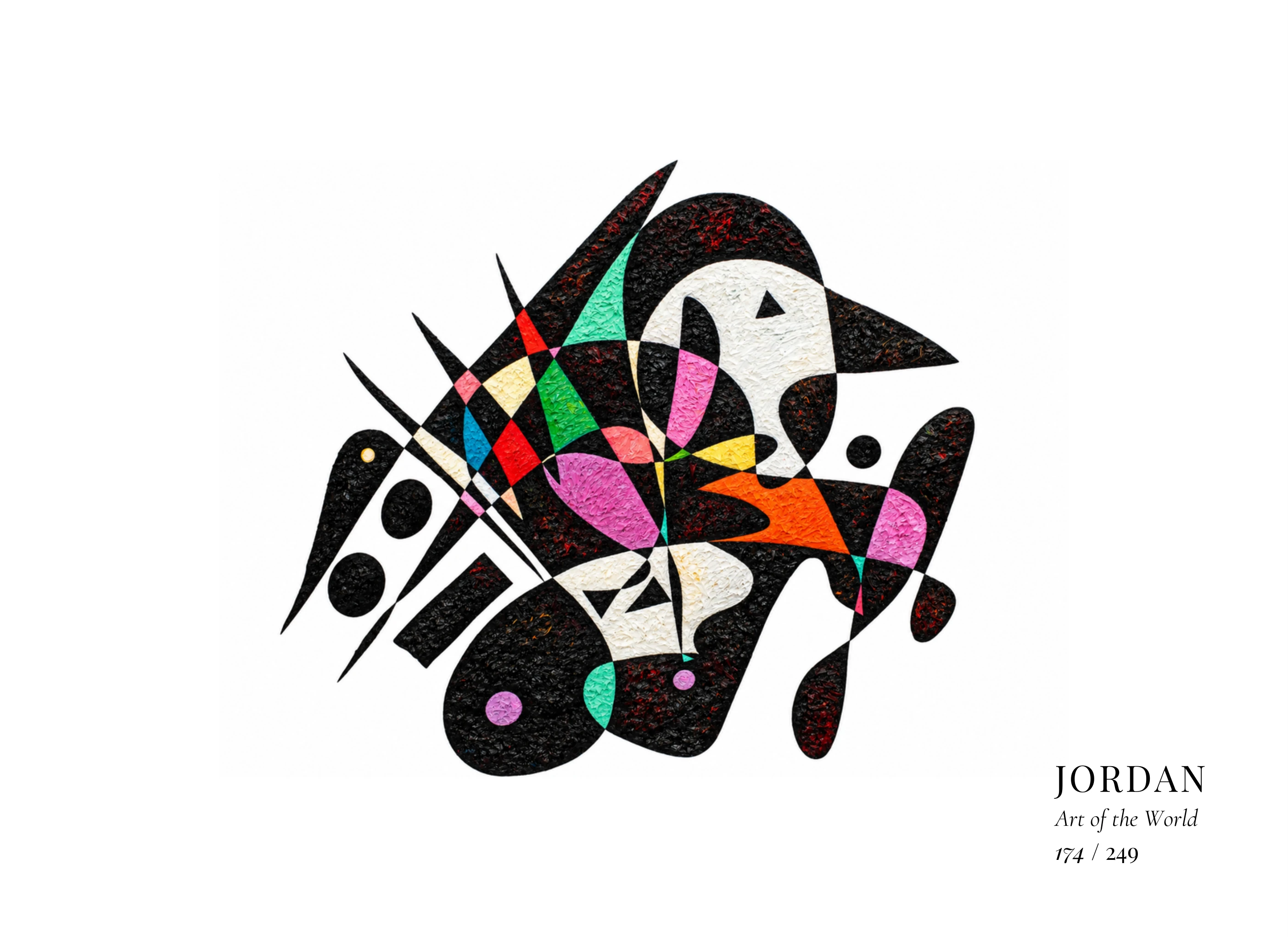
The artwork is anchored by dense black and deep burgundy impasto, dramatically interrupted by white, pink, orange, turquoise and green. Sharp spear-like projections radiate from the left and upper edges, while broad curved masses and narrow intersecting bands compress movement towards the centre. White passages cut through the darker structure, creating powerful negative spaces, and several detached black ovals establish a secondary rhythm around the main silhouette. Angular compartments coexist with softer loops and rounded forms, producing tension between enclosure and outward movement. The composition suggests a landscape of crossings and converging routes, evoking Jordan’s long history as a meeting ground between desert, settled communities and neighbouring cultural worlds.
Cultural Context
Jordan lies at the meeting point of the Levant and Arabian Peninsula, encompassing desert plateaux, the Jordan Valley and the shores of the Dead Sea. Its territory preserves traces of ancient Ammon, Moab and Edom, the Nabataean kingdom centred on Petra, and later Roman, Byzantine and Islamic civilisations. Incorporated into the Ottoman Empire for centuries, modern Jordan emerged under the Hashemite monarchy and became independent in 1946.
Jordanian culture is predominantly Arab and Arabic-speaking, enriched by Bedouin traditions and communities including Circassians, Chechens and Armenians. Poetry, oral storytelling and hospitality remain important cultural practices. Petra’s rock-cut architecture, desert archaeological sites, mosaics, embroidery, weaving and traditional crafts coexist with contemporary literature, music, cinema and design, reflecting a society shaped by both regional continuity and successive migrations.