136 / 249
Kazakhstan
Steppe, Sky and Expanding Horizons
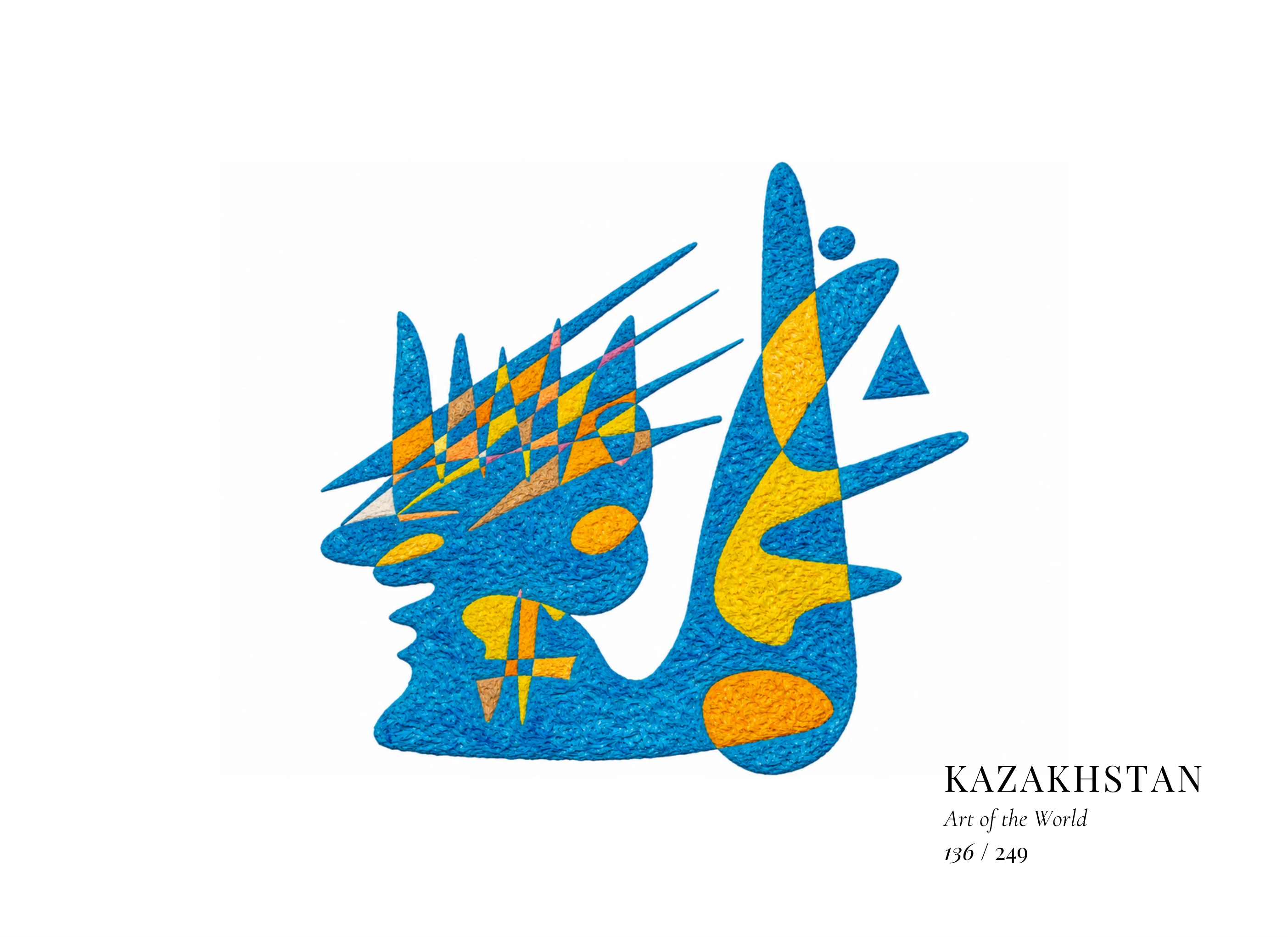
Description
The artwork is dominated by an intense field of blue, animated by yellow, ochre, orange and smaller passages of pink, beige and white. Dense impasto gives the broad silhouette a strongly tactile surface. On the left, repeated pointed forms and long diagonal extensions create a fast, almost wind-driven rhythm, crossed by a lattice of coloured geometric sections. To the right, a tall vertical structure rises dramatically, containing large yellow shapes and projecting blue arms. Detached circular and triangular elements heighten the surrounding white space. The combination of broad openness, upward thrust and sweeping horizontal movement suggests the scale and expansive horizons of the steppe, while the interwoven geometry evokes histories of movement, exchange and cultural continuity.
Cultural Context
Kazakhstan stretches from the Caspian Sea to the Altai Mountains across the immense Eurasian steppe. For centuries its territory connected nomadic societies with Silk Road networks linking Central Asia, China and Europe. Kazakh political identity emerged from Turkic and Mongol traditions and the Kazakh Khanate, before incorporation into the Russian Empire and later the Soviet Union. Kazakhstan became independent in 1991.
Kazakh culture is rooted in traditions of pastoral nomadism while reflecting a diverse modern population. Kazakh and Russian are widely spoken, and Islam is the majority religion. Epic poetry, oral storytelling, the music of the dombra, felt-making, embroidery, jewellery and the richly decorated yurt preserve important forms of cultural memory. Contemporary architecture, literature, cinema and visual art extend these traditions into an increasingly urban society.