193 / 249
Kyrgyzstan
Mountain Paths, Nomadic Memory
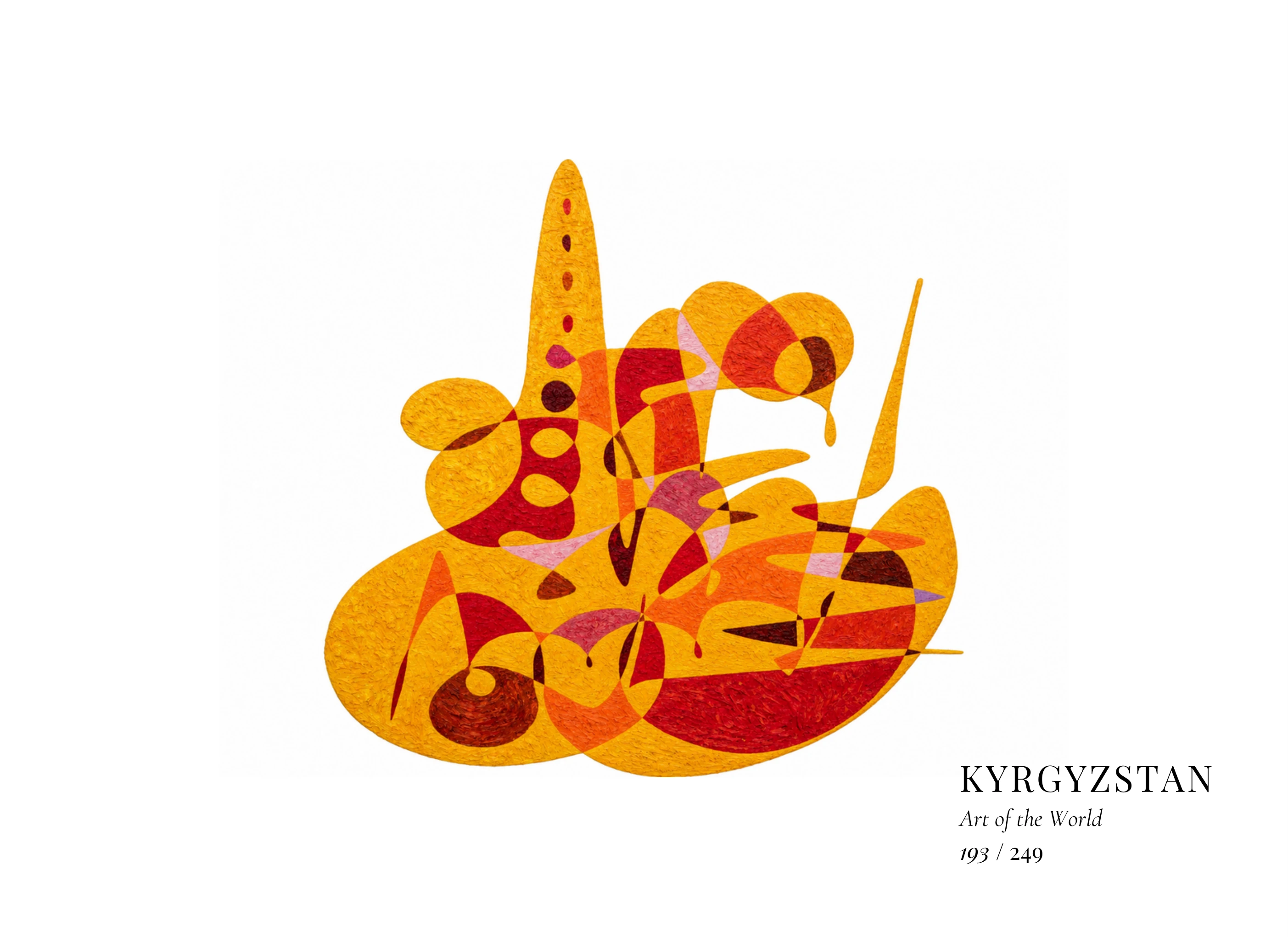
Description
The artwork is saturated with golden yellow, enriched by crimson, orange, burgundy, pink and earthy brown. Thick impasto gives the broad forms a warm, tactile density. A tall tapered element rises dramatically at the left, while rounded lobes, looping curves and narrow extensions generate movement across the upper composition. Below, larger circular and crescent-like masses overlap with sharp triangular divisions and elongated points. Small coloured ovals punctuate the surface like rhythmic accents. The balance between sweeping curves and upward projections suggests openness and elevation, while the interconnected geometry evokes movement through a mountainous landscape and the persistence of nomadic cultural memory.
Cultural Context
Kyrgyzstan lies in the heart of Central Asia, dominated by the Tian Shan mountains, high valleys and alpine lakes. Its history was shaped by nomadic Turkic peoples, Silk Road exchange and successive regional powers before incorporation into the Russian Empire and later the Soviet Union. Independence in 1991 established the modern Kyrgyz Republic, whose geography continues to influence settlement, movement and cultural identity.
Kyrgyz culture retains a strong inheritance of pastoral nomadism. The Kyrgyz language, oral poetry and the monumental Epic of Manas occupy central places in national memory. Felt-making, embroidered textiles, patterned carpets, leatherwork and the construction of yurts preserve sophisticated traditions of portable craftsmanship. Music performed on instruments such as the komuz accompanies an enduring culture of storytelling, hospitality and horsemanship.