102 / 249
Laos
River, Mountain and Living Memory
Description
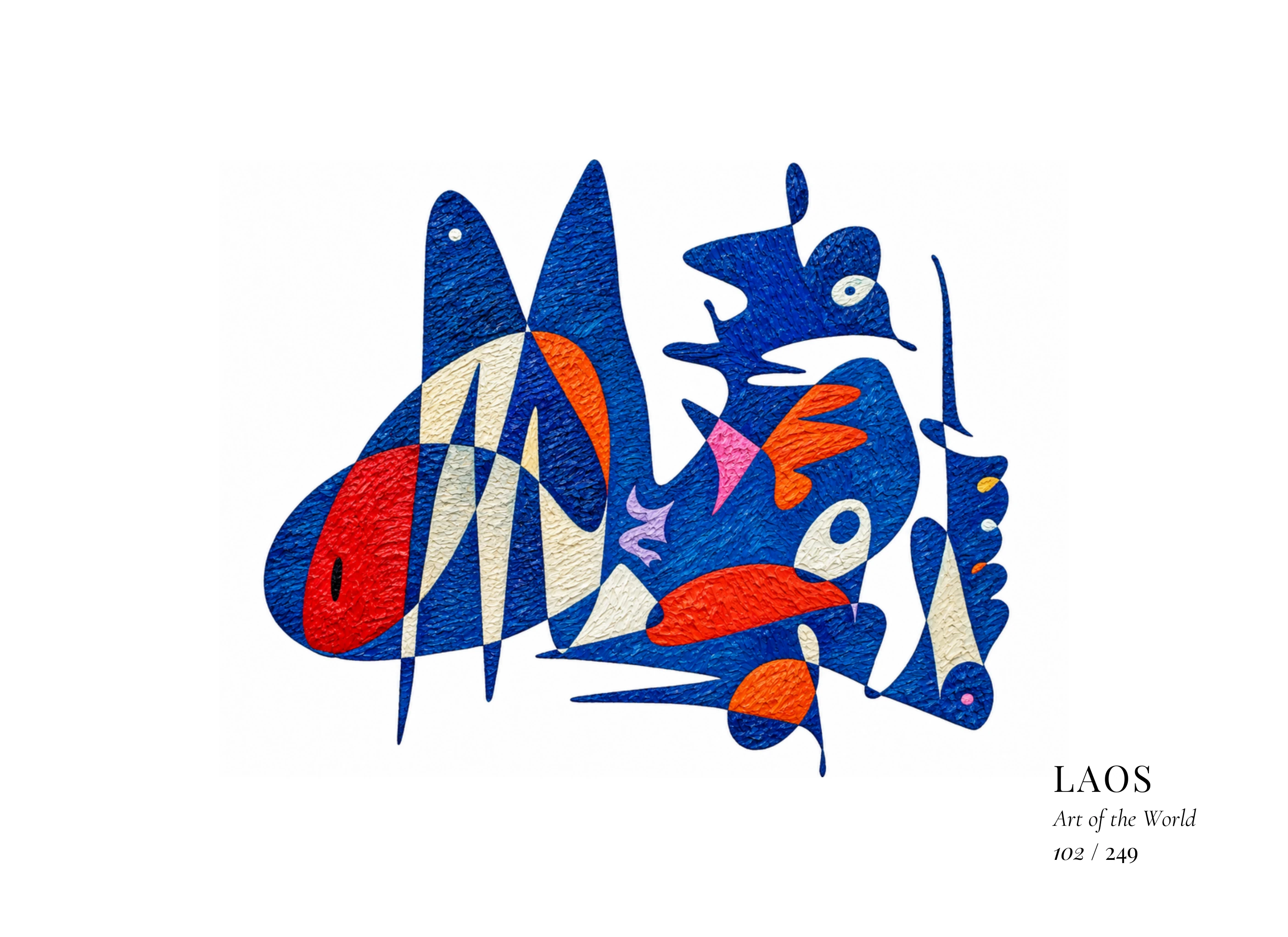
The artwork is dominated by deep cobalt blue, broken by vivid red, orange, white and smaller passages of pink and violet. Dense impasto gives the irregular forms a strongly tactile presence. Tall pointed structures rise on the left, crossed by narrow white divisions and an orange arc, while the centre and right unfold through fragmented, almost creature-like silhouettes, sharp projections and enclosed circular forms. A slender detached element at the far right creates a separate vertical rhythm. The balance between clustered masses and generous white openings suggests movement through a landscape of distinct but connected territories, evoking Laos’s mountainous geography, river corridors and cultural plurality.
Cultural Context
Laos is a landlocked country of mainland Southeast Asia, shaped by the Mekong River, forested mountains and fertile valleys. The kingdom of Lan Xang emerged in the fourteenth century and became an important regional power before fragmenting into smaller kingdoms. After incorporation into French Indochina, Laos achieved full independence in 1953. Revolution and regional conflict culminated in the establishment of the Lao People’s Democratic Republic in 1975.
Lao culture is closely associated with Theravada Buddhism, while the country is home to many ethnic and linguistic communities, including Khmu and Hmong peoples. Temple architecture, Buddhist sculpture, mural painting, weaving and intricate textiles form an important visual inheritance. Oral traditions, festivals and music centred on the khaen, a bamboo mouth organ, remain distinctive expressions of communal and regional identity.