181 / 249
Lebanon
Between Mountain and Mediterranean
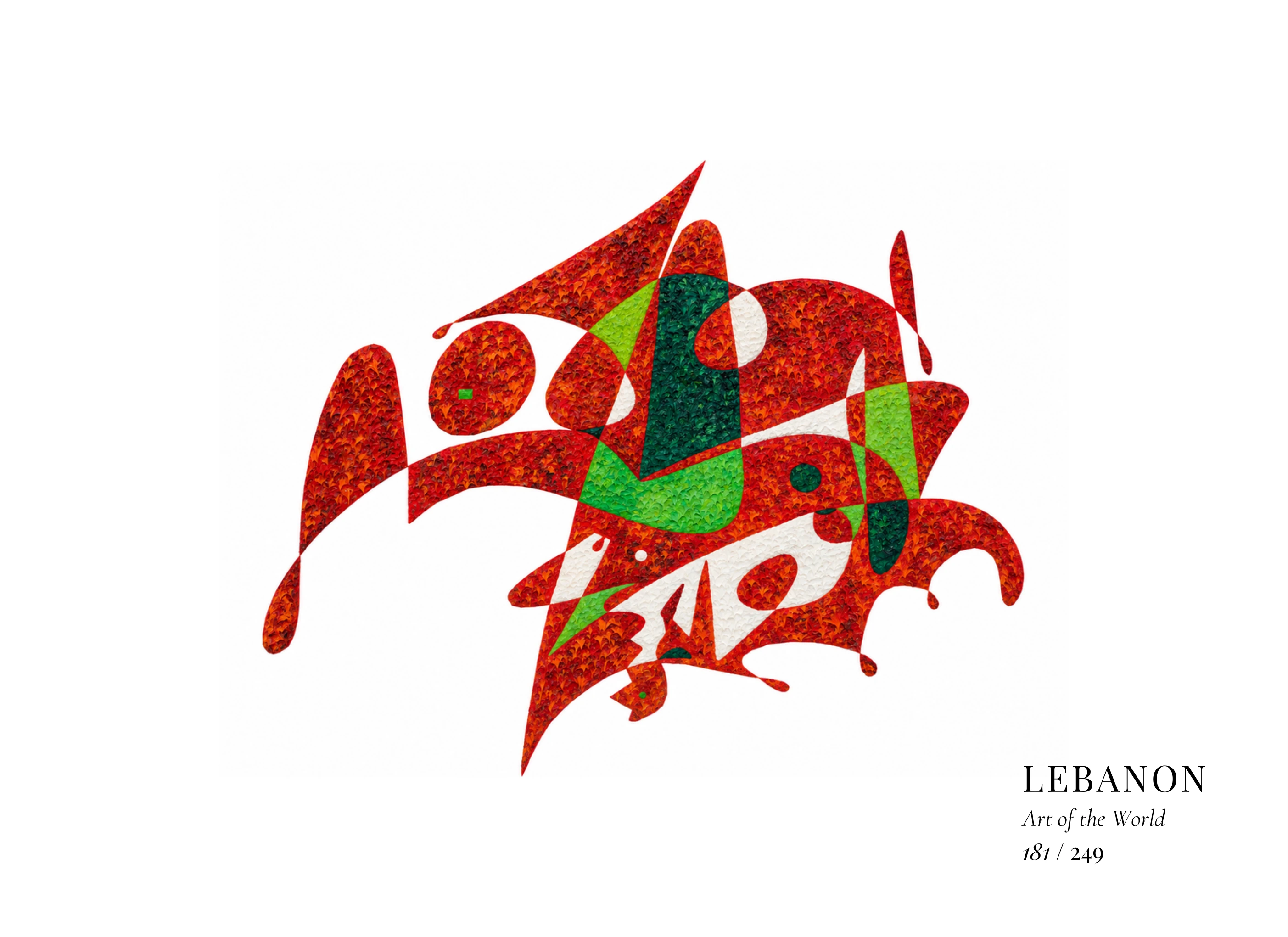
Description
The artwork is dominated by fiery red and orange impasto, interrupted by vivid greens, deep teal and sharply defined white passages. Its silhouette expands through pointed projections, suspended forms and curling extensions, producing an energetic balance between fragmentation and connection. A dark green vertical mass anchors the centre, while brighter green curves move across it and white channels open through the lower structure. Detached shapes on the left create deliberate intervals of white space. The combination of concentrated density, separation and renewed connection suggests a visual memory shaped by resilience and plurality, evoking Lebanon’s compressed geography and its layered histories without resolving them into a single form.
Cultural Context
Lebanon occupies a narrow Mediterranean coast framed by the Lebanon and Anti-Lebanon mountain ranges and the fertile Bekaa Valley. Its ancient cities were important centres of Phoenician maritime trade, followed by Roman, Byzantine, Arab, Ottoman and other periods of rule. The modern Lebanese state emerged under the French Mandate and gained independence in 1943. Civil war from 1975 to 1990, regional conflicts and subsequent political and economic crises have profoundly shaped its recent history.
Lebanon’s cultural identity reflects Arabic traditions alongside Christian, Muslim and other religious communities. Arabic is the official language, while French and English are widely used. Beirut has long been an influential centre of publishing, literature, music, theatre and visual art. Ancient architecture, religious monuments, embroidery, woodwork and craft traditions coexist with a modern cultural life shaped by migration and a large Lebanese diaspora.