24 / 249
Macao
Where Maritime Worlds Converge
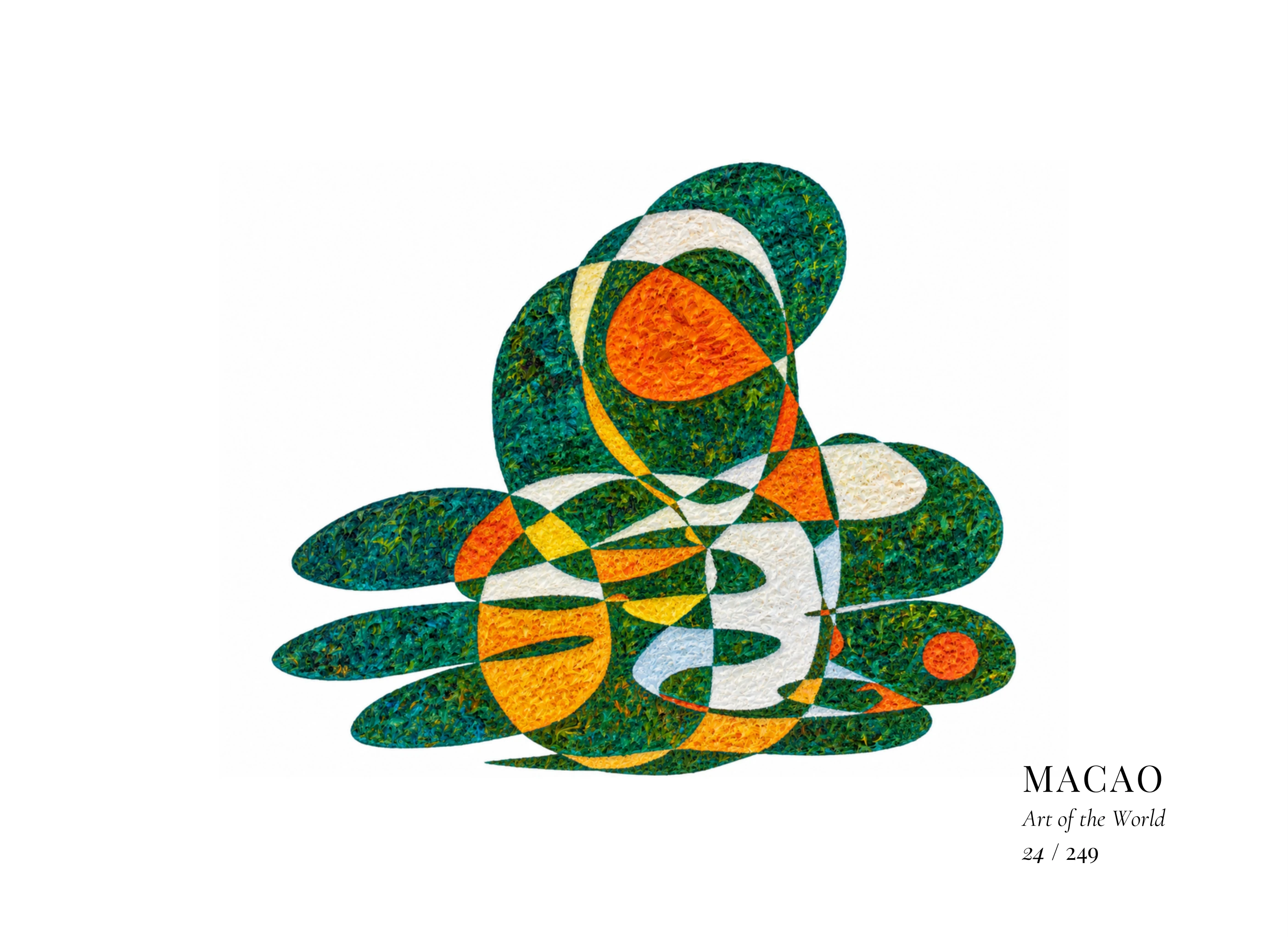
Description
The artwork is dominated by deep emerald and blue-green impasto, illuminated by orange, yellow and broad passages of textured white. Rounded masses overlap in a compact structure, while the centre becomes increasingly intricate through intersecting curves, narrow divisions and angular fragments. A large orange form anchors the upper section, balanced by golden shapes below and smaller orange accents towards the right. Long horizontal extensions spread outward from the dense centre, creating a strong contrast between concentration and expansion. The interlocking geometry suggests exchange rather than separation: distinct colours repeatedly cross, overlap and reappear, evoking Macao’s history as a compact meeting place shaped by maritime movement and enduring cultural convergence.
Cultural Context
Macao occupies a small territory on the southern coast of China, at the western side of the Pearl River estuary. Once a significant port linking China with maritime routes across Asia and Europe, it developed under Portuguese administration from the sixteenth century. Sovereignty was transferred to China in 1999, when Macao became a Special Administrative Region. Its compact urban landscape preserves traces of centuries of commercial and cultural exchange.
Chinese culture, particularly Cantonese traditions, forms the foundation of Macao’s identity, interwoven with a distinctive Portuguese and Macanese inheritance. Cantonese and Portuguese are official languages. Buddhist and Chinese folk temples stand alongside Catholic churches, while architecture, religious festivals, cuisine and decorative arts reveal sustained cultural interaction. Historic streets and public spaces retain an unusual mixture of southern Chinese and European forms.