133 / 249
Malaysia
Peninsula and Archipelago, Cultures in Confluence
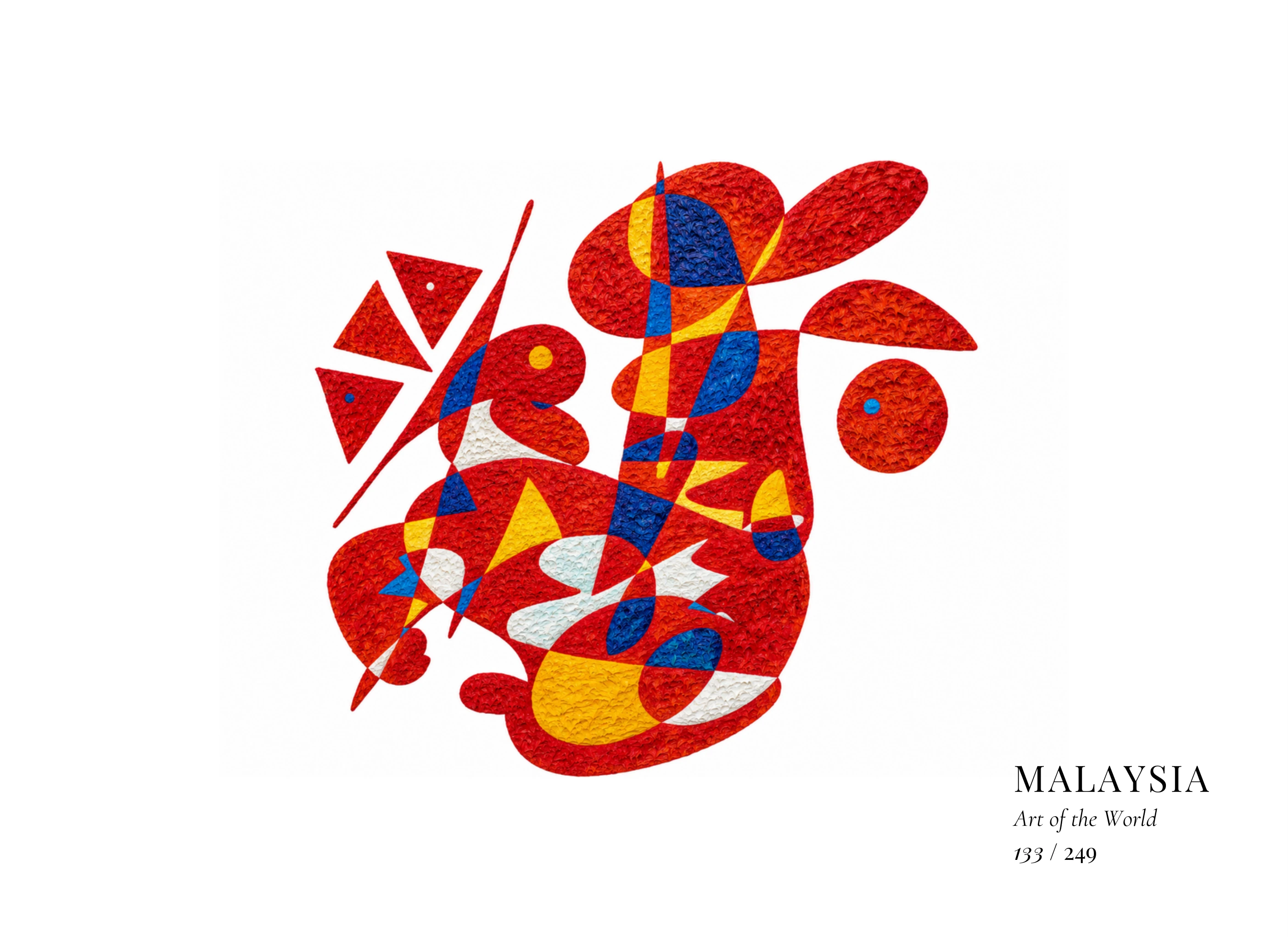
Description
The artwork is animated by a dominant red-orange field, punctuated by brilliant yellow, cobalt blue and textured white. Rounded masses intersect with sharp triangles, elongated points and narrow vertical bands, producing a lively alternation between enclosure and expansion. At the left, detached triangular elements and a sweeping diagonal introduce movement through the surrounding white space; elsewhere, circles and curved compartments create quieter internal rhythms. Dense impasto binds these contrasting geometries into a single energetic surface. The coexistence of separated and interlocking forms suggests Malaysia’s geography across peninsula and Borneo, while the layered colours evoke a society in which distinct cultural traditions meet, overlap and remain visibly individual.
Cultural Context
Malaysia spans the Malay Peninsula and northern Borneo, divided by the South China Sea and shaped by tropical forests, mountains and long maritime coastlines. Its strategic position connected it for centuries to Indian Ocean and East Asian trade, while the Malacca Sultanate became an influential centre of commerce and Islam. Portuguese, Dutch and British colonial periods followed. The Federation of Malaya gained independence in 1957, and Malaysia was formed in 1963.
Malaysia’s identity reflects Malay, Chinese, Indian, Indigenous and other cultural traditions. Malay is the national language, while numerous Chinese, Indian and Indigenous languages remain part of everyday life. Islamic architecture, mosques and royal arts coexist with Buddhist and Hindu traditions, while batik, songket weaving, woodcarving, metalwork, shadow theatre, music and contemporary design express the country’s cultural plurality.