206 / 249
Maldives
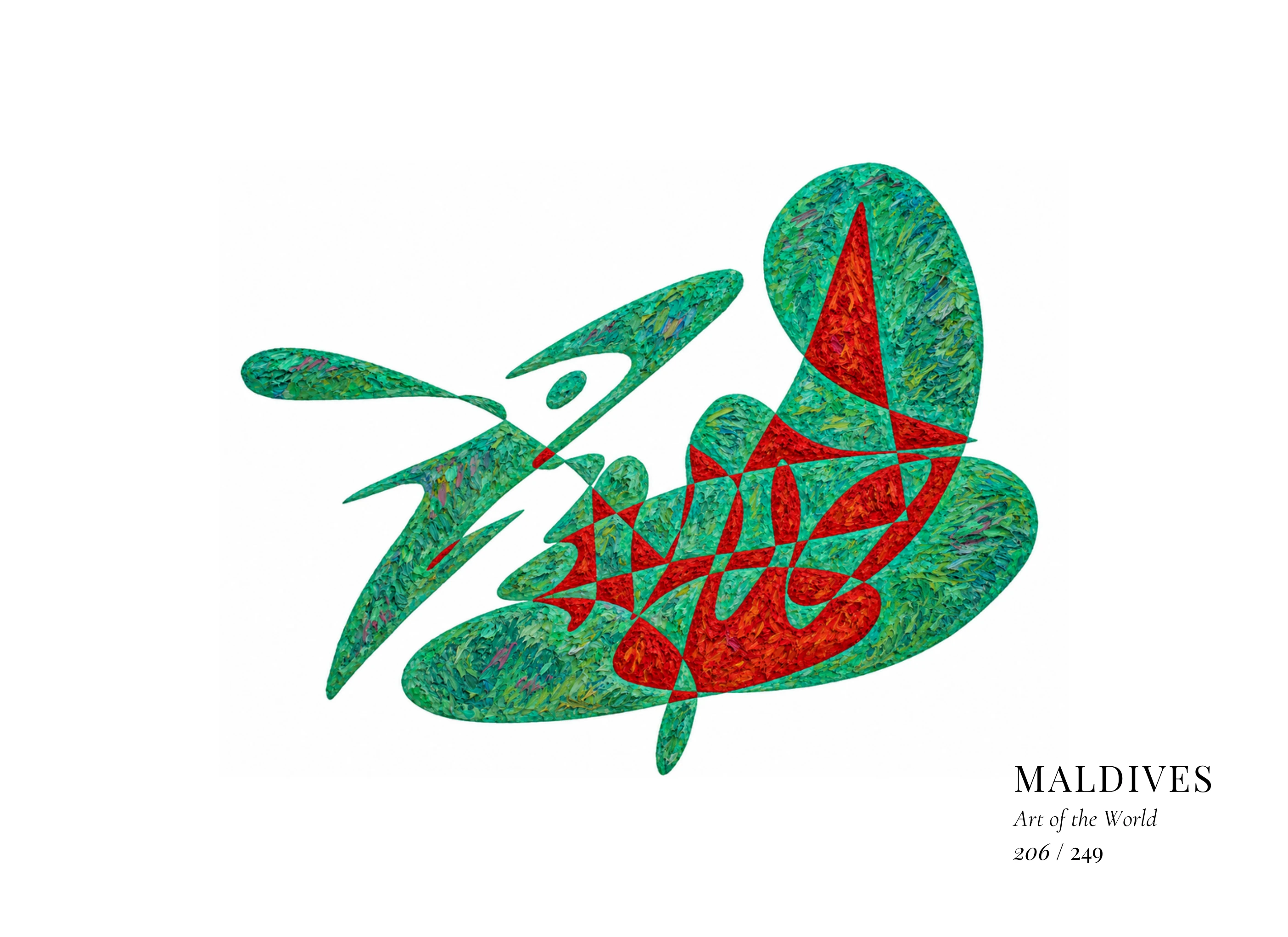
Islands Held by the Ocean
Description
The artwork is dominated by luminous turquoise and sea-green impasto, crossed by concentrated passages of crimson and orange-red. Large rounded forms gather on the right, where red triangles, arcs and interlocking divisions create a dense internal structure. To the left, elongated shapes separate and extend into generous white space, accompanied by smaller floating elements. Their dispersed rhythm contrasts with the compact central mass. The composition suggests an archipelagic geography: individual forms appear separated yet visually connected, while the pervasive blue-green field evokes the powerful presence of ocean surrounding limited areas of land.
Cultural Context
The Maldives forms a chain of coral atolls across the Indian Ocean, south-west of Sri Lanka and India. Its history has been shaped by maritime exchange linking South Asia, Arabia and East Africa. Buddhism preceded the adoption of Islam in the twelfth century, which became central to Maldivian identity. After periods of Portuguese intervention and British protection, the country became independent in 1965. Its low-lying geography makes the relationship between land and sea fundamental to national life.
Dhivehi language and Islamic traditions are central to Maldivian culture. Centuries of seafaring have shaped boatbuilding, navigation, fishing and forms of communal life adapted to small islands. Coral-stone architecture, lacquer work, mat weaving, poetry and bodu beru drumming belong to a distinctive cultural inheritance, while contemporary life increasingly connects island traditions with tourism and global exchange.