103 / 249
Mongolia
Horizons of the Eternal Steppe
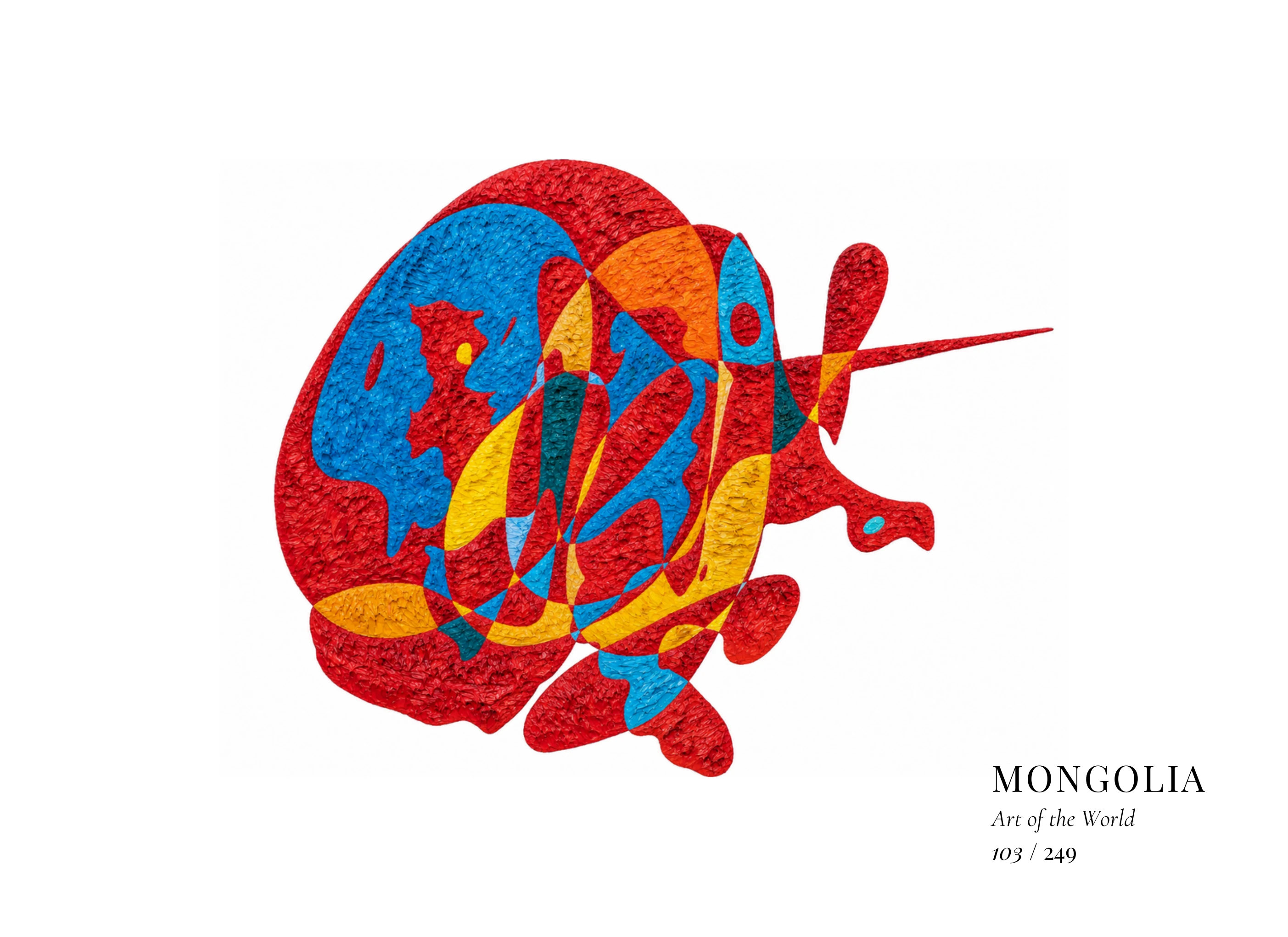
Description
The artwork is dominated by intense red, crossed by brilliant blue, yellow, orange and smaller areas of deep turquoise. Heavy impasto gives the broad rounded silhouette a vigorous physical density. Within it, sweeping blue forms curve around sharp yellow passages and narrow vertical divisions, producing a strong sense of circulation. The composition expands towards the right through a long pointed extension and smaller projecting shapes, while the lower edge breaks into separate rounded forms. Curves repeatedly meet points, and compressed internal geometry contrasts with the surrounding white space. This restless outward movement suggests the scale and mobility of the steppe, while its interconnected forms evoke Mongolia’s enduring relationship between landscape, movement and cultural memory.
Cultural Context
Mongolia lies between Russia and China, a vast land of open steppe, the Gobi Desert, mountains and immense skies. Its history was transformed in the thirteenth century by Chinggis Khan and the Mongol Empire, which created unprecedented connections across Eurasia. Later shaped by Tibetan Buddhism and Qing rule, Mongolia declared independence in the early twentieth century, became a socialist republic in 1924 and made a peaceful transition to democracy after 1990.
Mongolian identity remains strongly connected to pastoral nomadic traditions and the rhythms of seasonal movement. The Mongolian language, epic storytelling, throat singing, the horse-head fiddle and the Naadam traditions of wrestling, archery and horsemanship carry deep cultural significance. Felt-making, embroidery, Buddhist painting and sculpture coexist with contemporary literature, music, cinema and visual art.