89 / 249
North Korea
A Peninsula of Division and Continuity
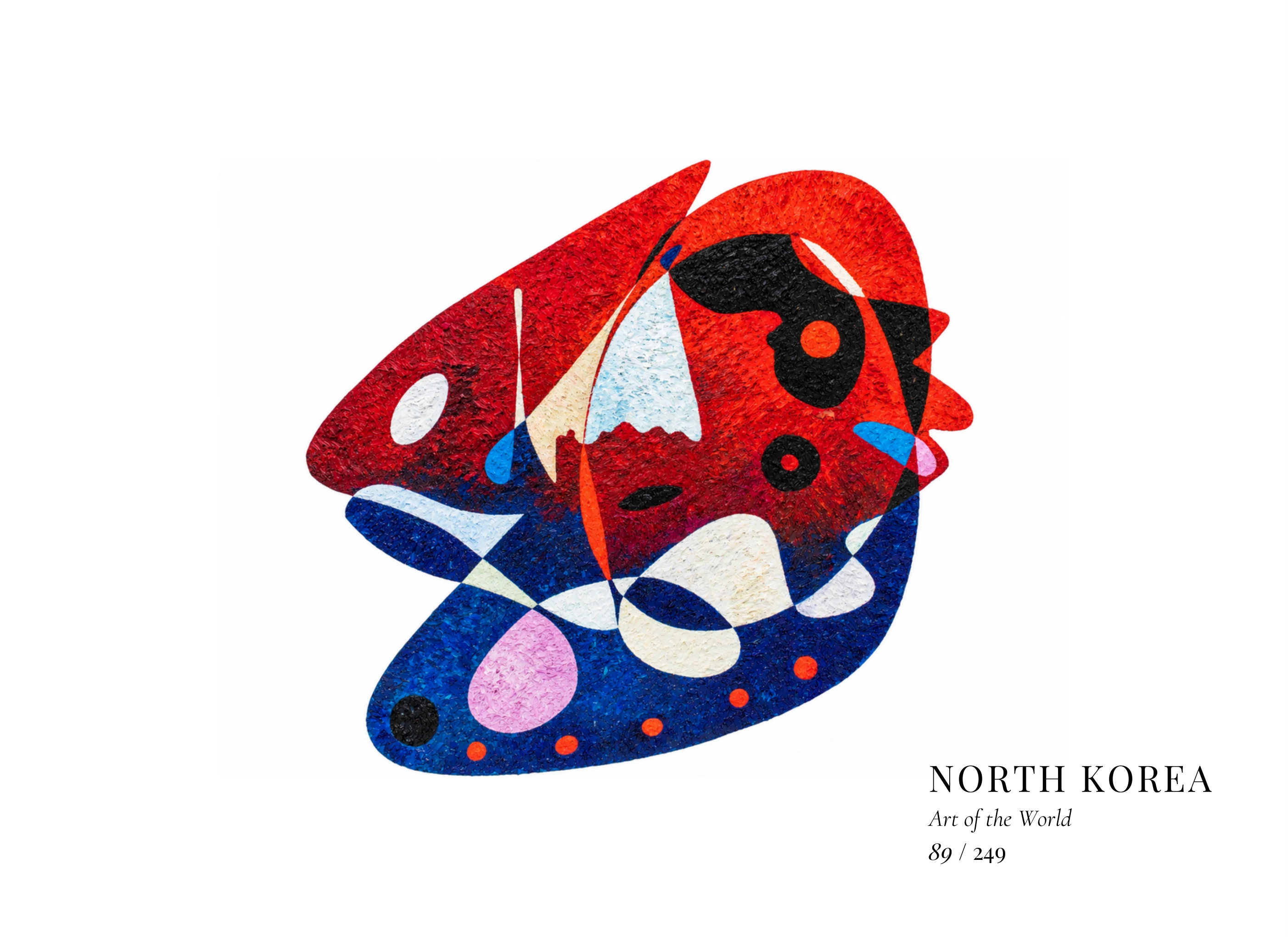
Description
The artwork is structured through a forceful opposition of red and deep blue, interrupted by black, white, pale pink and flashes of turquoise. Dense impasto intensifies the broad enclosing masses, while curved white bands weave through the darker lower section. Above, black circular and angular forms create concentrated points of visual weight against the red field. Sharp vertical divisions, pointed extensions and tightly enclosed shapes contrast with the flowing geometry below. The composition suggests tension between containment and movement, while its interlocked forms and divided colour fields evoke the historical rupture of the Korean Peninsula and the persistence of a deeper cultural continuity.
Cultural Context
North Korea occupies the northern half of the Korean Peninsula, between China, Russia and South Korea, with mountainous interiors and coastal plains facing the Yellow Sea and Sea of Japan. Its history belongs to the wider Korean civilisation shaped by successive kingdoms and dynasties. Following Japanese colonial rule from 1910 to 1945, Korea was divided. The Democratic People’s Republic of Korea was established in 1948, and the Korean War of 1950–53 entrenched a division that continues to define the peninsula.
Korean language and historical traditions remain fundamental to cultural identity. Earlier Buddhist and Confucian influences survive within architecture, ceramics, painting, music and customary practices, although modern cultural production has been extensively directed by the state. Monumental architecture, mass performance, music, cinema and visual arts have often served official narratives, while older forms of craftsmanship and shared Korean heritage precede the twentieth-century political division.