210 / 249
Oman
Monsoon Routes and Desert Horizons
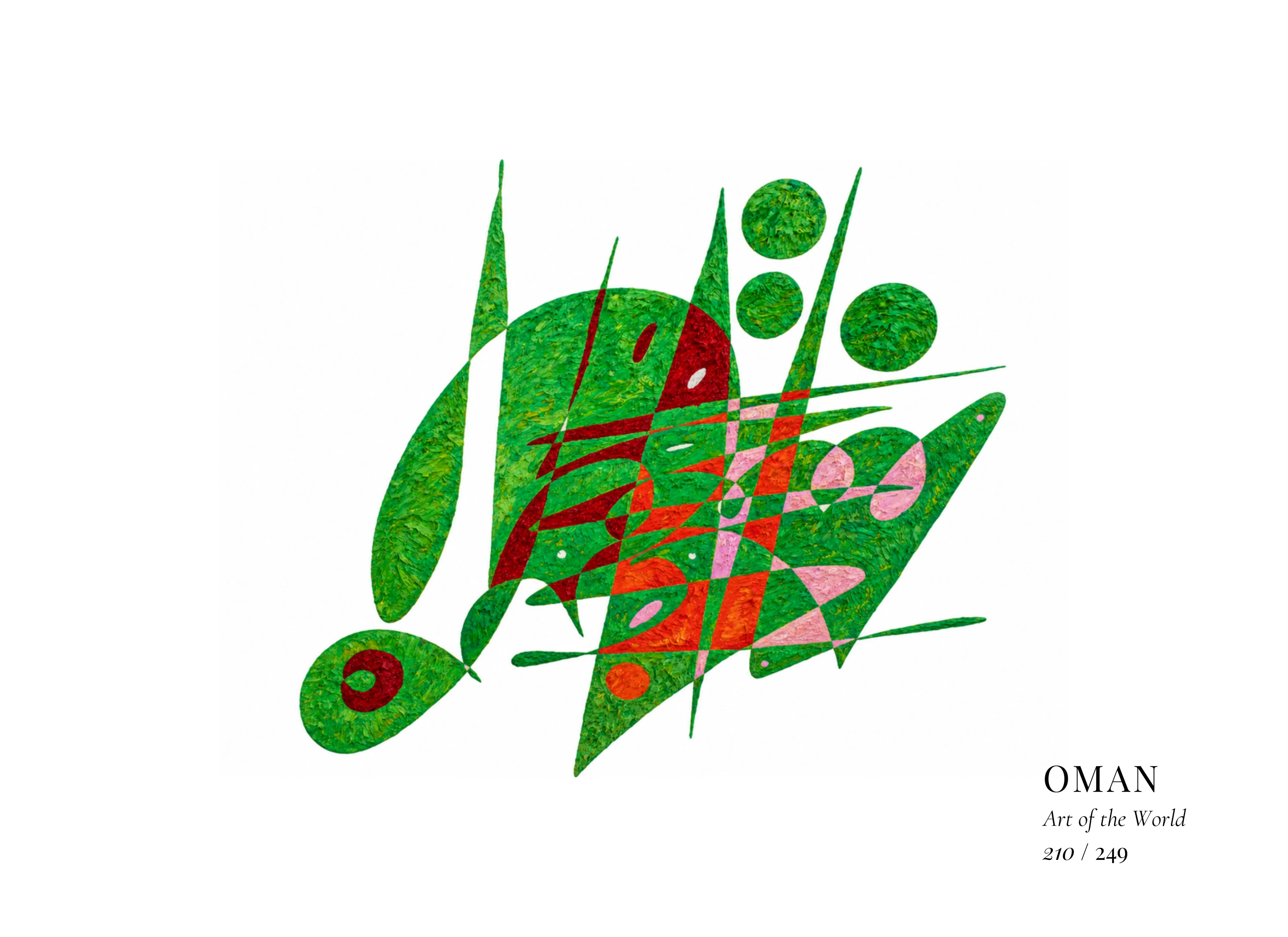
Description
The artwork is saturated with layered greens, crossed by burgundy, burnt orange and soft pink. Dense impasto creates an organic surface, while exceptionally long pointed extensions give the composition a strong directional energy. A compact central network of intersecting bands and angular compartments opens outward into elongated forms, detached circles and a separate rounded element at the lower left. White space flows between these projections, preventing the structure from becoming enclosed. The combination of concentrated geometry and far-reaching lines suggests movement across distance, evoking Oman’s historical position between desert routes and the maritime networks of the Indian Ocean.
Cultural Context
Oman occupies the south-eastern corner of the Arabian Peninsula, where desert interiors and rugged mountains meet long coastlines on the Arabian Sea and Gulf of Oman. Its history has been shaped by maritime trade linking Arabia with India and East Africa, as well as by the enduring influence of Ibadi Islam. Omani seafaring networks once extended across the Indian Ocean, while the modern sultanate underwent rapid development from the later twentieth century.
Omani culture combines Arab, coastal and Indian Ocean influences. Arabic is the official language, alongside several regional languages. Poetry, seafaring traditions, music and dance remain important, while silverwork, pottery, weaving, carved doors and the architecture of forts and settlements reflect highly developed craft traditions. Distinctive regional cultures from Muscat to Dhofar contribute to a varied national identity.