179 / 249
Pakistan
River Civilisations, Mountain Frontiers
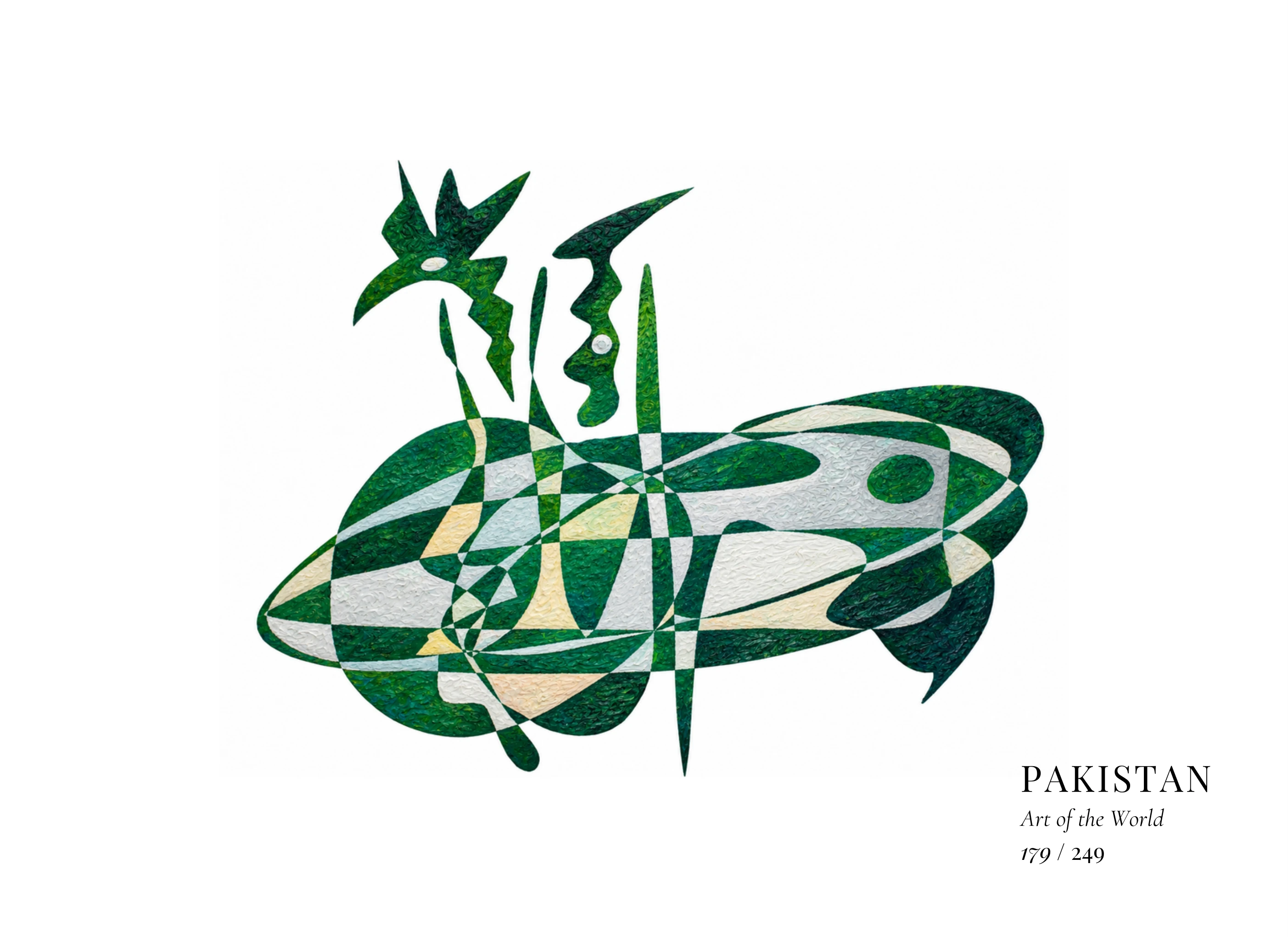
Description
The composition's emerald and forest greens interweave with white and ivory across a broad horizontal structure. Dense impasto strengthens triangular divisions, sweeping curves and narrow vertical lines, while detached pointed forms rise into open white space. The movement between compressed intersections and larger enclosures suggests contrasting landscapes and converging routes. Its separated yet related elements can be read as evoking Pakistan’s regional plurality within a deep and interconnected cultural continuum.
Cultural Context
Pakistan stretches from the Arabian Sea across the Indus plains to the Hindu Kush, Karakoram and Himalayan ranges. Its territory contains major centres of the ancient Indus Valley civilisation and later participated in Persian, Central Asian, Islamic and Mughal worlds. Pakistan emerged as an independent state in 1947, occupying a distinctive position between South, Central and West Asia.
Punjabi, Sindhi, Pashtun, Baloch, Saraiki and many other communities contribute to a culturally plural society. Urdu serves as the national language alongside rich regional literary traditions. Sufi poetry, qawwali, miniature painting, calligraphy, ceramics, textiles and architecture form an extensive artistic inheritance, continually renewed through contemporary literature, cinema, music and design.