125 / 249
Palestine
Between Mediterranean Shore and Ancient Highlands
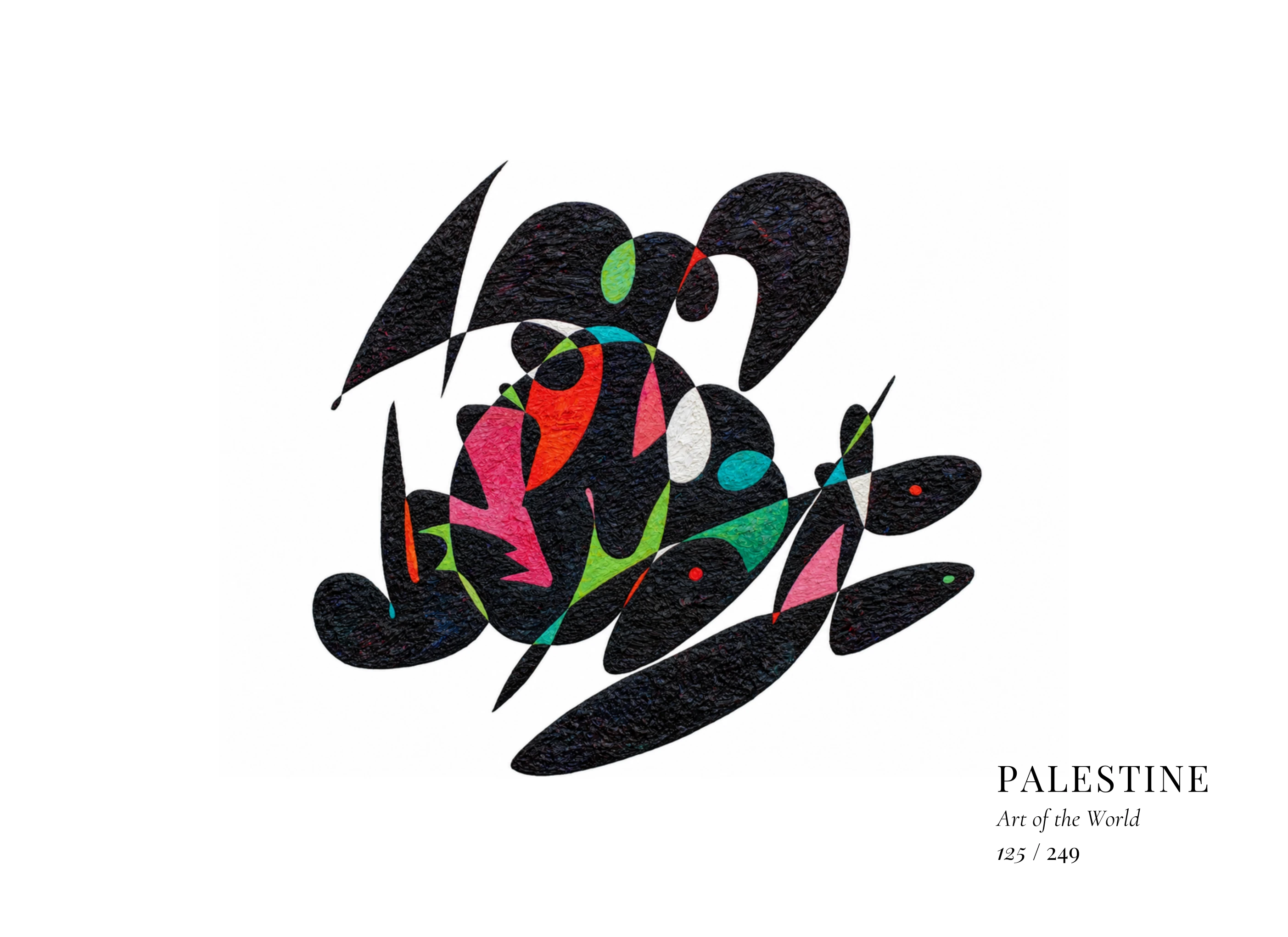
Description
The visual field concentrates dense black impasto around vivid crimson, pink, turquoise, green and white forms. Rounded masses are pierced by sharp extensions, while detached elements occupy the surrounding white space. The contrast between a compressed centre and outward-moving fragments suggests continuity under pressure. Its fractured geometry and brilliant internal colours can be read as an abstract meditation on separation, endurance and memory across distance.
Cultural Context
Palestine occupies a historic eastern Mediterranean landscape of coastal plains, limestone highlands and the Jordan Valley. Shaped by ancient Levantine societies and successive Roman, Byzantine, Islamic, Ottoman and British periods, its modern history has been profoundly marked by the events of 1948, displacement and the continuing Israeli–Palestinian conflict.
Palestinian culture draws strength from Arabic language, family and communal memory, and traditions sustained across towns, villages and the diaspora. Poetry, storytelling, tatreez embroidery, ceramics, architecture, music, cinema and contemporary art form a diverse inheritance in which place, memory and belonging remain enduring themes.
Exhibition Context
Two black headlike or winglike forms meet around red and green pieces, their edges both interlocking and pulling apart. Palestinian histories through Ottoman and British rule, displacement and continuing claims to self-determination make the image's difficult shared space meaningful. An attentive reading need not assign a political actor to each dark form. It can see how an inner colour remains visible through outer pressure and how the body struggles to hold a continuous outline.