4 / 249
Philippines
Archipelago of Crossings
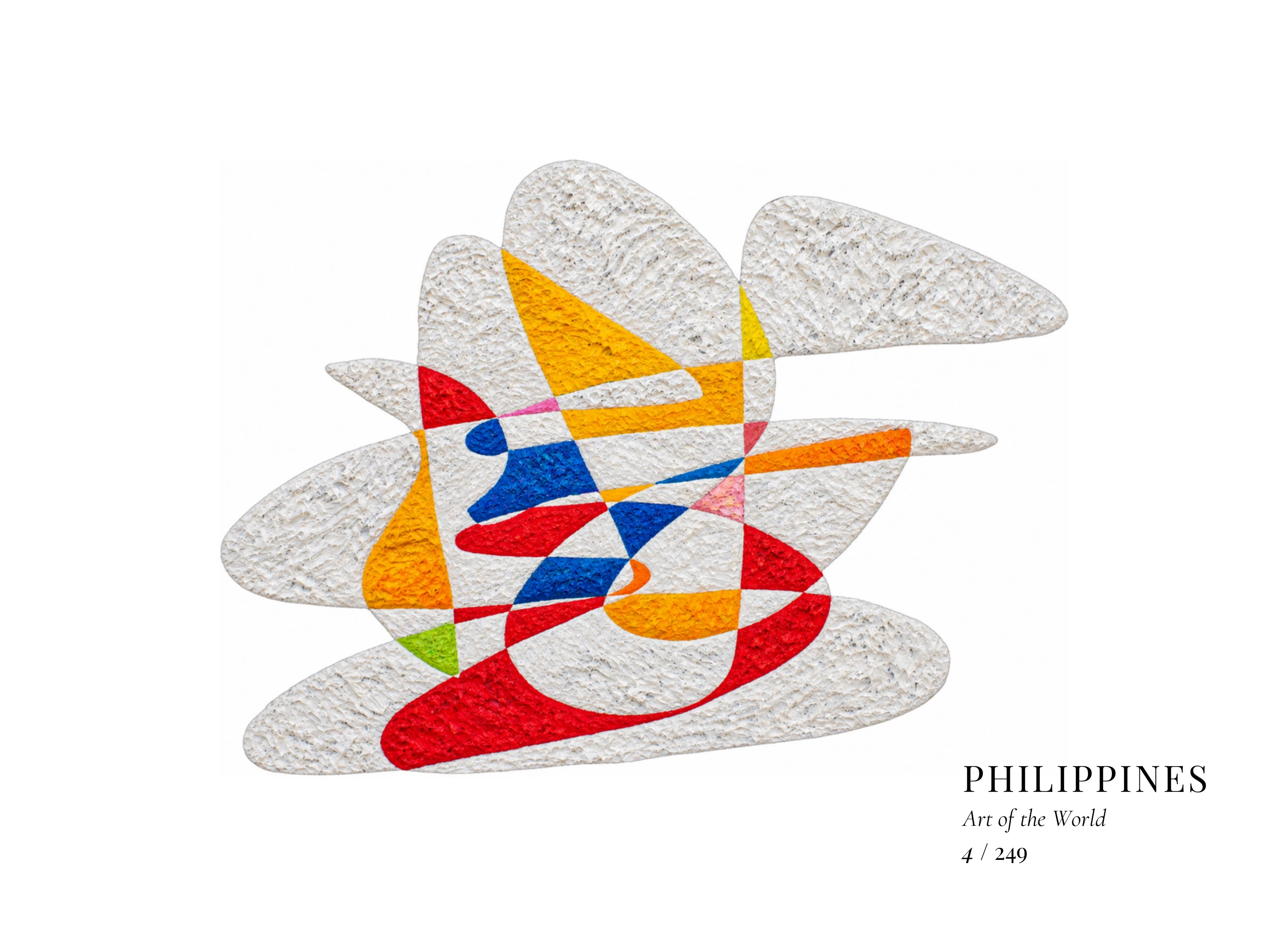
Description
The visual field is dominated by textured white forms crossed by vivid red, yellow, blue, orange, pink and green. Broad pale masses are divided by sharp diagonals, narrow extensions and interlocking coloured fragments. The composition suggests an archipelagic rhythm: distinct forms remain separated by white space yet participate in a larger visual structure. Its shifting geometry and energetic intersections can be read as evoking cultural plurality, maritime connection and histories layered across islands.
Cultural Context
The Philippines is an archipelago of more than 7,000 islands between the South China Sea and the Pacific Ocean. Austronesian societies developed extensive maritime networks long before Spanish colonisation began in the sixteenth century. More than three centuries of Spanish rule, followed by American administration and Japanese occupation during the Second World War, shaped the modern republic alongside enduring Indigenous and regional traditions.
Its cultural identity is exceptionally plural, encompassing numerous ethnolinguistic communities and languages, including Filipino, Cebuano, Ilocano and many others. Indigenous weaving, carving and metalwork coexist with Catholic traditions, Islamic cultures in the south, rich oral literatures and dynamic forms of music, cinema, architecture and contemporary design.