120 / 249
Qatar
Peninsula of Passage and Transformation
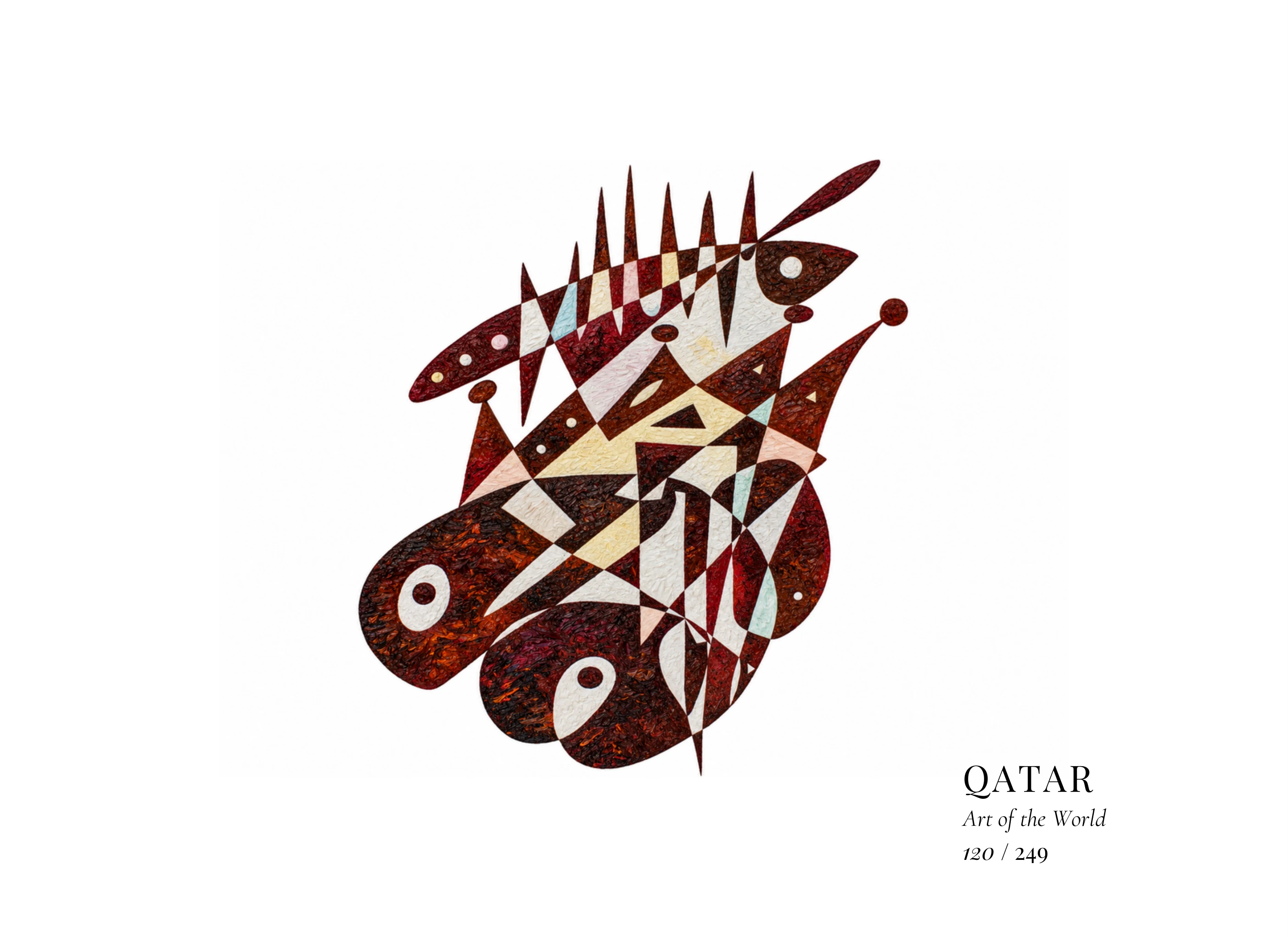
Description
The artwork is dominated by deep burgundy, brown and ivory, organised through pointed verticals, intersecting triangles and elongated organic forms. Dense impasto gives the dark surfaces unusual physical weight, while pale divisions create a strong internal rhythm. Sharp extensions rise and project outward as smaller detached circles punctuate the white space. The tension between compact mass and directional movement suggests a landscape of accelerated transformation grounded in older cultural structures.
Cultural Context
Qatar occupies a small peninsula extending into the Arabian Gulf, shaped historically by maritime trade, pearling and connections across Arabia, Persia and the Indian Ocean. Ruled by the Al Thani family since the nineteenth century, it became independent in 1971. Petroleum and especially natural-gas wealth subsequently transformed its economy, settlements and international presence.
Qatari culture combines Bedouin and maritime traditions with the cosmopolitan character of contemporary Doha. Arabic remains central to cultural life, while poetry, storytelling, falconry, dhow traditions, weaving and decorative arts preserve older forms of expression. Architecture, museums, design and contemporary art have become increasingly prominent within a rapidly changing society.