121 / 249
Saudi Arabia
Desert Crossroads, Sacred Heart
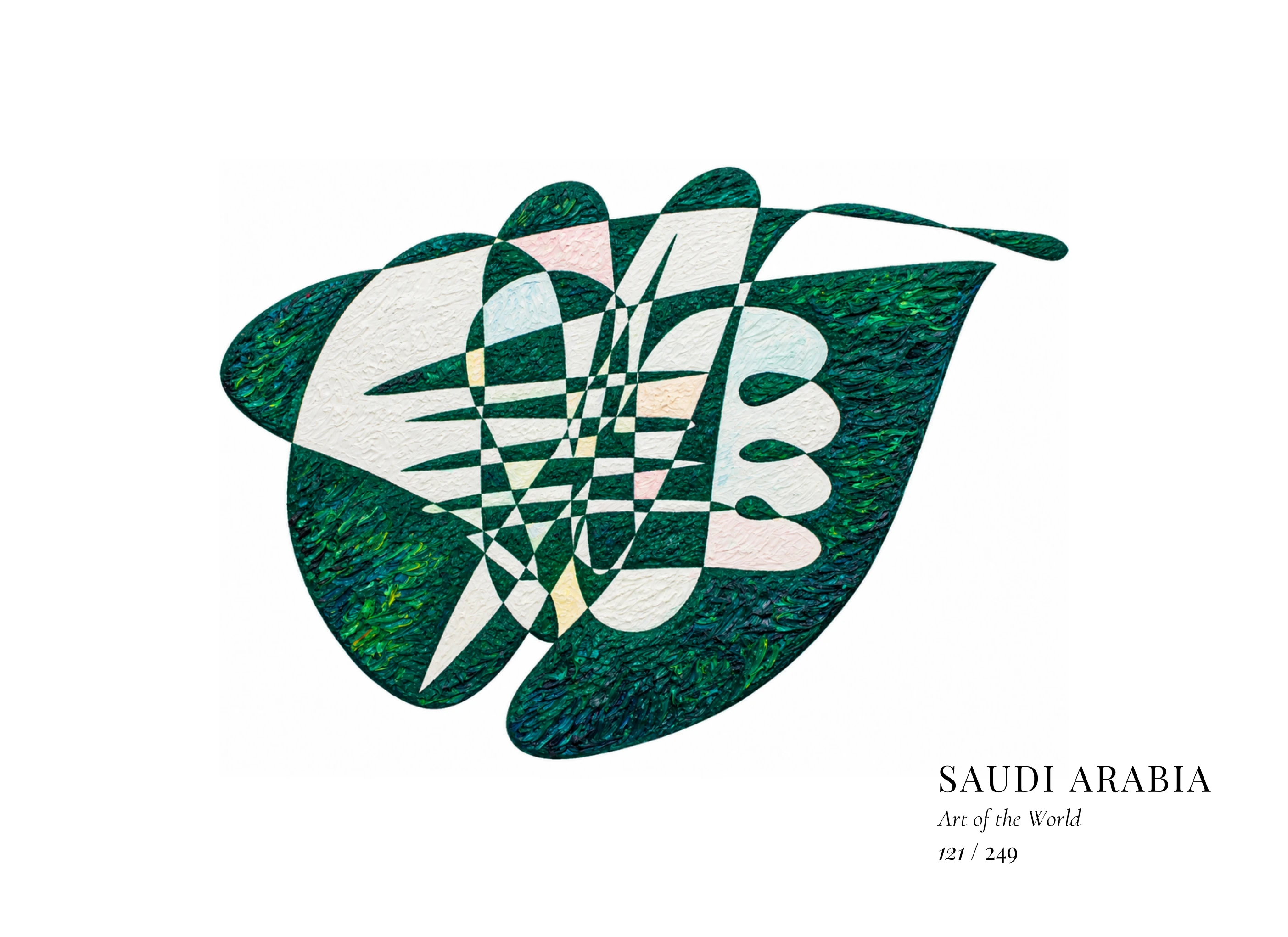
Description
The artwork is dominated by deep emerald and near-black greens crossed by broad ivory forms. Dense impasto gives the surface a tactile intensity, while interlocking curves, narrow diagonals and geometric divisions converge toward a compressed centre. Pale forms expand outward against the darker mass, creating a rhythm of enclosure and opening. The composition suggests continuity amid transformation, while its intricate internal structure evokes histories layered across a vast and culturally varied landscape.
Cultural Context
Saudi Arabia occupies most of the Arabian Peninsula, encompassing deserts, mountains, oases and long Red Sea and Gulf coastlines. Ancient caravan and maritime routes connected Arabia with Africa and Asia, while the emergence of Islam in Mecca and Medina gave the region enduring global significance. The modern kingdom was unified in 1932, with oil later transforming its economy and cities.
Saudi culture encompasses varied regional and tribal traditions shaped by Arabic language, Islam and longstanding patterns of trade and migration. Poetry and oral storytelling remain important, alongside calligraphy, architecture, weaving, metalwork, music and distinctive regional crafts. Contemporary literature, cinema, art and design increasingly contribute to a changing cultural landscape.
Exhibition Context
A broad green body holds an intricate white inner mesh, leaving the outside edge open to the surrounding field. Saudi Arabia's history includes the significance of Mecca and Medina as well as the much later formation of a modern state from older Arabian routes and kingdoms. The image's enclosed interior and outward extensions may speak to that overlap of spiritual centre and wider connections. It should not be forced into a depiction of a sacred site; the white lattice is an abstract construction, not a shrine.